Learning games / Tidepool Tenders / Guide
Tidepool Tenders
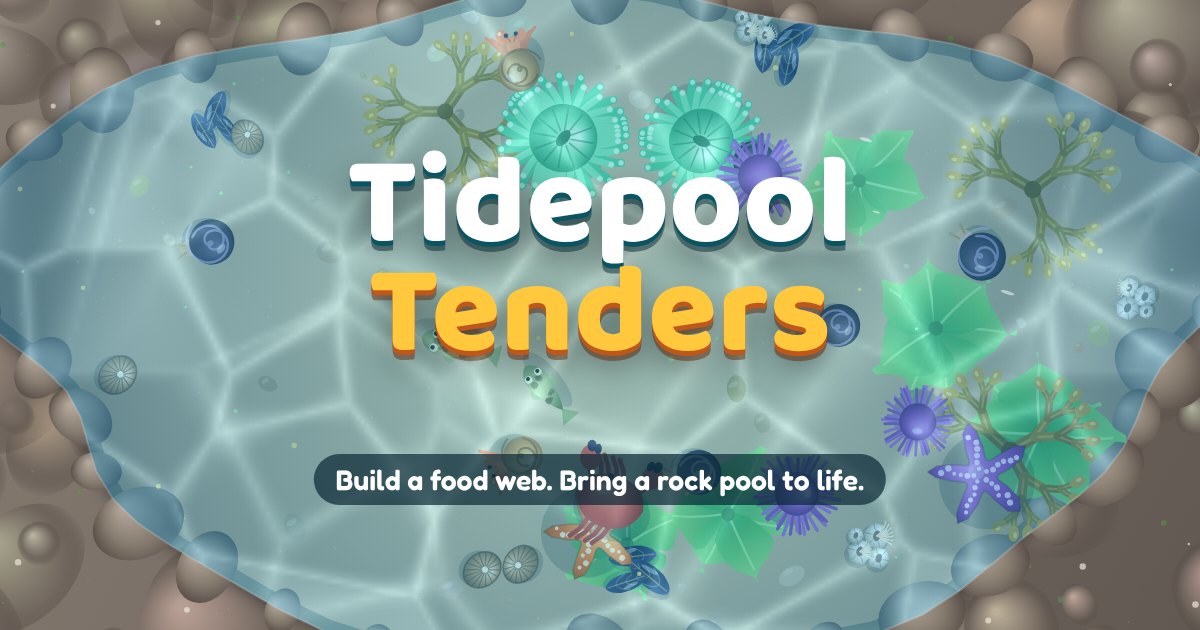
Five rock pools on a rocky shore have gone quiet. Your child brings each one back to life: adding seaweed, snails, crabs and sea stars, drawing the food web that connects them, and then running the tide to see if the pool stays in balance. A healthy pool brings rare visitors, like a red octopus or a black oystercatcher, for the tide pool journal.
Quick answers
Is Tidepool Tenders free?
Yes. Tidepool Tenders is free to play in the browser, with no ads, no accounts and no tracking. There is nothing to buy and nothing to download.
Do kids need an account to play Tidepool Tenders?
No. Our learning games have no accounts at all, so there is nothing to sign up for. Progress and stickers stay on the device they play on.
What your child learns
Every creature in the game is a real animal or seaweed from Pacific coast tide pools, and every feeding link is a real one. The ideas line up with NGSS life science for elementary and middle school (3-LS4-3, 5-LS2-1 and MS-LS2):
- Arrows show where the energy goes. In a food web the arrow points from the food to the eater: sea lettuce → turban snail → red rock crab. Drawing the arrow backward is the most common mistake kids make, so the game catches it every time and explains why.
- Producers, consumers and decomposers. Seaweed and plankton make food from sunlight. Grazers eat them, predators eat the grazers, and the clean-up crew (bacteria, bristle worms, hermit crabs) eats the dead stuff.
- Balance. Too many grazers and the seaweed runs out. Too many predators and the grazers vanish, then the predators go hungry. A pool is healthy when everyone keeps everyone else in check.
- Keystone species. Take the sea stars off Mussel Ledge and the mussels take over the rock, crowding out the barnacles. A real scientist, Robert Paine, discovered this on a real shore.
- Recycling. In Hidden Cove, bacteria turn dead stuff back into nutrients that seaweed uses again. Without them the dead stuff piles up and the seaweed starves.
- Predict, then test. Each pool ends with a change, like a warm spell or a winter storm. Your child predicts which creature changes first and which way, then the simulation shows what happens.
How it works
Each visit to a pool has four short steps, guided by Pebble the hermit crab:
| Step | What your child does |
|---|---|
| 1. Add | Tap + to add groups of each creature. Each creature card says what it is: producer, grazer, filter feeder, predator, scavenger or decomposer. |
| 2. Connect | Drag an arrow from each food to the animal that eats it. A right arrow lights up with energy flowing along it. A backward or impossible arrow gets a short, kind explanation. |
| 3. Tide | Watch two months of pool life in a few seconds. The creatures in the pool grow and shrink, and a line chart shows each population. If the pool falls out of balance, Pebble explains what went wrong and your child changes the numbers. |
| 4. Predict | Something changes, like a crab wandering off or a plankton bloom. Your child picks the creature that changes first and whether it goes up or down, then tests it. |
The pool is a real little simulation, not a scripted animation. The numbers your child picks decide what happens.
The five pools
| Pool | The big idea |
|---|---|
| Sunny Shallows | Sea lettuce, turban snails and a red rock crab: producer, grazer, predator. |
| Mussel Ledge | Plankton, mussels, barnacles, dogwinkles and the ochre sea star, a keystone predator. |
| Urchin Corner | Rockweed, purple urchins and the sunflower star. When the predator disappears, urchins boom. |
| Hidden Cove | Decomposers and the clean-up crew recycle dead stuff into nutrients. |
| Grand Tide Pool | Eleven creatures, fish and anemones included. A change to one ripples through the whole web. |
How it adapts
After two wrong arrows, the Hint button lights up and points to a creature that still needs its food. After two unbalanced tides, a Hint suggests one change to try. Later pools add more creatures and more links.
The Arrow Lab is quick practice: draw the arrow between two creatures (or say neither eats the other), pick the producer, or build a three-step food chain. Every feeding link is tracked, and links your child misses or draws backward come back sooner until they stick.
The journal and rare visitors
A healthy, balanced pool attracts visitors: 18 real tide pool animals, from the opalescent nudibranch and the gumboot chiton to a harbor seal napping on the rocks. Each one goes into the journal with a fact and what it eats. The journal also keeps a page for every pool creature your child has met. Restoring a pool opens the next one, and pools can be visited again to meet more visitors. Nothing is ever bought.
For grown-ups
Press and hold the For grown-ups button on the title screen. You will see pools restored, visitors found, arrows drawn (and how many were drawn backward first), balanced tides, predictions and Arrow Lab accuracy, plus the feeding links your child knows well and the ones still being practiced. Settings include a slower tide, calm water with less motion, sound, and the reading voice.
Tips for grown-ups
- Ask your child to say an arrow out loud: “energy goes from the sea lettuce into the snail.”
- Before a tide, ask what they think will happen. Afterward, ask what surprised them.
- At the beach or an aquarium, look for the real animals from the journal and talk about what each one eats.
- Sketch a food web for your backyard or a park together: sun, plants, bugs, birds, and the decomposers in the soil.
Privacy and safety
Tidepool Tenders is part of our learning games area. There are no ads, no accounts, no chat, no leaderboards and no tracking, and it loads nothing from outside services. Progress and the journal stay on the device. The read-aloud button uses the voice already on your device.
Questions
What age is Tidepool Tenders for?
Ages 8 to 12, about Grades 3 to 7. Younger players can enjoy it with a grown-up reading along, and the read-aloud button reads every instruction.
Which way should food web arrows point?
From the food to the eater, because the arrow shows the direction energy moves. Sea lettuce → turban snail means the snail eats the sea lettuce and gets its energy. The game checks every arrow and explains it when one is drawn backward.
Are the animals and food webs real?
Yes. Every creature lives in Pacific coast tide pools and every feeding link is real. The pool simulation is simplified so kids can see the big ideas: balance, keystone predators and recycling.
Can my child fail a pool?
No. An unbalanced tide is a clue, not a loss. Pebble explains what went wrong, your child changes the numbers, and there is no timer or penalty.
Does it work on phones and tablets?
Yes. It works on phones held either way, tablets and computers, with touch, mouse or keyboard.