Learning games / Cloudwhistle Lab / Guide
Cloudwhistle Lab
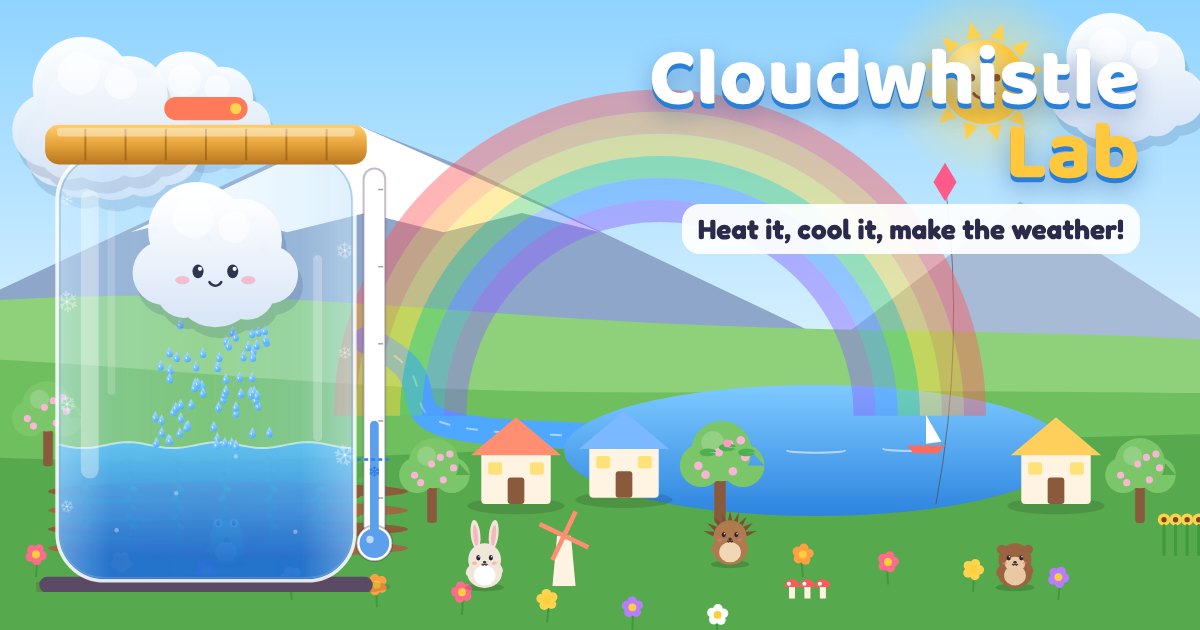
Puff the little cloud runs a lab full of glass sky jars. Your child heats them, cools them, blows wind on them and adds water or ice, but first they guess what will happen. Then they watch ice melt, puddles evaporate, clouds form, and rain or snow fall, and every discovery changes the weather in a little valley outside.
Quick answers
Is Cloudwhistle Lab free?
Yes. Cloudwhistle Lab is free to play in the browser, with no ads, no accounts and no tracking. There is nothing to buy and nothing to download.
Does Cloudwhistle Lab work on a tablet or phone?
Yes. It plays with touch on tablets and phones, and with a mouse on a computer. There is nothing to download.
Do kids need an account to play Cloudwhistle Lab?
No. Our learning games have no accounts at all, so there is nothing to sign up for. Progress and stickers stay on the device they play on.
What your child learns
Everything happens in one sealed jar, so the water never leaves. It just changes form, which is the big idea behind the water cycle:
- Melting and freezing. Ice melts into water when it gets warmer than freezing, 32°F (0°C), and water freezes into ice when it gets colder. The thermometer on the jar has a dashed freezing line to show where that happens.
- Evaporation. Warm water turns into water vapor, a gas you cannot see. The jar shows vapor as a faint shimmer and a label that says it is invisible. Wind dries a puddle faster too.
- Condensation. When vapor cools, it turns back into tiny drops of water. Billions of tiny drops make a cloud.
- Rain and snow. Cool a cloud more and its drops grow heavy and fall as rain. If the cloud gets below freezing first, it snows.
- Changes that go back, and changes that stay. In the Kitchen Lab, melted chocolate and butter turn solid again when cooled, but a cooked egg, toast and popcorn never change back. (NGSS 2-PS1-4)
- The water cycle. Water evaporates from lakes, makes clouds, and falls back down as rain or snow that fills rivers. (NGSS 5-ESS2-1)
How to play
Tap Start your first quest. A villager from the valley asks for help, like Fennel the frog, whose pond froze solid. Below the jar are the lab buttons: Heat, Cool, Big chill (two steps colder at once), Wind, Add water and Add ice. Each quest gives only the buttons it needs.
Every time your child taps a button, Puff asks a question before anything happens: "What will happen to the ice?" They pick an answer, like It melts into water or It stays ice, and then the jar shows what really happens. A right guess gets a cheer. A wrong one is called a surprise, and the explanation shows why, because surprises are how scientists learn.
Quests chain steps together. To make rain from a puddle, you heat it (the water evaporates), cool it (the vapor makes a cloud), then cool it again (the cloud rains). To make snow, the cloud has to get below freezing before it can rain, so the Big chill button comes into play. When the goal is reached, tap Whistle it out! and the jar's weather goes out into the valley: rain on the farm, snow on the mountain, a frozen pond for skating.
| Mode | What happens |
|---|---|
| Quests | Twelve hand-made quests across a year in the valley, then fresh ones made for your child, always checked to be solvable |
| Puzzle Jars | Six quick jars: guess what will happen, or pick which button makes it happen |
| Kitchen Lab | Heat chocolate, an egg, bread or a popcorn kernel, then guess if cooling changes it back |
| Free Lab | Every button, no goal. Try anything and see what you can make |
Levels and how it adapts
Each rule of water, like melting or condensing, has its own practice level. A right prediction moves it up and a miss moves it down, and missed rules come back sooner in Puzzle Jars. Rules your child knows well get three answer choices instead of two, and "which button?" questions appear once a rule is familiar. Later quests take more steps, based on how the last predictions went.
If a step does not move toward the goal, Puff offers a hint and lights up a helpful button. The Words button on the title screen switches between simple words and science words such as evaporation, condensation and precipitation, with temperatures shown in °F or °C. There are no timers and nothing to lose.
The valley, notebook and weather cards
Every finished quest changes the valley for good. Flowers bloom after rain, the river rises, snow piles on the mountain, and something new appears each time, from lily pads and a kite to a windmill and a snowman. Every three quests the season turns, and the valley looks different in spring, summer, fall and winter.
The Lab Notebook gets a page for each rule your child discovers, 14 in all, with a before and after picture and the rule in kid words. There are 20 Weather Cards to collect, each with a true fact, like why fog is a cloud on the ground and why raindrops are not shaped like tears.
Tips for grown-ups
- Put an ice cube on a plate and ask your child to predict what it will look like in an hour, then in a day. Where did the water go?
- Breathe on a cold mirror or window. The fog is the water vapor in your breath condensing into tiny drops, just like a cloud.
- Melt a few chocolate chips, let them cool, then compare with a slice of toast. Which change can go back?
- Press and hold For grown-ups on the title screen to see which rules your child knows best and change the settings.
Privacy and safety
Cloudwhistle Lab has no ads, no accounts, no chat and no tracking, and nobody types a name. Quests, the notebook, the valley and cards are saved only on your device. There are no streaks or timers, and nobody is sad when your child stops playing.
Questions
Is steam from a kettle water vapor?
Not quite. Water vapor is an invisible gas. The white puff you see above a kettle is made of tiny drops of water that formed when the vapor cooled in the air, like a little cloud. Right at the spout, where you can see a clear gap, that is the invisible vapor.
Are clouds made of water vapor?
Clouds are made of tiny drops of liquid water or tiny bits of ice, not vapor. They form when water vapor in the air cools and condenses. That is why the game turns invisible vapor into a cloud only when the jar is cooled.
Does water only evaporate when it is warm?
No, water evaporates slowly even when it is cool. Warmth and wind make it happen much faster, which is why puddles dry quickly on a hot, windy day. The game shows evaporation when it is warm or windy, when it is easy to see.
What age is Cloudwhistle Lab for?
Ages 6 to 10. Younger players get two picture choices and simple words, and the questions can be read aloud. Older players can switch on science words and get three choices and harder quests.