Games / Learning Games / Color Mix Lab / Guide
Color Mix Lab
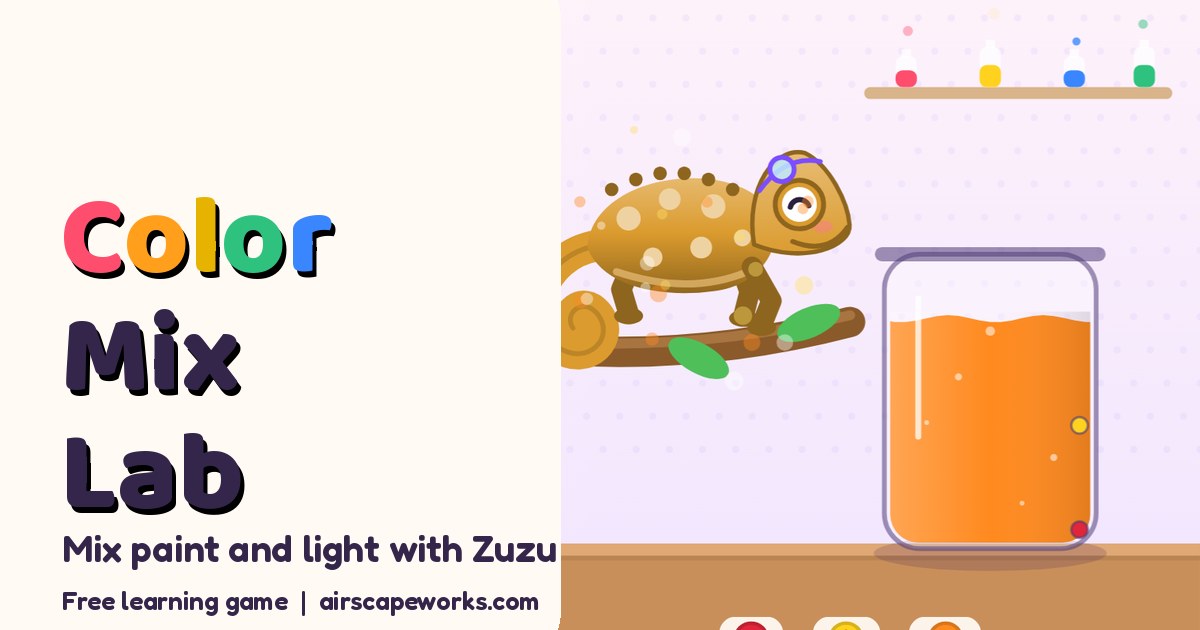
Zuzu the chameleon runs a little science lab, and she changes color whenever she sips a new mix. Your child drips red, yellow, blue, white and black paint into a beaker to make what Zuzu asks for, and finds out what happens when colored light mixes instead.
What your child learns
Color Mix Lab uses the red, yellow and blue color wheel taught in most elementary art rooms, so what happens in the game matches what happens with poster paint at the kitchen table.
- Primary colors. Red, yellow and blue can't be mixed from other paints.
- Secondary colors. Red and yellow make orange, yellow and blue make green, red and blue make purple. All three together make brown.
- Tints and shades. White makes a color lighter (red and white make pink). Black makes it darker (blue and black make navy).
- In-between colors. Two drops of one paint and one of another make red-orange, yellow-green, blue-purple and the rest.
- Warm and cool colors. Reds, oranges and yellows are warm. Blues, greens and purples are cool.
- Light mixes differently. In the Light Lab, red and green light make yellow light, and red, green and blue together make white.
How it works
Tap Play and Zuzu shows an order, like "Make orange. Tap 2 paints." Your child taps the paint jars, each drop falls into the beaker, and the color swirls and changes. Dots on the side of the beaker show how many drops it holds. Every order is read aloud, and each jar has a symbol as well as a color.
A round is 6 questions. Besides making colors, Zuzu asks some quick ones: guess what two paints will make, decide if a color is warm or cool, or turn on red, green and blue flashlights in a dark room. Right answers turn Zuzu the new color.
The Labs button lists five labs:
| Lab | What it covers |
|---|---|
| 1. Mixing Magic | Orange, green and purple |
| 2. Big Three | Primary colors, brown, warm and cool |
| 3. Light and Dark | Tints with white, shades with black, gray, peach, lavender |
| 4. In-Between Colors | Two of one paint and one of another |
| 5. Light Lab | Mixing red, green and blue light |
Levels and how it adapts
Colors your child misses come back sooner, and colors they know well come back less often. A wrong mix isn't wasted: the game names what was really made and gives a hint, like "That made green. Purple is like grapes. It has no yellow in it." After two tries, the right paint jars glow one at a time so your child can make it with help, and the same color returns a few questions later. On guessing questions, a wrong guess shows the real mix and that question comes back later in the round. There are no timers and no way to lose.
The age buttons on the title screen open different labs at the start. 4 to 6 opens the first two labs, 6 to 8 opens four, and 8 to 11 opens all five. Getting every question right on the first try earns 3 stars, missing one or two earns 2.
Color Book, Paint corner and stickers
Every new color your child mixes goes into the Colors book, which has 36 to find, from cream and lavender to maroon and dusty blue. Finding more colors unlocks new patterns for Zuzu's skin: spots at 6 colors, then stripes, stars, hearts, zigzags, confetti and sparkles at 30. In the Paint corner your child colors a picture of Zuzu, a flower or a fish using the colors they have found, and a small mixer there lets them make new ones.
Stickers go into the Sticker Book shared by all our learning games: one for the first round, one for finishing each lab, one for a perfect round, one for finding 15 and 30 colors, and one for Today, 6 mixed questions that are the same for everyone, with a streak flame.
Tips for grown-ups
- Mix real paint or a few drops of food coloring in water. Ask your child to predict first, then check: did it match the game?
- Make a tint ladder: paint a stripe of blue, then add a little more white for each stripe after it.
- Go on a warm and cool hunt on a walk. Is a stop sign warm or cool? What about the sky?
- Shine two flashlights covered with colored cellophane or plastic wrap on a white wall and look at the overlap.
Privacy and safety
Color Mix Lab has no ads, no accounts, no chat and no tracking, and nobody types a name. Stars, colors, paintings and stickers are saved only on your device, and the only links lead to our other learning games and the Sticker Book.
Questions
What are the primary colors?
For paint, the traditional primary colors are red, yellow and blue. They mix to make the secondary colors orange, green and purple. Light uses a different set: red, green and blue.
Why does red and green light make yellow?
Paint mixing takes colors away, so mixed paints get darker. Light mixing adds colors together, so red and green light add up to a bright yellow, and all three lights make white.
Is Color Mix Lab free?
Yes. It runs free in the browser on a phone, tablet or computer, with no download, no ads and no in-app purchases.