
Games / Guides / Strategy articles / Hidden object game tips
Hidden object game tips
A hidden object game hands you a busy picture and a list, and the fun is in the quiet hunt. Some finders clear a scene in two minutes while others stare at the same shelf for ten. The difference is rarely sharper eyes. It's a handful of habits: where to look first, how to sweep, what hiding spots designers love, and when a hint is worth it.
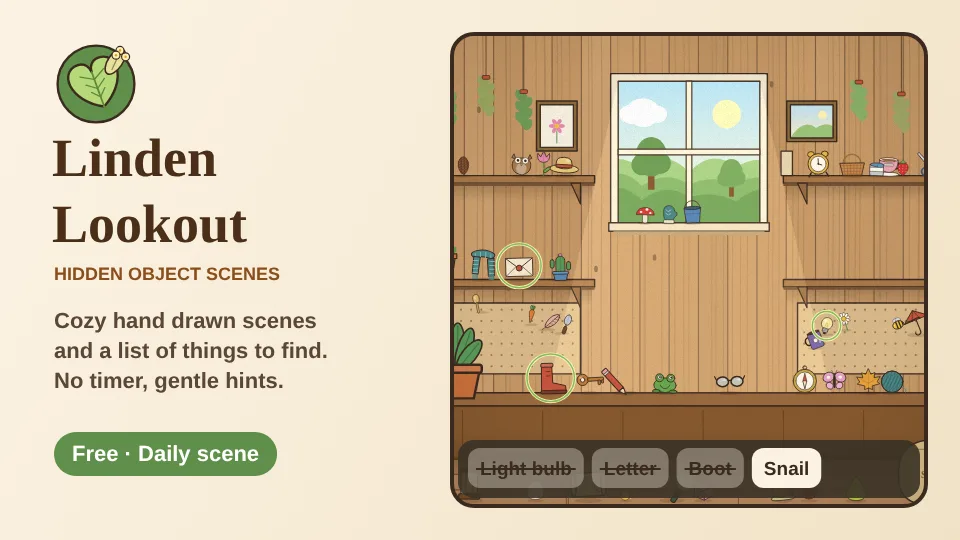
Start big, save the small ones
Read the whole list before you tap anything. Pick out the big, plain things first: a watering can, a teapot, an umbrella. Finding them clears the list fast and teaches you the layout of the room. By the time you're down to the ring, the coin and the button, you already know where the shelves, tables and corners are.
Small things tend to sit near things of their own kind. A thimble likes the sewing basket, a seed packet likes the potting bench, a coin likes a dish or a drawer. Ask where the thing would really live in a room like this, and look there first.
Sweep the scene in rows
Darting around the picture feels quick but misses things. A steady sweep is faster in the end. Pick a pattern and keep to it: top shelf left to right, then the next shelf, then the tabletop, then the floor, then the corners. Your eyes stop jumping, and every part of the picture gets one honest look.
- Look up. Keys, little frames and pocket watches often hang on the wall, and many finders never lift their eyes above the shelves.
- Check the edges of things. The arm of a chair, the rim of a basket and the edge of a leaf are favorite spots for something partly tucked behind.
- Mind the floor and rugs. Loose things lie on rugs, grass and dock planks, often near the bottom edge where the eye rarely goes.
- Think about color. A yellow star on pale wood or a green thing in the grass is camouflaged. When you're hunting something, picture the colors it would blend into and search those patches.
Zoom in and slow down
On a phone, a scene is usually wider than the screen and the things are small, so zooming is not cheating, it's how the game is meant to be played. Zoom in on one corner, pan slowly across, then move to the next corner. Small arrows or a scroll bar at the edges are a reminder that there's more picture out of view.
In Linden Lookout you can pinch with two fingers, double tap an empty spot or press the plus button, then drag to look around. On a computer the scroll wheel zooms and you drag with the mouse. The game also forgives a wrong tap: a miss just makes a soft ripple. Only a long burst of quick misses pauses taps for about a second, a gentle nudge to look rather than poke.
Reading words, shapes, pictures and riddles
Many hidden object games let you choose how the list looks, and each style asks for a slightly different way of looking.
| List style | What it shows | How to search |
|---|---|---|
| Words | The name of each thing | Picture the thing first, its size and color, then sweep for that shape. |
| Shapes | A dark outline of each thing | Search by silhouette, not color. Outlines are great for odd shapes like a horseshoe or a key. |
| Pictures | Small colored drawings | Match color and shape together. Easiest for young finders. |
| Riddles | A clue instead of a name | Solve the clue before you look. "Carries its house on its back" is a snail, so check the garden spots. |
If a word list is wearing you out, switching to shapes can feel like a whole new game, because your eyes start hunting for outlines instead of names. Riddle lists add a little word puzzle on top of the hunt and suit finders who like a challenge.
When to use a hint
A hint is best saved for the last one or two things, after you've done an honest sweep. Using one early only takes away the easy finds you'd have made anyway. When you do use one, watch where it points and notice why you missed it. Was it on the wall? Behind a leaf? The same color as the shelf? That lesson makes the next scene quicker.
In Linden Lookout the lantern button holds up to three hints, and a used one comes back every 45 seconds. A hint puts a warm glow round one thing still on your list and glides the view over to it if it's off screen. Hints are free in every scene. Only in the Daily scene does each one add 20 seconds to your time.
Practice with a daily scene
Like any puzzle, finding gets faster with a little regular practice. Linden Lookout is free in your browser with no clock on screen and nothing to download. Each scene starts at level 1 with eight things to find and climbs to level 5 with twelve, with more clutter and slightly smaller things. Because the scenes are built from separate little drawings, every visit picks a fresh list and fresh hiding spots.
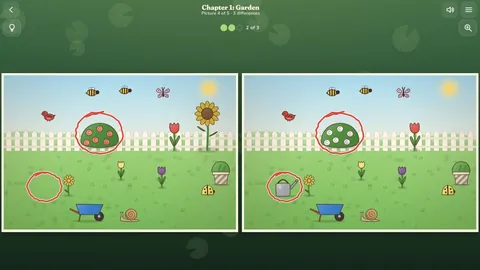
At midnight a new Daily scene appears, the same scene, list and hiding spots for everyone, with a daily leaderboard if you like a gentle race. Right now the seasonal Harvest Kitchen is visiting too, with pumpkins, pies and a warm stove, until November 30. For more picture puzzles, our free hidden object games page lists them all, including a spot the difference game.
Questions
How do you get better at hidden object games?
Find the big things first, then sweep the scene in rows: shelves, tabletops, floor, corners and the wall. Zoom in on small areas, think about where each thing would really live, and save hints for the last one or two.
Why can't I find the last item?
It's usually in a spot you skipped, like the wall above the shelves, the floor near the bottom edge, or tucked partly behind the edge of something. It may also be the same color as what's around it.
Are there free hidden object games with no download?
Yes. Linden Lookout is a free hidden object game that runs in your browser on a phone, tablet or computer, with a new Daily scene every day.
Is there a time limit in Linden Lookout?
No. There's no clock on screen. Your time only matters for the Daily scene leaderboard, where each hint adds 20 seconds.
Game guides
More strategy articles
 How to solve logic grid puzzlesScoot Over
 Tile rummy strategySundown Tile Rummy
 How to win at Spider SolitaireMoonlit Spider
 Chess openings for beginnersKingsway Chess
 Three stars every timeCopper Pot Kitchen
 How to catch rare bugsBramble Bug Museum
 How to win at Mahjong SolitaireMahjong Cloud Steps
 Pinball tips for beginnersPocket Pinball