
Games / Guides / Strategy articles / How to solve logic grid puzzles
How to solve logic grid puzzles
A logic grid puzzle looks like a wall of clues the first time. It's really a short chain of small certain steps, and the grid is just a place to write them down. Here's how the grid works, which clues to start with, and what to do when you seem to be stuck.
How the grid works
Every puzzle has a few groups of things to match up: people and places, guests and seats, neighbors and times of day. The rule under all of it is one to one. Each person gets exactly one place, and in most puzzles each place gets one person.
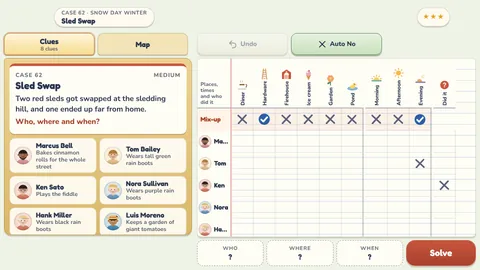
In the grid, a row is a person and a column is one thing they could be matched with. There are only two marks. A cross means this match is impossible. A check means it's certain.
Two things happen every time you place a check. The rest of that row gets crosses, because the person can't be anywhere else. And if each place holds one person, the rest of that column gets crosses too. Most of the puzzle is those crosses piling up.
Read the clues in this order
- Plain facts. "Rosa went to the library." One check, and a row and column of crosses.
- Plain negatives. "Ben did not go out in the morning." One cross. Small, but they add up.
- Clues that link two people. "Mei went out earlier than Omar." Mei can't be last and Omar can't be first. Cross those out now and come back when one of them is placed.
- Clues with a choice in them. "Either Ana or Cole sits at an end." Leave these until other clues have narrowed things down.
After each new mark, look again at the linking clues. A clue that told you nothing a minute ago often finishes the job once one more cell is filled.
The three moves that solve most puzzles
The last cell standing
If a row has crosses in every cell but one, the last cell is a check. The same goes for a column. Scan for these after every few marks.
Passing things along
If Ana sits next to Ben, and Ben is in seat 1 at the end of a bench, Ana must be in seat 2. Whatever you learn about one side of a linking clue tells you something about the other.
Try it and see
When someone has two cells left, pick one in your head and follow it. If a clue breaks, the other cell is the answer and you've proved it. This isn't guessing, as long as you follow the try all the way to a break.
A small example
Three friends, Ana, Ben and Cole, sit in seats 1, 2 and 3 on a bench, left to right. The clues: Ana does not sit at an end. Ben sits somewhere left of Cole.
The first clue places Ana at once: seat 2 is the only seat that isn't an end. That leaves seats 1 and 3 for Ben and Cole. The second clue puts Ben on the left, so Ben is in seat 1 and Cole is in seat 3. Two clues, two steps, one answer.
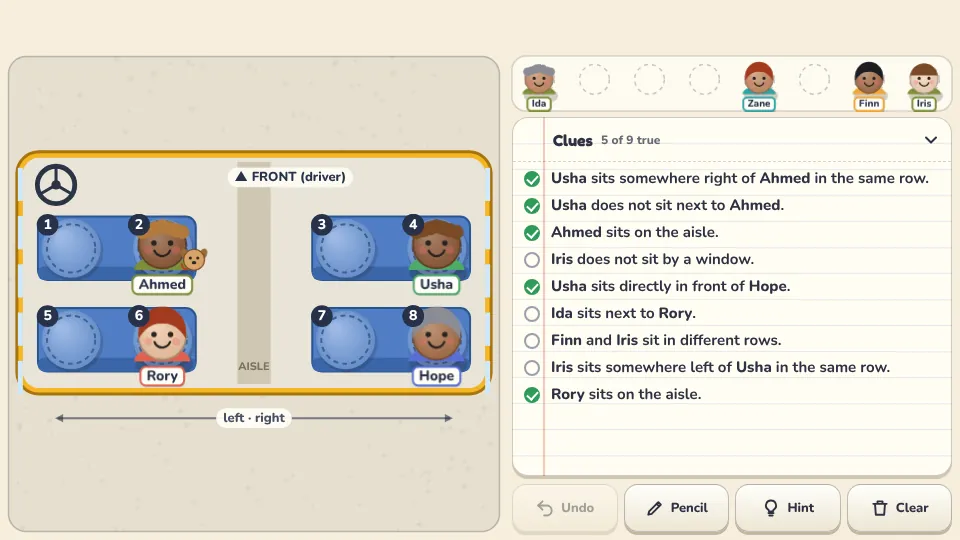
Bigger puzzles are the same thing with more people. In Scoot Over you do it by dragging guests onto seats and watching each clue turn green. In Mail Route Mysteries you mark a notebook grid with crosses and checks to find who was where, and when.
When you're stuck
- Reread every clue slowly. The missed step is usually in a clue you thought you had finished with.
- Count the open cells in each row and column. The one with the fewest is where to look.
- Check words like next to, left of and across from. Next to means side by side. Left of can mean anywhere to the left.
- Ask for a hint. Ours explain one step in plain words, so the next puzzle goes faster.
Questions
Do you ever have to guess in a logic grid puzzle?
No, not in a well made one. Every step can be worked out from the clues. Trying an option and following it until a clue breaks is a proof, not a guess.
What do the marks in the grid mean?
A cross means the match is impossible and a check means it's certain. A row or column with one open cell left must have its check there.
Which clue should I start with?
Start with plain facts that name one person and one thing, then the plain negatives, then clues that link two people.
Where can I practice logic grid puzzles free?
Scoot Over has 200 seating puzzles with five short lessons, and Mail Route Mysteries has 120 mystery cases with a notebook grid. Both are free in the browser.
Game guides
More strategy articles
 Tile rummy strategySundown Tile Rummy
 How to win at Spider SolitaireMoonlit Spider
 Chess openings for beginnersKingsway Chess
 Three stars every timeCopper Pot Kitchen
 How to catch rare bugsBramble Bug Museum
 How to win at Mahjong SolitaireMahjong Cloud Steps
 Pinball tips for beginnersPocket Pinball
 Bubble shooter strategyBubble Bay
You might also like
 10 minSaves
Mail Route Mysteries
Mystery logic puzzlesCozy mystery logic puzzles on a friendly small-town street. Read the clue cards, mark the notebook grid and work out who, where and when. 120 cases in six seasons, a Daily Case, hints in plain words and a mixed-up neighbor in the Hard cases.