
Games / Puzzle Games / Scoot Over / Guide
How to play Scoot Over
Scoot Over is our seating logic puzzle. A few friends need seats on a porch bench, in a diner booth, on the school bus or around a birthday table, and a short list of clues tells us who sits where. We read the clues, seat every guest, and find the one arrangement that keeps them all happy.
This is our guide to playing Scoot Over. Want to jump straight in? Play Scoot Over right here in your browser.
Missing something you need? Tell us.
Quick answers
Does Scoot Over work on my phone?
Yes. Scoot Over works with touch on phones and tablets, and with a mouse or keyboard on a computer. It runs in the browser you already have, so there is no app to download.
Do I need an account to play Scoot Over?
No. Just open it and play, with no sign-up. If you like, a free account (username only, no email, for players 13 and older) puts your scores on the leaderboards and backs up your progress so it follows you to any device.
Is there a daily challenge in Scoot Over?
Yes. Scoot Over has a new daily challenge every day, the same one for every player, with its own daily leaderboard. Find it alongside the others on our daily challenges page.
Does Scoot Over save my progress?
Yes. It saves on this device on its own, so you can close the page and pick up where you left off. Sign in with a free account to keep the same progress on your phone and your computer.
Is Scoot Over OK for kids?
Yes, players of any age can enjoy it. There is no chat and no way to message other players, and nobody needs an account to play. Accounts are for players 13 and older, so younger players just play and their progress stays on their device. For ages 4 to 11 we also have learning games in their own kids area, with no ads, no accounts and no tracking.
How it works
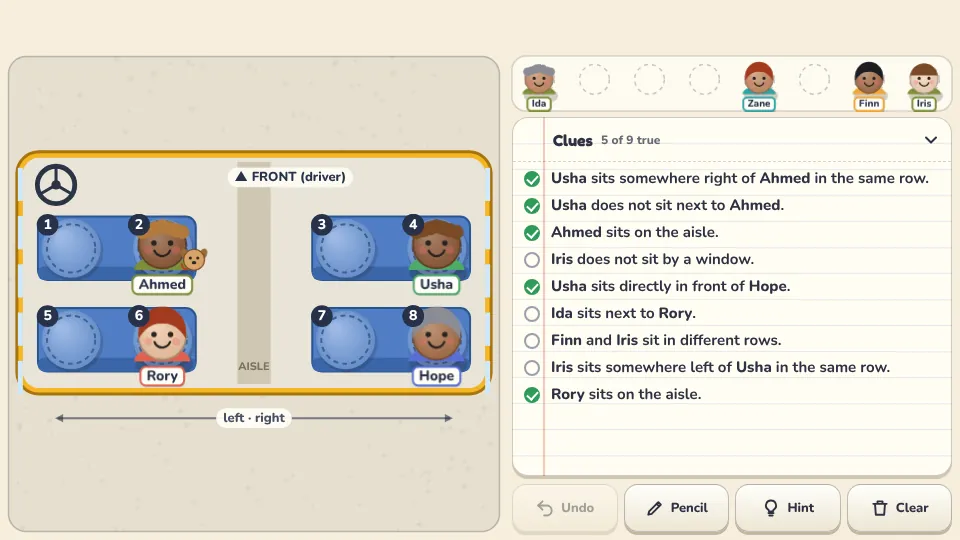
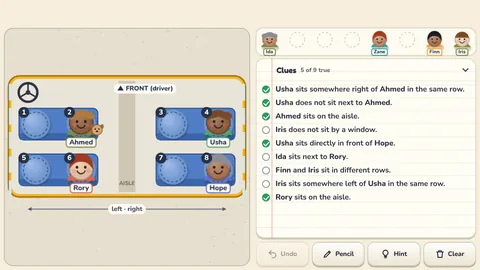
Every puzzle is a little get-together seen from above. There are 4 to 10 guests, the same number of seats, and 3 to 9 clues in a notepad under the scene. Each guest is a round friendly face with a name tag, and some have one thing we can spot right away: a red cap, glasses, braids or a dog on a leash. Each seat has a number.
Our job is to seat everybody so that every clue is true at once. There is exactly one way to do it. We check that with our own solver before a puzzle ships: it tries every arrangement and keeps the puzzle only if exactly one works. We also check that no clue is spare, so every line in the notepad matters.
It's free and it plays in your browser on a phone, tablet or computer, with nothing to download.
The rules in order
- Drag a guest from the line onto a seat, or tap a guest and then tap a seat. Both work everywhere.
- Tap a seat that is already taken and the two guests swap. Drag a seated guest back to the line, or tap the line while that guest is picked, to stand them up.
- Each clue has a small dot. A gray ring means someone in that clue is still standing. A green check means the clue is true right now. An amber triangle means it is broken right now.
- The puzzle is solved when every guest is seated and every clue is true.
- Undo takes back a move, Clear stands everyone up (Undo brings them back), and Pencil marks seats where a guest cannot sit.
- Hint explains one step in plain words and seats that guest for us. Three stars for no hints, two for one hint, one for more.
If we'd rather the notepad stayed quiet, Clue dots can be turned off in Settings. The Daily Seating never shows the dots.
The clue kinds, with examples
Every kind of clue always uses the same words, so once we've met one we know it the next time.
| Clue | What it means |
|---|---|
| Ana sits next to Ben. | Side by side in the same row, with no seat between them. Around a table it wraps all the way round. |
| Ana does not sit next to Ben. | Anywhere except side by side. |
| Ana sits across from Ben. | Facing each other over the table. At the holiday table the two heads face each other. |
| Ana sits somewhere left of Ben in the same row. | Anywhere to Ben's left, not only right beside him, and on the same bench or row. |
| Ana sits at an end. | The first or last seat of a row. At the holiday table only the two heads are ends. |
| Ana sits in a middle seat. | The center seat of a row. On the four-seat porch bench both center seats count, and the bleachers have one in each of their three rows. |
| Ana sits between Ben and Cy. | Ben is on one side of Ana and Cy on the other, both right beside her: along a row, around a table, or at a corner of the holiday table with the head on one side. |
| Ana sits by a window. | A seat with that thing beside it. Others: on the aisle, facing the door, by the fireplace, by the picnic basket, by the cooler, in the birthday chair. |
| Ana sits directly in front of Ben. | The very next seat toward the front, in the same line. Directly behind is the same the other way. |
| Ana and Ben sit in the same row. | Same bench or row of seats. Different rows is the opposite. |
| Ana and Ben sit exactly two seats apart. | Count seats along the row, or the shorter way around a table (at the holiday table that goes past the heads). Next to each other is one seat apart. |
| Someone with glasses sits next to Ana. | At least one guest wearing glasses is right beside Ana. Nobody with glasses means none of them is. |
Left, right and the front
Left and right are always our left and right as we look at the screen. Little arrows under each scene say so, and we never switch that around. Round tables never use left or right, because around a table that depends on where we stand.
Scenes with a front show it: the driver on the school bus, the bow of the canoe, the TV on movie night, and the field at the bleachers. On the bus, seats across the aisle are in the same row but not next to each other. On movie night each floor cushion sits directly in front of the couch seat behind it.
How to start a puzzle
- We read every clue once before seating anybody. Count how often each name comes up. The busiest guest is often the place to start.
- Start with clues about one guest and one kind of seat: at an end, in the middle, by a window, on the aisle. They throw out most seats at once.
- Next look at clues that pin two guests together: across from, directly in front of, between. Once one of the pair is seated, the other usually has one seat left.
- Use the negative clues (does not sit next to, does not sit by a window) to rule seats out rather than to place people.
- When two seats are still possible for someone, we try one in our heads and follow it. If a clue breaks, the other seat is the answer.
- Pencil is there for the hard ones: we pick a guest, turn on Pencil and mark the seats we've ruled out.
Three worked examples
A porch bench (the first lesson)
Four seats in a row. The clues: Ana sits at an end. Ana sits somewhere left of Ben in the same row. Dee sits at an end. Ben sits next to Ana. Ana is at an end, so she's in seat 1 or seat 4. Ben sits somewhere to her right, and there is no seat to the right of seat 4, so Ana must be in seat 1. Dee takes the other end, seat 4. Ben sits next to Ana, so he's in seat 2, and Cy gets seat 3.
A little booth (the across from lesson)
Two benches of two face each other over a table, with the window on the right and the top bench facing the door. The clues: Ana sits by a window. Ana sits facing the door. Ben sits across from Ana. Cy sits next to Ana. Only one seat is by the window and facing the door: seat 2. Ben faces her from seat 4. Cy sits beside Ana in seat 1, and Dee gets seat 3.
Ruling out with not next to (the third lesson)
On the porch bench the clues are: Ben sits somewhere left of Dee. Dee sits at an end. Ana does not sit next to Cy. Ana does not sit next to Dee. We find Dee first: she sits at an end, and Ben sits somewhere to her left, so Dee is in seat 4. Ana cannot sit beside Dee, so seat 3 is out for her. If Ana sat in seat 2, Cy would need seat 1 or seat 3, and both are right beside Ana, so Cy would have no seat. So Ana sits in seat 1. Cy cannot sit beside her in seat 2, so Cy takes seat 3 and Ben seat 2. Bigger puzzles work the same way, just with more steps and, near the end of the packs, a few places where we try a seat in our heads and watch a clue break.
Packs, lessons and the Daily Seating
There are 200 puzzles in ten scene packs: Porch Bench, Movie Night, Picnic Blanket, Diner Booth, Campfire Circle, Canoe Trip, Holiday Table, School Bus, Ballgame Bleachers and Birthday Party. They grow from 4 guests to 10, and solving 10 puzzles in a pack opens the next one. The first three puzzles have a pointing hand and won't let a guest sit somewhere wrong, so the very first minute always goes well.
How to think is a set of five tiny lessons, one for each of the most common clues: at an end, next to, not next to, across from, and left and right.
The Daily Seating has three tables a day, small, medium and large, the same for everyone on the same day, each with its own board. Every table is three seatings in a row on one clock, with new friends each time. On the Daily the clues have no dots and a seating only answers when every seat is full. A full table that isn't right yet adds eight minutes. Hints cost more each time: two minutes, then four, then six, and so on. The clock starts when we open a table and keeps running until the last seating is solved. Points are 3,600 less one for every second.
Getting better
Our house players on the Daily boards are set from a careful robot that only reads the clues and works step by step through all three seatings. A good real solver beats the best house time on most days. We also tested two guessers that do the easy steps and then guess: one learns only from filling the table, the other rules seats out with every clue first and guesses among the few seats left. Because a Daily table is three seatings, a guess has to come up right three times in a row, every wrong full table costs eight minutes, and hints cost more each time, so neither guesser reaches the best house time except on rare lucky days. In the packs the dots make trial and error possible, and that's fine there, since there's no board and stars only count hints.
The fastest solvers we've watched do the same three things: they find the guest every clue seems to mention, they treat negative clues as erasers, and when stuck they ask which single seat would break a clue rather than staring at the whole scene.
Questions
How do you solve a seating logic puzzle?
Start with clues about one guest and one kind of seat, like at an end or by a window, then use clues that tie two guests together, like across from or directly behind. Rule seats out with the negative clues, and when two seats are left, try one in your head and see if a clue breaks.
Does left mean my left or the guest's left?
Always our left as we look at the screen, which is your left too. Small arrows under each scene show it, and round tables never use left or right.
Is there always exactly one answer?
Yes. Our solver checks every puzzle before it ships, and it only keeps puzzles with exactly one arrangement that makes every clue true.
Can two people play Scoot Over together?
It's a one player puzzle, but it works well with two people sharing a phone and talking the clues through. The Daily Seating gives friends the same three tables each day to compare times.
Is Scoot Over free?
Yes. All 200 pack puzzles, the five lessons and the Daily Seating are free, with no download and no sign-up needed.
What does a hint do?
A hint explains one step in plain words and seats that guest. If someone is in a wrong seat, it tells you which clue is broken or who has to move first.
Related guides
 How to play Tulip QueensQueens
 How to play CagewiseMath logic puzzle
 How to play Mosaic LogicPicture logic
 How to play Mail Route MysteriesMystery logic puzzles
 How to play Jelly JarsSort puzzle
More to read
 How to solve logic grid puzzlesStrategy articleQueens puzzle tips: how to solve it without guessingStrategy article · Tulip QueensHow to solve nonograms: a worked 5x5 and the harder tricksStrategy article · Mosaic LogicLogic Grid PuzzlesRules, tips and games like this
 Logic PuzzlesRules, tips and games like this
You might also like
10 minSavesTulip Queens
QueensA calm queens puzzle in a flower garden. Place one crowned tulip in every row, every column and every bed, with no two touching. Seven levels from 5 × 5 to 11 × 11, a Daily Puzzle, X marks, hints that explain, and every puzzle has exactly one answer.