
Games / Puzzle Games / Mail Route Mysteries / Guide
How to play Mail Route Mysteries
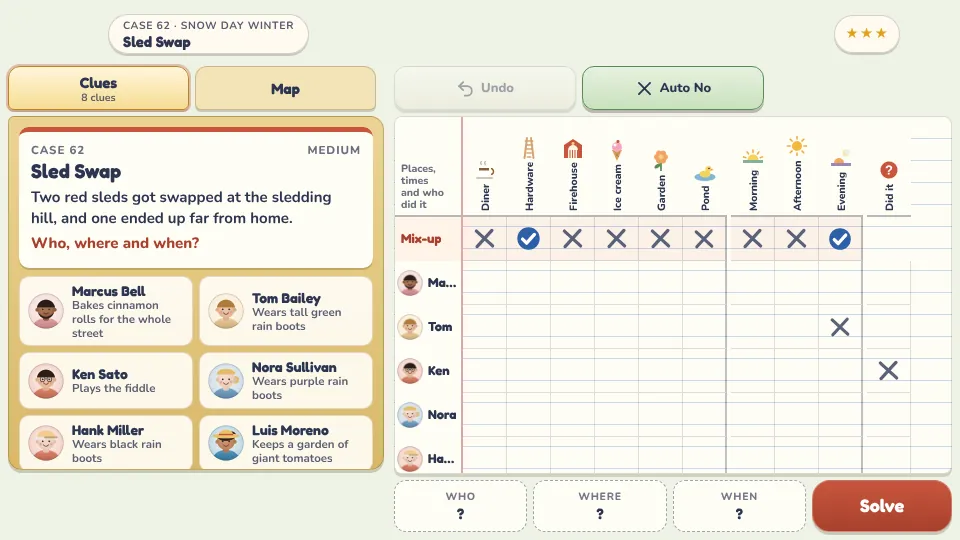
Mail Route Mysteries is a set of cozy mystery logic puzzles on a friendly small-town street. Something harmless got mixed up on Maple Street, and Dot the mail carrier figures out who did it, where and when, from a handful of clue cards and a notebook grid.
This is our guide to playing Mail Route Mysteries. Want to jump straight in? Play Mail Route Mysteries right here in your browser.
Quick answers
Does Mail Route Mysteries work on my phone?
Yes. Mail Route Mysteries works with touch on phones and tablets, and with a mouse or keyboard on a computer. It runs in the browser you already have, so there is no app to download.
Do I need an account to play Mail Route Mysteries?
No. Just open it and play, with no sign-up. If you like, a free account (username only, no email, for players 13 and older) puts your scores on the leaderboards and backs up your progress so it follows you to any device.
Is there a daily challenge in Mail Route Mysteries?
Yes. Mail Route Mysteries has a new daily challenge every day, the same one for every player, with its own daily leaderboard. Find it alongside the others on our daily challenges page.
Does Mail Route Mysteries save my progress?
Yes. It saves on this device on its own, so you can close the page and pick up where you left off. Sign in with a free account to keep the same progress on your phone and your computer.
How it works
Every case is a small puzzle with exactly one answer. The case card tells you what got mixed up: the last slice of blueberry pie at the bakery is gone, somebody left the community garden gate open, a ladder turned up somewhere it shouldn't be. Nothing dark ever happens on Maple Street. These are gentle mix-ups between neighbors, and they always end with somebody making it right.
That day, every neighbor in the case made just one stop: one place on the street, at one time of day (morning, afternoon or, in the bigger cases, evening). Exactly one neighbor was at the spot where it happened, at the time it happened. That neighbor is the one who did it. So the answer is three things: who, where and when.
It's free and plays in your browser on a phone, tablet or computer. There's nothing to download and no account to make.
How to read the clues
The clues sit in a manila folder, one card each. There are four kinds, and it helps to know what each one can and can't tell you.
- The case card is the first clue in many cases. It often names the place ("it happened at the bakery"), so the question is only who and when.
- Facts are plain statements that are always right: "Rosa went to the library", "Ben did not go out in the morning", "Mei went out earlier in the day than Omar".
- Notes found on the map are things Dot found at a place, and each note says what it means: a neighbor's mitten at the diner means that neighbor went to the diner, a receipt stamped 2:40 in the afternoon means it happened in the afternoon, paw prints by the spot mean whoever did it has a dog. The Map tab shows where each note was found.
- Neighbors' statements come with a portrait. Neighbors always say what they believe is true. In Easy and Medium cases every statement is right.
Some facts name a neighbor by what they're known for, such as "the neighbor with the beagle". Each neighbor's card in the folder shows their trait line, so that's always something you can look up, never something you have to know.
Using the notebook grid
The Notebook is a logic grid. Each row is a neighbor, and the top row is the mix-up itself. The columns are the places, then the times of day, then a Did it column.
- Tap a cell once for No (a pencil cross) and twice for Yes (a blue check). A third tap clears it.
- With Auto No on, a Yes fills in the No marks it forces. If Rosa went to the library, she went nowhere else, so the rest of her places get a No.
- Mark the mix-up row as soon as you know where or when it happened. That row is what clears neighbors fastest.
- A neighbor who never went to the place where it happened, or who wasn't out at that time, did not do it. Mark No in their Did it cell.
- Tap a clue card to cross it off once you've used it. Undo takes back the last mark.
When you know who, where and when, fill in the answer line at the bottom and tap Solve. On the keyboard, the arrow keys move around the notebook, Space or Enter marks a cell, H asks for a hint and U undoes.
The mixed-up neighbor rule
Hard cases add one twist: exactly one neighbor mixed something up. Their statement is wrong, but honestly so. They remembered the wrong time, or thought a friend went to the bakery when it was the barbershop. Nobody on Maple Street says anything they know is wrong.
The trick is that facts and notes are always right. So work from the facts and notes first, and leave the statements alone for a moment. Sooner or later one statement can't fit what the facts and notes already show. That's the mixed-up one. Tap Mixed up? on its card to set it aside, take its opposite as true, and from then on trust every other statement. Only one statement can ever be the mixed-up one, and our solver checks that for every Hard case.
A worked case, step by step
Here's the very first case in the Casebook, in words. The bakery saved the last slice of blueberry pie for Dot, and the plate was empty. Five neighbors: Frank, Bev, Fatima, Omar and Marcus. Four places: the bakery, the post office, the ice cream stand and the duck pond. Two times: morning and afternoon. The clues:
- The case card: it happened at the bakery.
- Fatima says it wasn't her, and she promises.
- A note found at the post office: Marcus's oven mitt. So Marcus went there.
- Bev says Omar went to the duck pond, and she's sure of it.
- It happened in the afternoon.
- Frank says he went to the post office.
Clues 1 and 5 settle the mix-up row straight away: it happened at the bakery, in the afternoon. Mark Yes in both places on that row.
Now clear people. Fatima says it wasn't her (clue 2), and this is an Easy case, so every statement is right. Marcus went to the post office (clue 3), and everyone made just one stop, so he never went to the bakery. Omar went to the duck pond (clue 4) and Frank went to the post office (clue 6), so neither of them was at the bakery either. Mark No for all four in the Did it column.
That leaves Bev. Somebody was at the bakery that afternoon, and everyone else is ruled out, so it was Bev, at the bakery, in the afternoon. She thought the slice was a free sample, and she bought Dot a whole pie to make up for it.
The Casebook and the Daily Case
The Casebook holds 120 cases in six seasons on Maple Street, from Mud Season to Parade Summer. The first season has five neighbors, four places and two times of day. By the last season there are nine neighbors, eight places and three times, and more Hard cases with a mixed-up neighbor. Every case earns up to three stars. A wrong answer costs a star and tells you which clue to check again, but the case stays open until you solve it.
The Daily Case is the same case for everyone on the same day: seven neighbors, six places and three times, with a mixed-up neighbor on weekends. It has two boards. The time board scores 3,600 points less one for every second, and the clock starts when the case opens and keeps going even if you close the page. A wrong answer adds four minutes and a hint adds 45 seconds, so guessing never pays. The No-mistake board counts the Daily Cases you've solved with no wrong answer and no hint.
New to logic grids? Play opens three tiny practice cases first, with a pointing hand that shows each step.
Tips for solving mystery logic puzzles
- Start with the mix-up row. Where and when it happened clears more neighbors than anything else.
- Use the "whoever did it" notes early. "Whoever did it has a dog" can rule out half the street in one go.
- Look for clues that link two neighbors, like "went to the same place" or "went out earlier in the day than". They do nothing on their own, then suddenly do a lot once one of the two is known.
- An either-or clue ("went to the diner or the library") rules out every other place right away, even before you know which one.
- In a Hard case, don't lean on a statement until you've found the mixed-up one, or a wrong mark can sneak into the notebook.
- Stuck? Hint gives the next step in plain words, worked out from your notebook as it is. If a mark doesn't fit, it tells you which one.
Getting better
The quickest solvers don't fill the whole grid. Most cases never tell you where every neighbor went, and they don't need to. Find where and when first, then only work on the neighbors who could still have been there. Watch for the moment a neighbor's last possible place or time is crossed off, because that's usually what unlocks the next clue.
For the Daily time board, read every clue once before you mark anything. Knowing which clues link which neighbors saves more time than fast tapping, and a wrong answer costs four minutes. We checked the boards with robots. A careful player who works each step beats the best house result on most days. A player who skims the clues and guesses gets there on fewer than 5 days in 100, and only when the very first guess happens to be right, because the second guess already costs four minutes.
Questions
How do you solve a mystery logic puzzle?
Write down what the clues say in a grid, one row per person, and rule things out. Find where and when it happened first, then cross off everyone who could not have been there at that time. When only one person is left, that's the answer.
Do I need to guess in Mail Route Mysteries?
No. Every case has exactly one answer that the clues prove, and our solver checks each one. Nothing needs outside knowledge: anything a clue refers to, like a neighbor's dog or bike, is on that neighbor's card.
What happens if I give a wrong answer?
You lose a star, and we tell you which clue your answer breaks so you can check it again. The case stays open. On the Daily Case a wrong answer also adds four minutes to your time.
What is the mixed-up neighbor?
In Hard cases exactly one neighbor's statement is wrong because they remembered something wrong. Facts and notes are always right, so the statement that can't fit them is the mixed-up one. Everyone else is right.
Is Mail Route Mysteries free?
Yes. It's free to play in your browser on a phone, tablet or computer, with nothing to download.
Can kids play these mystery puzzles?
Yes. The cases are gentle mix-ups like a missing slice of pie or a borrowed ladder, with nothing scary in them. Younger players can start with the three practice cases, which show every step.
Is there a new mystery puzzle every day?
Yes. The Daily Case is a new case each day, the same for everyone, with a time board and a No-mistake board.
Related guides
 How to play Keyhole CottageEscape room
 How to play Riddle RoostRiddles and rebus puzzles
 How to play Linden LookoutHidden object
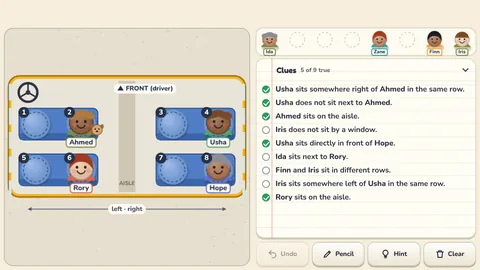 How to play Scoot OverSeating logic puzzle
 How to play Mosaic LogicPicture logic
More to read
You might also like
10 minSavesKeyhole Cottage
Escape roomCozy escape rooms you solve by tapping, picking things up and putting them together. Bake the first loaf in a village bakery, water a sunny greenhouse and polish a lighthouse lamp, with little lock puzzles whose answers hide in each room, hints that nudge in steps, a new room every week and a Daily Lock.
10 minSavesRiddle Roost
Riddles and rebus puzzlesThree riddles and two picture word puzzles every day, all written by us. Tap letter tiles to answer, lean on free hints, and catch up on past days in the Library.
10 minSavesLinden Lookout
Hidden objectFind the things on the list in cozy hand drawn scenes, from a sunny potting shed to a lamplit reading nook. Words, shapes, pictures or riddles, boxes to peek inside, sets of three, a lantern hint that refills, keepsake collections, seasonal scenes and a Daily scene.
10 minSavesScoot Over
Seating logic puzzleA seating logic puzzle at American get-togethers seen from above: a porch bench, a diner booth, a canoe, the school bus, a holiday table and more. Read the clues and seat every guest in the one arrangement that keeps them all happy. 200 puzzles in ten scene packs from 4 guests to 10, five tiny lessons, a pencil, hints that explain one step, and a Daily Seating in three sizes.