Games / Strategy Games / Pinochle Porch / Guide
Pinochle Porch
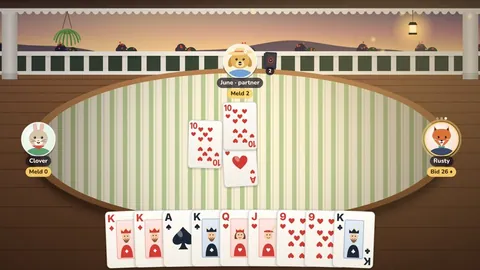
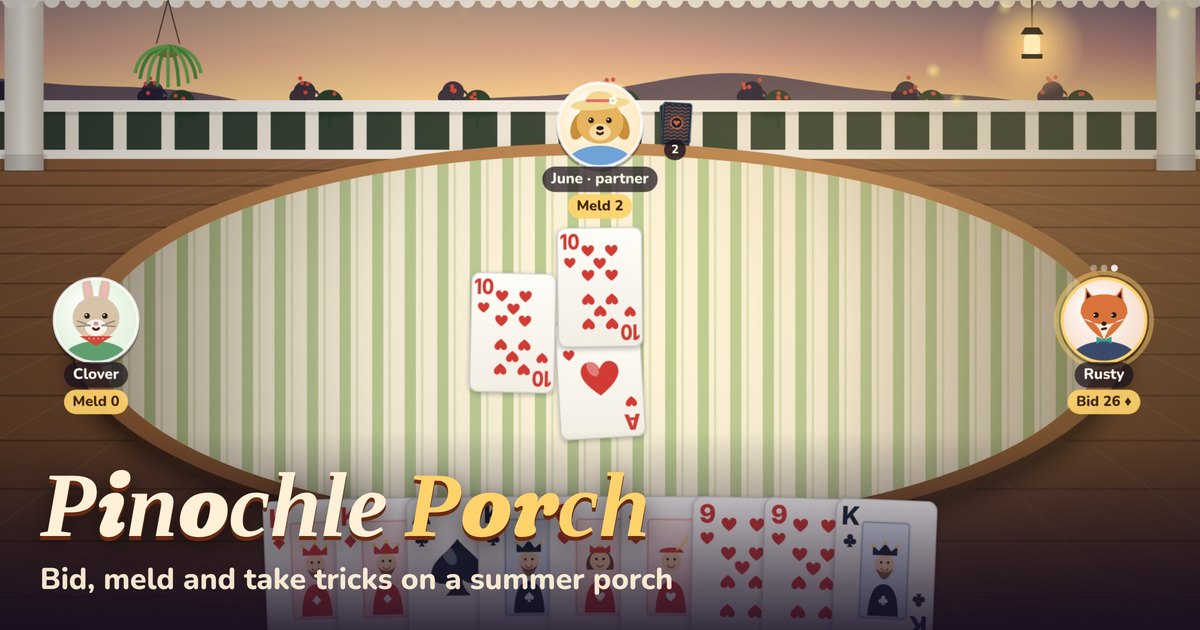
Partnership Pinochle on a summer porch at dusk. You and June, a golden retriever in a sun hat, bid, meld and take tricks against the neighbors around Linden Lake.
Missing something you need? Tell us.
Quick answers
Does Pinochle Porch work on my phone?
Yes. Pinochle Porch works with touch on phones and tablets, and with a mouse or keyboard on a computer. It runs in the browser you already have, so there is no app to download.
Do I need an account to play Pinochle Porch?
No. Just open it and play, with no sign-up. If you like, a free account (username only, no email, for players 13 and older) puts your scores on the leaderboards and backs up your progress so it follows you to any device.
Is there a daily challenge in Pinochle Porch?
Yes. Pinochle Porch has a new daily challenge every day, the same one for every player, with its own daily leaderboard. Find it alongside the others on our daily challenges page.
Does Pinochle Porch save my progress?
Yes. It saves on this device on its own, so you can close the page and pick up where you left off. Sign in with a free account to keep the same progress on your phone and your computer.
Is Pinochle Porch OK for kids?
Yes, players of any age can enjoy it. There is no chat and no way to message other players, and nobody needs an account to play. Accounts are for players 13 and older, so younger players just play and their progress stays on their device. For ages 4 to 11 we also have learning games in their own kids area, with no ads, no accounts and no tracking.
What is Pinochle?
Pinochle is a trick-taking card game for four players in two teams. Partners sit across from each other. Every hand has three parts: you bid on how many points your team can make, you lay down meld (card combinations worth points), and then you play tricks to win counters.
The Classic deck has 48 cards: two each of the A, 10, K, Q, J and 9 in every suit. The order is a little unusual, and it trips up almost everyone at first: the 10 ranks just under the ace and above the king. Each player gets 12 cards.
In Pinochle Porch you always play with June as your partner. The other team is a pair of neighbors, and who you face depends on the mode and the difficulty.
How bidding works
Starting with the player on the dealer's left, everyone either bids a number or passes. A pass lasts for the rest of the hand. In Classic, bids start at 25 and go up by 1. If the first three players all pass, the dealer is stuck with the bid at 25.
The bid is a promise: your team will make at least that many points from meld plus trick points. The winner of the bid names trump and leads the first trick.
Our bid helper shows your meld for each possible trump suit, a fair estimate of the trick points you can expect, and what June's meld and the pass usually add. It ends with a suggested top bid. You can hide it in Settings once you have the feel for it.
Passing cards
After trump is named, the bidder's partner passes 4 cards to the bidder, and the bidder sends 4 back. Partners usually send trump first, then aces. The bidder returns cards that are not trump, not aces and not part of their meld. In Quick match you can switch the pass to 3 cards or turn it off.
When it's your turn to pass, a Suggest button picks a good set and the panel shows how your own meld changes as you choose.
The meld chart
Once trump is set, everyone lays down meld. A card can count in different kinds of meld at once, so the queen of spades can be part of a marriage, a pinochle and queens around. It can never count twice in the same kind.
| Meld | Cards | Points | Doubled |
|---|---|---|---|
| Run | A 10 K Q J of trump | 15 | 150 |
| Royal marriage | K and Q of trump | 4 | 8 |
| Marriage | K and Q of another suit | 2 | 4 |
| Nine of trump | 9 of trump | 1 | 2 |
| Pinochle | J of diamonds and Q of spades | 4 | 30 |
| Aces around | One ace of each suit | 10 | 100 |
| Kings around | One king of each suit | 8 | 80 |
| Queens around | One queen of each suit | 6 | 60 |
| Jacks around | One jack of each suit | 4 | 40 |
A run with an extra king and queen of trump counts as the run plus a royal marriage, 19 in all. The game finds and counts all meld for you, then shows every player's meld on one board with each combination named.
Playing the tricks
- The bidder leads the first trick, and play goes to the left.
- You must follow suit if you can. If you can follow, you must also play higher than the winning card when you can. Players call this heading the trick. Once a trick has been trumped, any card of the led suit is fine.
- If you have none of the suit led, you must play trump, and beat any trump already played if you can.
- With neither, play anything.
- The highest trump wins. Otherwise the highest card of the suit led wins. When two identical cards fall, the first one played wins.
Each ace, ten and king you capture is a counter worth 1 point, and the last trick is worth 1 more, so there are 25 trick points in every Classic hand. During play, a meter at the top shows how many trick points the bidding team still needs, and a small chip counts the trump you have not seen yet.
Scoring
The bidding team adds its meld to its trick points. If the total reaches the bid, it scores the whole total. If not, the team is set: it scores nothing that hand and the bid comes off its score. The other team always scores its trick points, plus its meld.
There is one catch for both teams: you must take at least one trick point to keep your meld. If the bidders' meld plus all 25 trick points still cannot reach the bid, the hand ends right after meld. The bidder can also choose to throw in the hand. Either way the bidders lose the bid and the other team scores only its meld.
The first team to 150 wins a Classic match. If both teams pass the target on the same hand, the team that won the bid takes the match. A score pad keeps every hand, and a recap after each hand shows exactly where the points came from.
Double deck Pinochle
Double deck is the form most clubs and tournaments play. It uses 80 cards, four each of A, 10, K, Q and J in every suit, with no nines. Everyone gets 20 cards and melds get much bigger.
| Meld | x1 | x2 | x3 | x4 |
|---|---|---|---|---|
| Run | 15 | 150 | 225 | 300 |
| Pinochle | 4 | 30 | 60 | 90 |
| Aces around | 10 | 100 | 150 | 200 |
| Kings around | 8 | 80 | 120 | 160 |
| Queens around | 6 | 60 | 90 | 120 |
| Jacks around | 4 | 40 | 60 | 80 |
Royal marriages are 4 each and other marriages 2 each. Bids start at 50 and go up by 1 to 60, then by 5. The last trick is worth 2, so there are 50 trick points. Games go to 500, or 250 if you want a shorter match.
Modes, daily deal and leaderboards
Quick match lets you pick the deck, Easy, Normal or Hard house players, the target score, how many cards partners pass, and whether you must beat the winning card on every trick or only when trump is led.
Porch Tour is ten stops around the lake, from the Back Porch and the Boat Dock to the Lighthouse Deck and the Moonlight Gazebo. Each stop has its own pair of neighbors, its own scenery and tablecloth, and three stars to earn: win, win without being set as bidders, and win by a third of the target or more.
The Daily Deal is four Classic hands with the same deals for everyone that day, and every seat deals once. Your score is 1,000 plus 10 for every point your team finishes ahead (or minus 10 for every point behind). The first run each day goes to the daily leaderboard. Wins in Quick match and the Porch Tour also move your porch rating, and your best rating goes on the all-time board.
A guided first hand with June teaches every step, and the rules and meld chart are one tap away in the menu.
Tips from our porch
- Count trump length, not just meld. A hand with six or more trump and an ace or two takes far more trick points than the same meld spread thin.
- When June is bidding, think before you outbid her. Two bids from one team only push your own contract higher.
- As the partner, pass trump and aces even if it breaks up one of your marriages. A run in the bidder's hand is worth far more.
- As the bidder, lead the ace of trump early. Nothing can beat it, and it shows you who is short in trump.
- When your partner is winning a trick and you can't beat it, drop a counter on it. That's an easy point that would otherwise go to the other team.
- Save one sure winner for the end. The last trick is worth an extra point in Classic and 2 in double deck.
- Defending, remember you need just one trick point to keep your meld. Grab a counter early if you can.
Questions
Is Pinochle Porch free?
Yes. It plays in your browser on a phone, tablet or computer with nothing to download, and every card back and tablecloth is earned by playing.
Which Pinochle does the game use?
Four-player partnership auction Pinochle. Classic single deck is the default, with modern scoring where aces, tens and kings are worth 1 point each. Double deck is one tap away in Quick match.
Does the 10 beat the king in Pinochle?
Yes. The order from high to low is A, 10, K, Q, J, 9. The 10 is the second highest card in every suit.
What happens if you don't make your bid?
Your team is set. You score nothing for that hand, not even your meld, and the amount you bid is subtracted from your score.
Do the computer players cheat?
No. They only know their own cards and what everyone at the table can see: the bids, the meld laid down, cards passed to them and cards played. Deals are ordinary shuffles.
Can I undo a card?
In Easy and Normal matches you can take back your last card. A match where you used Undo does not change your porch rating, and the Daily Deal has no undo.
Can I play pinochle online without other people?
Yes. June is your partner and two computer neighbors sit across the table, so you can play whenever you like. Our pinochle online page has a short version of the rules and the meld chart.
Related guides
 How to play Euchre LodgeTrick taking
 How to play Spades ClubTrick taking
 How to play Hearts HollowTrick taking
 How to play Spite StreetSpite and Malice
 How to play Updraft DuelDuel solitaire