Games / Strategy Games / Bridge Brook / Guide
Bridge Brook
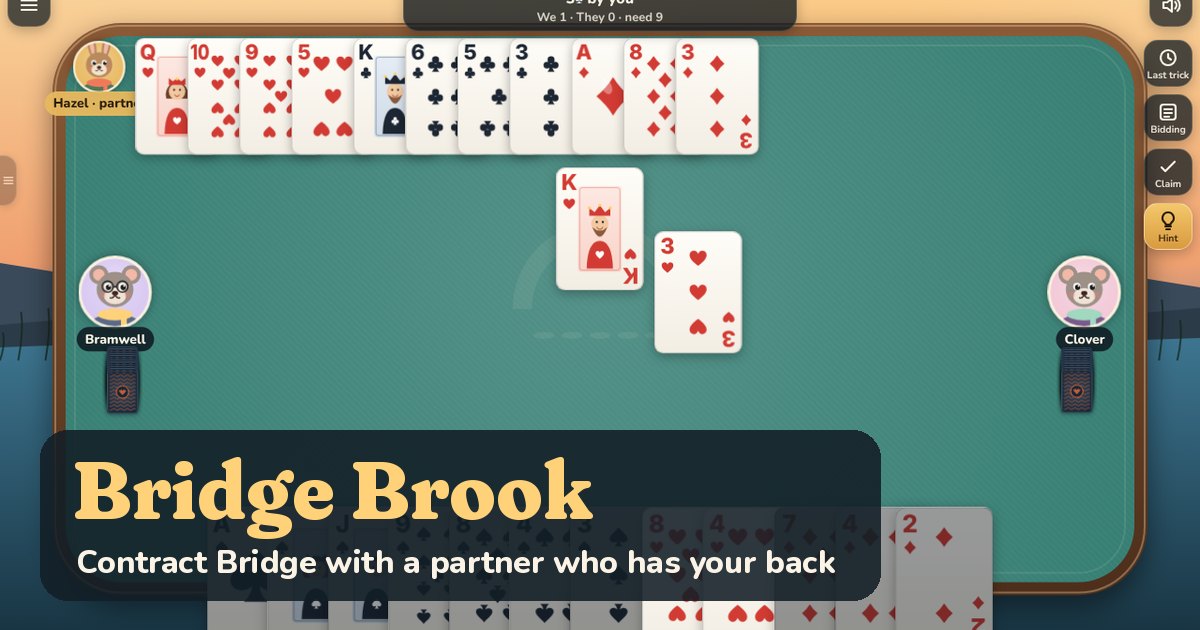
Contract Bridge at a little table by the water. You sit South with Hazel the hare as your partner, and a friendly bidding helper explains every call while you learn.
Quick answers
Does Bridge Brook work on my phone?
Yes. Bridge Brook works with touch on phones and tablets, and with a mouse or keyboard on a computer. It runs in the browser you already have, so there is no app to download.
Do I need an account to play Bridge Brook?
No. Just open it and play, with no sign-up. If you like, a free account (username only, no email, for players 13 and older) puts your scores on the leaderboards and backs up your progress so it follows you to any device.
Is there a daily challenge in Bridge Brook?
Yes. Bridge Brook has a new daily challenge every day, the same one for every player, with its own daily leaderboard. Find it alongside the others on our daily challenges page.
Does Bridge Brook save my progress?
Yes. It saves on this device on its own, so you can close the page and pick up where you left off. Sign in with a free account to keep the same progress on your phone and your computer.
Is Bridge Brook OK for kids?
Yes, players of any age can enjoy it. There is no chat and no way to message other players, and nobody needs an account to play. Accounts are for players 13 and older, so younger players just play and their progress stays on their device. For ages 4 to 11 we also have learning games in their own kids area, with no ads, no accounts and no tracking.
What is Contract Bridge?
Bridge is a trick-taking card game for four players in two partnerships. Partners sit across from each other. Every deal has two parts: an auction, where both sides bid for the right to name trumps, and the play of thirteen tricks. The side that wins the auction has to take at least the number of tricks it promised.
What makes bridge special is that you talk to your partner only through bids. Each bid is a small, coded message: how many points you hold and which suits are long. Learning that language is the fun part, and it's what our bidding helper teaches.
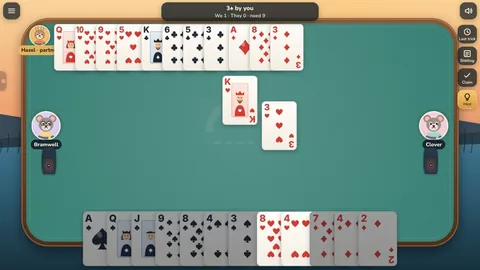
Bridge Brook is free and plays in your browser on a phone, tablet or computer. You always sit South, at the bottom of the screen. Hazel sits North, across from you.
How to play bridge
The deal
All 52 cards are dealt, so everyone holds 13. Aces are high. The dealer makes the first call, then the auction goes around the table clockwise.
The auction
A bid names a number of tricks over six and a trump suit, or notrump. So 2♥ promises eight tricks with hearts as trumps, and 3NT promises nine tricks with no trumps at all. Suits rank clubs, diamonds, hearts, spades, then notrump, and each new bid must be higher than the last one.
- Pass is always allowed.
- Double is allowed over the opponents' last bid. It raises the score for making or failing.
- Redouble is allowed after the opponents double your side.
- The auction ends after three passes in a row. The last bid is the contract.
- If all four players pass at the start, the deal is thrown in.
Declarer and dummy
The player on the winning side who first named the final suit (or notrump) becomes declarer. The player on declarer's left leads the first card. Then declarer's partner lays their hand face up on the table. That hand is the dummy, and declarer plays it too. In Bridge Brook, whenever our side wins the auction you play both hands, even when Hazel is the declarer.
Playing tricks
Everyone must follow the suit that was led if they can. The highest card of that suit wins the trick, unless somebody played a trump, in which case the highest trump wins. The winner leads to the next trick.
Bidding: the system we teach
We use Standard American with five-card majors, the system most club players learn first. Count high card points: ace 4, king 3, queen 2, jack 1. Add a point for each card over four in a long suit. About 25 points between you and partner usually makes a game. About 33 makes a small slam.
| Opening bid | What it shows |
|---|---|
| 1♣ or 1♦ | 12 to 21 points, no five-card major |
| 1♥ or 1♠ | 12 to 21 points, five or more cards in the suit |
| 1NT | 15 to 17 points, balanced |
| 2♣ | 22 or more points, strong and artificial |
| 2♦, 2♥, 2♠ | Weak: a good six-card suit and 5 to 10 points |
| 2NT | 20 to 21 points, balanced |
| 3 of a suit | Weak with seven cards |
Answering partner
A new suit at the one level shows 6 or more points and is forcing, so partner must bid again. A new suit at the two level shows about 10 or more. A simple raise of partner's major shows three-card support and 6 to 9 points, and a jump raise shows 10 to 12. Over 1NT, 2♣ is Stayman (asking for a four-card major) and 2♦ or 2♥ is a transfer to hearts or spades.
When the opponents bid
Overcall with a good five-card suit and 8 to 16 points. A takeout double shows an opening hand that is short in their suit and asks partner to pick a suit. If partner opened and the next player overcalls, your double is a negative double: it shows the unbid major. For slams, 4NT (Blackwood) asks partner how many aces they hold.
The bidding helper
When it's your turn to bid, Hazel suggests a call with a one-line reason, like "14 points and five hearts: open 1♥". Tap any button in the bidding box to see what that bid would mean before you confirm it, and tap any bid already in the auction to read its meaning. You can set the helper to show always, only when asked, or never.
How bridge scoring works
Each deal is scored on its own, the way clubs score duplicate games. Making your contract earns trick points, and if those reach 100 you have made a game and collect a bonus.
| Item | Points |
|---|---|
| Each trick over six in ♣ or ♦ | 20 |
| Each trick over six in ♥ or ♠ | 30 |
| Notrump | 40 for the first trick, 30 after |
| Game bonus | 300, or 500 if vulnerable |
| Part score bonus | 50 |
| Small slam (12 tricks) | 500, or 750 vulnerable |
| Grand slam (13 tricks) | 1000, or 1500 vulnerable |
| Each trick short | 50, or 100 vulnerable (more if doubled) |
A worked example: 4♠ making exactly ten tricks, not vulnerable, scores 4 x 30 = 120 trick points plus 300 for game, so 420. At the end of every deal we show the score line by line so you can see where each number came from.
Club Game is a four-deal Chicago game by default: add the four scores. In Settings you can switch to a rubber, where part scores carry over, the first side to win two games takes the rubber (bonus 700 for two games to none, 500 for two to one), and four or five trump honors in one hand score extra.
Modes
Down the Brook
Eight little bridges with eight deals each, 64 in all. Every bridge has its own opponents and teaches one idea: counting tricks in notrump, finding a major fit, responding and rebidding, Stayman and transfers, competing, opening leads and defence, slams, and strong and weak openings. Each deal earns up to three stars. You get three when your result matches or beats the house table, which is our computers playing the same cards at another table. Finish a bridge to keep its table cloth. After the last bridge, open water deals keep coming.
Daily Deal
Four boards, the same for everyone each day (it changes at midnight UTC). Your result on each board is compared with eleven house tables and turned into a percentage, and your daily score is the average out of 1000. It counts once a day, it's saved after every card, and undo and play hints are off. The bidding helper still works.
Club Game, Weekly Regatta and Bidding Practice
Club Game has undo, hints and a choice of Relaxed, Steady or Sharp opponents. Hazel always plays her best. The Weekly Regatta is six themed deals each week, and twelve stars earns that week's stamp. Bidding Practice gives you a hand and an auction and asks what you would bid, then explains the answer.
Controls
Tap a card to play it. On a computer you can also use the arrow keys to pick a card and Enter to play it, H for a hint, L to see the last trick, U to undo in Club Game and Esc for the menu. The Claim button finishes the deal early when the rest of the tricks are surely yours.
Tips and strategy
- Before you play to the first trick as declarer, count your sure tricks. If you're short, decide which suit will give you the extra ones.
- In notrump, a hold up helps a lot: if they lead a suit where you have only the ace, let them win the first round or two so their partner runs out of that suit.
- Set up long suits early, while you still have high cards protecting the other suits. Lead the high cards from the shorter hand first so the suit doesn't get stuck.
- In a trump contract, draw the opponents' trumps unless you need dummy's trumps to ruff your losers.
- On defence: second hand low, third hand high, and cover an honor with an honor.
- Lead partner's suit if partner bid one. Otherwise the top of a sequence (the king from KQJ) is a safe, strong lead.
- Add your points to what partner showed. With 25 between you, look for game. If partner could be anywhere in a range, invite instead of guessing.
Questions
Is Bridge Brook free?
Yes. It's free to play in your browser on a phone, tablet or computer, with nothing to download and no ads.
Can I learn bridge here as a complete beginner?
Yes. The first deal is guided, the bidding helper suggests and explains every call, and each bridge on the brook teaches one idea with a short lesson.
What bidding system does the computer use?
Standard American with five-card majors: 15 to 17 point 1NT, strong 2♣, weak twos, Stayman, transfers, negative doubles and Blackwood.
Does the computer cheat or see my cards?
No. Our computers only see their own cards, the dummy and the cards already played. After every deal you can look at all four hands and replay the tricks.
What does vulnerable mean in bridge?
A vulnerable side scores bigger bonuses for games and slams but loses more for going down. It follows a fixed cycle and is shown at the top of the table.
How is the Daily Deal scored?
Each of the four boards is compared with eleven house tables that played the same cards. Beating a table counts more than tying it, and your daily score is the average percentage out of 1000.
Can I play bridge online without a partner?
Yes. Hazel is your computer partner and both opponents are computer players, so you can play any time. Our play bridge online page covers the basics on one page.
Related guides
 How to play Spades ClubTrick taking
 How to play Hearts HollowTrick taking
 How to play Euchre LodgeTrick taking
 How to play Spite StreetSpite and Malice
 How to play Updraft DuelDuel solitaire