Learning games / Touchdown Tally / Guide
Touchdown Tally
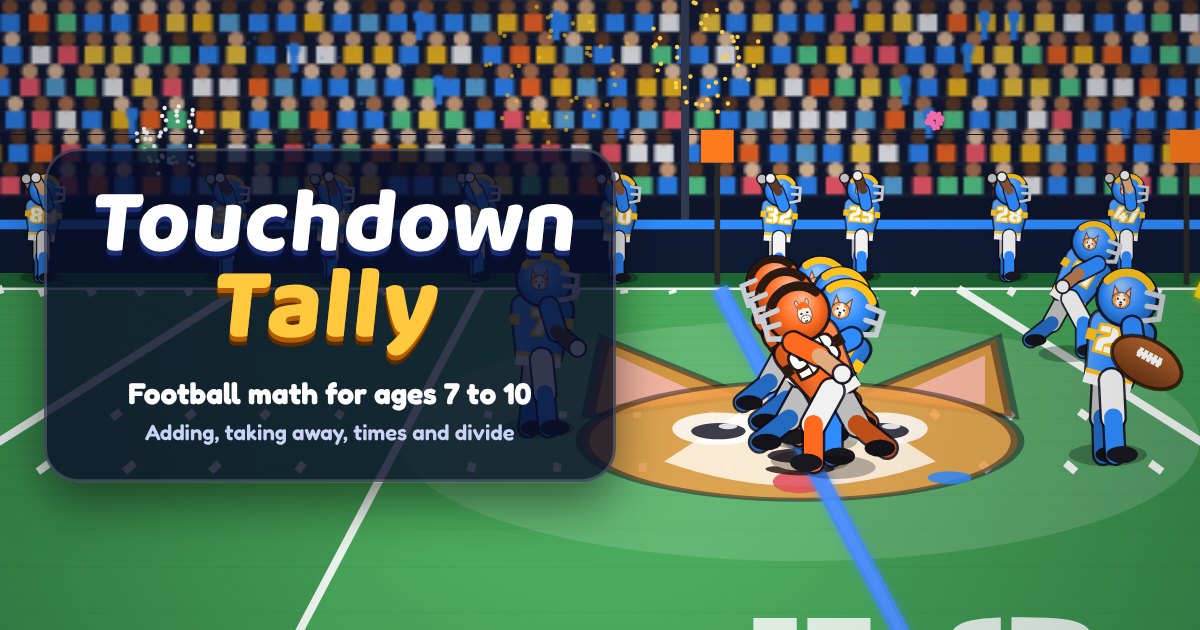
Touchdown Tally turns math facts into a real football game. Your child builds a team, calls the plays and moves the ball by typing answers to addition, subtraction, times table and division facts. Quick, right answers mean longer gains, and the other team only scores when the math slips.
Quick answers
Is Touchdown Tally free?
Yes. Touchdown Tally is free to play in the browser, with no ads, no accounts and no tracking. There is nothing to buy and nothing to download.
Does Touchdown Tally work on a tablet or phone?
Yes. It plays with touch on tablets and phones, and with a mouse on a computer. There is nothing to download.
Do kids need an account to play Touchdown Tally?
No. Our learning games have no accounts at all, so there is nothing to sign up for. Progress and stickers stay on the device they play on.
What your child practices
- Addition and subtraction facts within 20, like 8 + 7 and 15 − 7 (Grades 1 and 2). A grown-up can keep it within 10.
- Times tables from 1 to 10, like 6 × 7 (Grade 3). A grown-up can turn on only some tables, for example just the 2s, 5s and 10s.
- Division facts with whole-number answers, like 56 ÷ 8, always tied back to the times fact (Grade 3).
- Fact strategies: doubles, near doubles, make ten, think addition for subtraction, skip counting, and ten groups minus one group for the 9s.
How to play
First your child picks a grade, a mascot, a team name and colors. There are eight mascots to choose from, including a llama, a narwhal, a corgi and a moose, and the team plays in our own Backyard League.
On offense, you call a play, then a math fact appears. Type the answer on the big number pad (or a keyboard) and tap Hike. There are no answer choices, so every play needs real recall. A Run asks an easier fact and gains 2 to 13 yards. A Pass asks a fact at your level and gains 6 to 23 yards. A Trick play asks a stretch fact and can gain 18 to 44 yards, but a miss on a trick play can be picked off.
The rules are real football, kept simple: four downs to reach the yellow first down line, touchdowns are 6 points, then kick for 1 point (an easier fact) or go for 2 (a tougher one). On 4th down you can go for it, punt, or try a field goal from the other team's 35 yard line or closer.
On defense, every answer is one play by the other team. Quick right answers make sacks, knockdowns and interceptions. A missed fact lets them gain big. Answer right on a field goal try and their kick goes wide. So the other team's pace comes only from your child's answers, never from fast fingers.
A Quick game has four quarters with one drive each, and your team always gets the last drive. When the game is close, that last drive is a two-minute drill: every play uses a few game seconds, and quicker answers use fewer. There is always one last play, and ties go to overtime.
Speed without stress
Research on math fact fluency says speed helps facts stick once a child is accurate, but timed tests can cause worry. So there is no countdown anywhere in Touchdown Tally and nothing bad happens when your child takes their time. A quick right answer simply earns more yards, and quick is measured against your child's own usual pace. Two-digit answers get a little extra time. A grown-up can turn speed off completely in the Coach's Clipboard.
Each game gives three timeouts. Calling one shows a coach tip that sets up the fact without giving away the answer (for 6 + 7: double 6 is 12), and that play gains fewer yards.
How it adapts
Every fact has its own mastery level. A fact answered right and quickly the first time counts as already known, so a child who knows their adding facts moves past them within a few minutes. Facts that are slow or missed stay in the mix. At most a handful of brand new facts are in play at once, and new facts follow a sensible order: plus 1, doubles, make ten and near doubles for adding; 2s, 10s and 5s first for times tables, then 3s, 4s and 9s, then 6s, 8s and 7s.
After a miss, the coach shows a short strategy with the answer (6 × 7: 5 × 7 is 35, plus one more 7 is 42), and your child types the answer once to lock it in. That fact comes back a few plays later, then again on later days, until it is quick to recall. The next defensive play often asks a fact family partner, so 7 × 8 is followed by 56 ÷ 8.
Seasons, cards and trophies
The season is six games against the other Backyard League teams, then a playoff game and the Golden Helmet Game. The schedule starts with the easier teams. Your team always makes the playoffs, and a lost playoff game can be played again, so a season never ends in a dead end. The next season is a little tougher.
The Game of the Day is the same matchup and field all day. A two-week calendar shows the days played, with no streak to lose.
The Practice Field has untimed drills for each fact group, like Doubles, Make ten, the 7s or Divide by 6, with a coach tip before each drill. Master a group (most of its facts quick and right) and a new made-up player joins the team with their own player card. Right answers also earn fans, which unlock uniforms, end zone dances and fields such as Night Lights, Canyon Sunset and Snowy Field. Trophies mark moments like a first touchdown, a pick six, a perfect drive or a comeback win. Nothing is ever bought: all of it comes from playing.
For grown-ups: the Coach's Clipboard
Press and hold the For grown-ups button on the title screen. The clipboard shows how many facts are mastered for each operation, a color map of every fact (mastered, getting there, needs work, not tried yet), and a list of the facts that need the most work. Settings choose which operations and which times tables are on, adding within 10 or 20, speed yards, the two-minute drill clock, game length, and reading every problem out loud.
Tips
- Call Run on 3rd and short. It asks an easier fact, and a few yards is all you need.
- Save trick plays for when you feel sure. A big gain can turn a long drive into one play.
- Use a timeout on a fact that always trips you up. Fewer yards is better than a miss.
- On 4th down near their 35, a field goal is 3 points for one right answer.
- When a fact comes back after a miss, slow down for a second and think about the coach's tip.
Tips for grown-ups
- Watch a game together and count by 5s along the yard lines. That is skip counting.
- Ask about the plays: what did you call on 4th down, and why?
- Pick one tricky fact family from the Needs work list and say all four facts at dinner: 7 × 8, 8 × 7, 56 ÷ 8, 56 ÷ 7.
Privacy and safety
Touchdown Tally is part of our learning games area. There are no ads, no accounts, no chat, no leaderboards and no tracking, and it loads nothing from outside services. Progress, cards and trophies stay on the device. The teams, mascots and league are all made up.
Questions
What age is Touchdown Tally for?
Ages 7 to 10, about Grades 2 to 4. A grown-up can set it to adding and subtracting within 10 for younger players, or only some times tables.
Is there a timer?
No countdown. Quick right answers earn more yards, measured against your child's own pace. In a close game the last drive has a gentle game clock, and there is always one last play. Speed can be turned off.
Can my child just guess?
No. Every answer is typed on a number pad, with no choices to pick from. A miss shows a strategy, your child types the right answer once, and the fact comes back a few plays later.
How does division work?
Every division fact has a whole-number answer and is shown as the partner of a times fact: to find 56 ÷ 8, think 8 × what makes 56.
Can I choose which times tables to practice?
Yes. In the Coach's Clipboard you can turn each operation on or off and pick tables, for example just the 2s, 5s and 10s.
Does my child need to know football?
No. Downs, the yellow first down line and touchdowns are shown on screen, and it all teaches itself in the first drive.