
Games / Strategy Games / Jade River Chinese Chess / Guide
How to play Jade River Chinese Chess
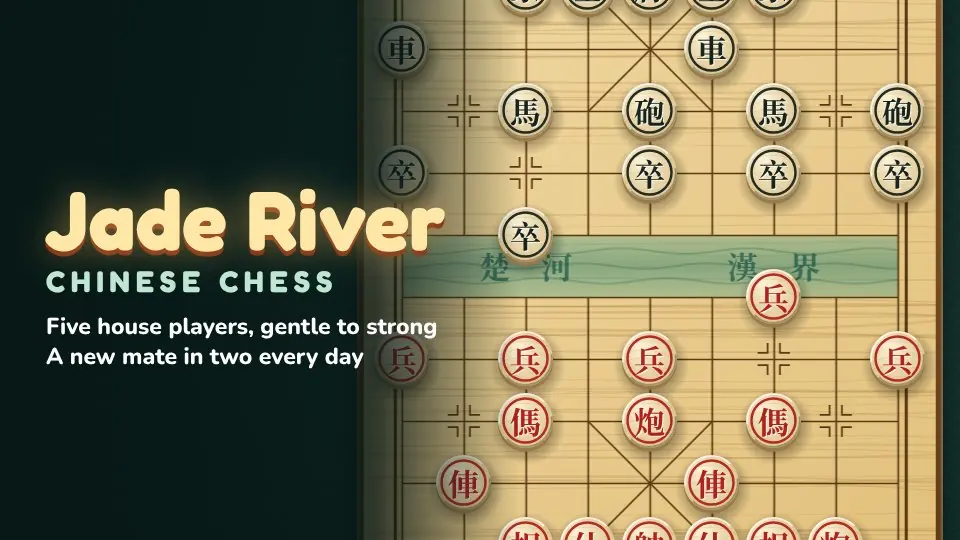
Jade River is our table for anyone who wants to play Chinese chess online, also known as xiangqi. Two armies face each other across a river, cannons jump to capture, and the Generals never leave their palaces. You can play xiangqi against five house players from gentle to strong, share one device with a friend, or solve a new mate in two every day.
This is our guide to playing Jade River Chinese Chess. Want to jump straight in? Play Jade River Chinese Chess right here in your browser.
Quick answers
Does Jade River Chinese Chess work on my phone?
Yes. Jade River Chinese Chess works with touch on phones and tablets, and with a mouse or keyboard on a computer. It runs in the browser you already have, so there is no app to download.
Do I need an account to play Jade River Chinese Chess?
No. Just open it and play, with no sign-up. If you like, a free account (username only, no email, for players 13 and older) puts your scores on the leaderboards and backs up your progress so it follows you to any device.
Is there a daily challenge in Jade River Chinese Chess?
Yes. Jade River Chinese Chess has a new daily challenge every day, the same one for every player, with its own daily leaderboard. Find it alongside the others on our daily challenges page.
Does Jade River Chinese Chess save my progress?
Yes. It saves on this device on its own, so you can close the page and pick up where you left off. Sign in with a free account to keep the same progress on your phone and your computer.
Is Jade River Chinese Chess OK for kids?
Yes, players of any age can enjoy it. There is no chat and no way to message other players, and nobody needs an account to play. Accounts are for players 13 and older, so younger players just play and their progress stays on their device. For ages 4 to 11 we also have learning games in their own kids area, with no ads, no accounts and no tracking.
What is Chinese chess?
Chinese chess, or xiangqi (say it roughly like "shyahng chee"), is one of the most played board games in the world. It is a cousin of western chess: two sides, sixteen pieces each, and the goal is to trap the enemy leader. The feel is different, though. The board is more open, the pieces meet sooner, and games tend to be sharp from the first few moves.
The board has nine lines across and ten lines down, and the pieces sit on the points where lines cross, not inside the squares. A river runs across the middle. Each side has a palace, the small box marked with an X, where its General lives. Red sits at the bottom and always moves first.
If you know western chess, you already know half of it. Our own Kingsway Chess is the place for that game. This guide covers what is different here.
How the pieces move
Jade River offers two looks for the pieces, and you can switch at any time with the button in the top corner. Picture pieces show a crown, a shield, an elephant, a horse, a wheel, a cannon and a soldier in a cone hat. Traditional pieces show the classic characters. Red and Black use slightly different characters for the same piece, which is normal.
| Piece (picture) | Red / Black | How it moves |
|---|---|---|
| General (crown) | 帥 / 將 | One point straight (not diagonal). Never leaves the palace. |
| Advisor (shield) | 仕 / 士 | One point diagonally. Never leaves the palace. |
| Elephant (elephant) | 相 / 象 | Exactly two points diagonally. Cannot cross the river. Blocked if a piece sits on the middle point. |
| Horse (horse) | 傌 / 馬 | One point straight, then one diagonally. Blocked if a piece sits right beside it in that direction. |
| Chariot (wheel) | 俥 / 車 | Any distance in a straight line, like a rook. |
| Cannon (cannon) | 炮 / 砲 | Moves like a Chariot. To capture, it must jump over exactly one piece of either color. |
| Soldier (cone hat) | 兵 / 卒 | One point forward. After crossing the river it may also step sideways. Never backward. |
Three of these surprise chess players. The Horse can be blocked, so a piece next to it can take away two of its moves. The Cannon needs a screen: with nothing to jump, it cannot capture at all, and with two pieces in the way it cannot either. And Soldiers do not promote. A Soldier that reaches the far edge can only shuffle sideways.
The flying General
The two Generals may never face each other along an open line with nothing between them. No move that would leave them staring at each other is allowed. This matters more than it sounds: late in a game your General can guard a whole line from the far side of the board.
Winning, check and draws
- Check means a General is under attack. The side in check must deal with it at once.
- Checkmate means the General is attacked and nothing can save it. That wins the game.
- No legal move also loses. In western chess that would be a draw called stalemate. In Chinese chess the stuck side loses.
- It is a draw after sixty moves each with no capture, or when neither side has a piece left that can cross the river.
Our repetition rule
Tournament xiangqi has pages of rules about repeating moves. We use a short version that keeps the same spirit. When the same position comes up for the third time, the game ends, and we look at how it got there. A side that gave check on every one of its moves in that loop loses. If nobody did, a side that attacked an unguarded piece on every one of its moves in that loop loses. If neither side did either thing, or both did, it is a draw.
The game warns you the second time round, and it will not let you play the move that would lose this way if you have any other move.
Controls
| On | Move a piece | Other |
|---|---|---|
| Phone or tablet | Tap a piece, then tap a green dot or a ringed piece. Dragging works too. | Undo and Hint sit under the board, the menu is in the top corner |
| Mouse | Click a piece, then click where it should go, or drag it | The same buttons |
| Keyboard | Arrow keys move a marker, Enter or Space picks up and puts down | U undo, H hint, Esc menu |
Green dots show where the picked piece can go, and a red ring marks a piece it can take. Gold corners mark the last move. A red glow under a General means check. The dots can be switched off in Settings.
Ways to play
Learn the pieces
New here? The first thing you see is a tiny board with one Chariot and three pieces to take. There are eight of these short lessons, one per piece plus one on checkmate, and each ends with a real capture. Most people finish all eight in a couple of minutes. Already know the game? Skip takes you straight to the title. In your very first game against Bao, the coach also points out three classic opening moves. Follow them or ignore them.
Five house players
| Player | Style |
|---|---|
| Bao the panda | Gentle. Plays loosely and leaves pieces hanging. |
| Momo the monkey | Easygoing. Takes what is loose, wanders the rest of the time. |
| Lian the fox | Looks a move ahead and guards her pieces. |
| Hu the tiger | Plans several moves deep. |
| Long the dragon | Our strongest. Careful, but a good club player can beat him. |
You can play Red or Black against any of them. Undo is free and so are hints. A win earns one star, two if you used three undos and hints or fewer, and three for a clean game with none at all. Against Bao, Momo and Lian the game also speaks up when your last move left a piece hanging, or when one of your pieces comes under attack, so you can take a move back or deal with the threat. Hints come with a short reason, such as stepping out of danger or giving check. After a game against a house player, Look back and learn steps through it and stops on the moments where a stronger move was waiting, with an arrow showing it. Play on from any step starts a practice game from that position, and practice games leave your record as it was.
Two players
Two people can share one phone, tablet or computer and take turns. In Settings you can turn Black's pieces to face the far seat, which is handy with a tablet lying flat between you.
Daily Mate in Two
Every day there is one puzzle, the same for everyone: Red to move and force checkmate in two. Each puzzle has exactly one first move that works, checked by our engine. A perfect solve scores 100. Each miss costs 25 and each hint costs 20. Miss a day and you can still catch up on the last week from the daily strip.
Puzzle Path
Sixty more puzzles to take at your own pace. The first twenty are mate in one, a good warm up after the lessons. The other forty are mate in two. Each solved puzzle is worth a star.
Stars, trophies and jade seals
Stars come from the five house players (up to three each) and from the Puzzle Path, for 75 in all. They feed the stars leaderboard. Sixteen trophies mark the big moments, from your first capture to three stars against all five house players.
Each day brings three small goals, such as capturing with a Cannon twice or solving the daily puzzle. Every goal earns a jade seal, and finishing all three adds two more. Seals unlock new boards: Rosewood at 5, Jade stone at 15 and Night ink at 30. There is no penalty for skipping a day.
Tips for your first games
- Get the Chariots out early. A Chariot stuck in the corner for ten moves is the most common beginner problem. Slide one up or sideways in the first few moves.
- Aim a Cannon at the middle. Moving a Cannon to the central line on move one is the most popular opening for a reason: it eyes the enemy's central Soldier and the General behind it.
- Watch the Horse's legs. Before you count on a Horse move, check the point right beside it. If your opponent's Horse threatens something, sometimes the best defense is to put a piece next to it.
- Count the screens. When a Cannon points at your General with one piece between, that piece is pinned in a new way: moving it away is fine, but a second piece landing on the line switches the threat on and off.
- Keep the Advisors and Elephants at home. They cannot attack, but a General with all four guards is very hard to mate.
- A Soldier across the river is worth two at home. Once it can step sideways, it starts to bother everything near the palace.
- Use your General. In the endgame, sliding your General to an open line can take away the enemy General's escape points because of the flying General rule.
Questions
Is Chinese chess the same as xiangqi?
Yes. Xiangqi is the Chinese name of the game, and Chinese chess is what most English speakers call it. You may also see it called elephant chess.
How is Chinese chess different from chess?
Pieces sit on the points instead of in the squares, a river and two palaces limit some pieces, Cannons capture by jumping, Horses can be blocked, Soldiers never promote, the Generals cannot face each other, and a player with no legal move loses instead of drawing.
Can I play Chinese chess against the computer for free?
Yes. Jade River has five house players, from a gentle panda to a strong dragon. It runs in the browser on a phone, tablet or computer with nothing to download.
I can't read the Chinese characters. Can I still play?
Yes. Picture pieces are the default unless your browser is set to Chinese or Vietnamese, and the name and move of each piece appears when you pick it up. Switch to the traditional characters whenever you like.
Is perpetual check allowed in xiangqi?
No. In Jade River, when a position repeats for the third time, the side that gave check on every move of the loop loses. The game warns you before that happens.
Can two people play on the same device?
Yes. Choose Two players on the title screen and take turns. The game saves itself, so you can come back and continue later.
Can I get a head start against the stronger players?
Yes. On the Who shall we play screen, pick a Horse or Chariot head start and the house player starts without that piece, the traditional way to even up a game. Head start wins are counted on their own, and stars come from even games.
Related guides
 How to play Kingsway ChessChess
 How to play Airscape GoGo
 How to play Crown Jump CheckersCheckers
 How to play Airscape Chinese CheckersChinese checkers
 How to play Sprout ParadeWalker puzzle
More to read
The best chess openings for beginnersStrategy article · Kingsway ChessHow to beat the computer at chess: play into your rival's blind spotsStrategy article · Kingsway ChessGo for beginners: the rules and your first strategyStrategy article · Airscape GoPlay Chess OnlineRules, tips and games like this Two Player GamesRules, tips and games like this
You might also like
Long playSavesKingsway Chess
ChessTravel the Kingsway and beat 30 rivals, up to an opponent no human has beaten. Puzzles, hints and game review, all free.
10 minSavesAirscape Go
GoThe ancient board game of surrounding space, also called weiqi and baduk. Nine short lessons from your first stone, 127 life and death puzzles in five levels, seven house players from brand new to strong, 9x9, 13x13 and 19x19, pass and play, friends online with one room code (one on one, or two pairs taking turns; others can watch) and Daily Puzzles.