
Games / Strategy Games / Airscape Go / Guide
How to play Airscape Go
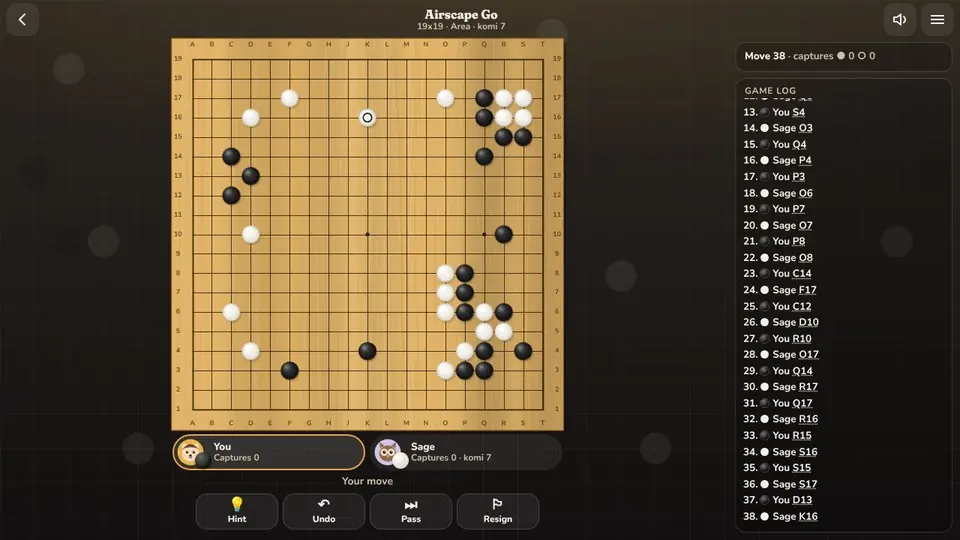
Airscape Go is the ancient board game of surrounding space, also called weiqi and baduk. Learn it from your very first stone in nine short lessons, sharpen your reading with graded puzzles, then play seven house players from brand new to strong, a friend on the same device, or a friend online with one room code.
This is our guide to playing Airscape Go. Want to jump straight in? Play Airscape Go right here in your browser.
Quick answers
Does Airscape Go work on my phone?
Yes. Airscape Go works with touch on phones and tablets, and with a mouse or keyboard on a computer. It runs in the browser you already have, so there is no app to download.
Do I need an account to play Airscape Go?
No. Just open it and play, with no sign-up. If you like, a free account (username only, no email, for players 13 and older) puts your scores on the leaderboards and backs up your progress so it follows you to any device.
Is there a daily challenge in Airscape Go?
Yes. Airscape Go has a new daily challenge every day, the same one for every player, with its own daily leaderboard. Find it alongside the others on our daily challenges page.
Does Airscape Go save my progress?
Yes. It saves on this device on its own, so you can close the page and pick up where you left off. Sign in with a free account to keep the same progress on your phone and your computer.
Is Airscape Go OK for kids?
Yes, players of any age can enjoy it. There is no chat and no way to message other players, and nobody needs an account to play. Accounts are for players 13 and older, so younger players just play and their progress stays on their device. For ages 4 to 11 we also have learning games in their own kids area, with no ads, no accounts and no tracking.
What is Go?
Go is a two player strategy game that has been played for thousands of years. One player has black stones, the other white, and they take turns placing one stone on the board. Stones never move, but they can be captured. Whoever surrounds more of the board by the end wins.
The rules fit on a postcard, yet the game is deep enough to study for a lifetime. That mix is why we built Airscape Go around learning: short lessons first, small puzzles next, and gentle house players for your first real games. It's free, it plays in the browser, and there is nothing to download.
How to play Go
Black moves first. On your turn you place one stone on any empty point where two lines cross, or you pass. Stones go on the points, not in the squares, and once a stone is down it stays where it is unless it gets captured.
Liberties and capturing
The empty points right next to a stone along the lines are its liberties. Stones of one color that touch along the lines form a chain and share their liberties. When you fill the last liberty of an enemy chain, the whole chain is captured and comes off the board as prisoners. A chain with only one liberty left is in atari, which means it can be taken on the next move.
No suicide
You may not play a stone that leaves your own chain with no liberties, unless that move captures something first. Captures always come off before we check your own stones, so a move into a tight spot that takes enemy stones is fine.
Ko
Sometimes one stone captures one stone and the other player could capture straight back, again and again. The ko rule says the second capture has to wait a turn: play somewhere else first, often a threat the other side must answer, then take back if you still can. We also offer a superko option, where no move may ever repeat an earlier whole board position.
Two eyes and life
An eye is an empty point surrounded by your stones. The other side can't play inside it, because a stone there would have no liberties. A group with two separate eyes can never be captured, and a group that can't make two eyes is dead even before it comes off the board. Much of the game is about giving your groups room for two eyes and taking that room away from your opponent.
How the game ends and how scoring works
When neither player has a useful move left, both pass, and two passes in a row end the game. Then we mark the stones we think are dead. You can tap any chain to change that, or choose to play on if you disagree, and once you accept, the count is final.
We support both common ways of counting, and they nearly always pick the same winner:
- Area scoring (Chinese style): the empty points you surround plus your stones on the board. White gets 7 points of komi for moving second.
- Territory scoring (Japanese style): the empty points you surround plus your prisoners, including dead stones. Komi is 6.5.
- Handicap: a weaker player can take 2 to 9 black stones on the star points before the game starts (up to 5 on 9x9). White then moves first and komi drops to half a point.
The end card shows the whole count line by line: territory, stones or prisoners, komi and the totals.
Learn Go in nine lessons
Our lesson path starts with where stones go and ends with your first game. Each lesson is a few small steps on a little board: you tap the liberties of a stone, capture a stone with its last liberty, put a stone in atari and escape from one, chase a stone down a ladder, catch one in a net, kill a group by playing the vital point, make two eyes, try (and fail) to retake a ko, and press Pass to finish a game and count it. The last lesson starts a game against Pip, our gentlest house player.
Life and death puzzles
There are 127 puzzles in five levels, always with Black to play: Seed (captures, ladders, nets and a snapback), Sprout, Sapling, Tree and Old oak. The life and death levels cover straight and bent threes, pyramid fours, bulky fives, flower sixes and harder spaces with stones already inside. Some ask you to kill a white group, others to make your own group live.
Every puzzle's answers come from a full search of the position, so any move that really works is accepted. A wrong move shows how White answers it, then the puzzle resets. After two misses you can ask to see the answer played out.
Daily puzzles and leaderboards
Every day there are five new puzzles, one from each level, the same for everyone in the world and turned or flipped so even a familiar shape looks fresh. Each solved puzzle scores 100 points plus 40 for every level above Seed. A second try halves it, a later try quarters it, a hint costs 30, and quick solves earn up to 40 extra. Your day's total goes on the Daily Puzzles leaderboard once, with a share line of five colored dots.
The second leaderboard is the Ladder. Even 9x9 games against a house player, played without take backs or hints, move your rating up or down, starting from 1000.
The house players
Seven animal friends play on every board size. They think in the background, so the page never freezes while they ponder:
| Player | Level | Ladder rating |
|---|---|---|
| Pip | Brand new | 600 |
| Clover | Beginner | 651 |
| Scamper | Novice | 760 |
| Hazel | Casual | 949 |
| Bramble | Club | 1217 |
| Sage | Strong | 1400 |
| Thistle | Strongest | 1506 |
The stronger ones play out thousands of imagined games before each move, and the steady and strong ones also double check big captures and eye shapes directly. We measured every neighboring pair head to head on 9x9 and set their ratings from the results. Thistle takes a few seconds a move.
Playing on a phone, tablet or computer
On a touch screen, press and slide: a round magnifier floats above your finger and shows exactly where the stone will land, and it goes down when you let go. On 13x13 and 19x19 your first tap zooms into that part of the board, so even the full board is easy to play on a small phone. You can also switch on a confirm tap for every move.
With a keyboard, the arrow keys move a cursor and Enter places a stone. P passes, H asks for a hint, U takes back a move and Z zooms on the big boards.
Modes
Play friends online
One of you hosts and gets a four letter room code, the other types it in. The host picks the board, komi, scoring, handicap and an optional move timer. With four or more in the room, the host can switch to pairs: two teams of two, where partners take turns placing stones and can only talk through reactions, so you learn to read your partner's plan from the board. Anyone else who joins with the code can watch. If a player leaves for good, a house player finishes the game for them (in pairs, the partner plays on alone).
Pass and play
Two people share one device and take turns, with names, any board size and handicap.
Records and review
Every finished game is kept as a record. Step through it move by move, ask us to check your moves, and we mark the ones that lost the most points along with a better choice. You can copy any game out in SGF, the standard file format for Go games, or paste one in to review it.
Go tips for beginners
- Corners first, then sides, then the middle. The edges help you surround space with fewer stones.
- Keep your stones connected. Two weak groups are much harder to look after than one strong one.
- Count liberties before you start a fight. The chain with more liberties usually wins a capturing race.
- If a group of yours is surrounded, look for the vital point that makes two eyes before your opponent takes it.
- Don't chase every stone. Building territory while your opponent runs is often worth more.
- Use the coach notes and the review: they show you which moves cost the most points, which is the fastest way to improve.
Looks and awards
Six boards and three sets of stones are drawn entirely in code: kaya wood with slate and shell stones to start, then Bamboo for your first win, Cherry for finishing the lessons, Walnut for solving a whole puzzle level, Paper for a win on 13x13 and Night for a win on 19x19. River pebbles come with capturing ten stones in one game and Glass with your tenth puzzle. Twenty one awards track the rest, from first steps to beating Thistle in an even game.
Questions
Is Airscape Go free?
Yes. Every lesson, puzzle, board size, house player and mode is free to play in your browser, with nothing to download.
Can I play Go online with a friend?
Yes. One player hosts and shares a four letter room code, the other joins with it on their own device. With four, you can also play in pairs, partners taking turns. Anyone else with the code can watch. No account is needed.
Is Go the same as weiqi and baduk?
Yes. Go is the Japanese name, weiqi the Chinese name and baduk the Korean name for the same game. The rules differ only in small details such as how the score is counted, and we support both area and territory scoring.
I have never played. Where should I start?
Open Learn and go through the nine lessons, which take a few minutes each. The last one starts a game against Pip on the small 9x9 board. After that, the Seed puzzles are a great next step.
Which board size should I play?
Start on 9x9: games are short and every move matters. 13x13 is a good middle step, and 19x19 is the classic full board for long games.
How strong is the strongest house player?
Thistle is the strongest of our seven by a clear margin in our head to head tests, and plays out up to twenty four thousand imagined games for each move on 9x9. On the bigger boards it thinks for about the same time, so it is relatively a little weaker there.
Related guides
 How to play Rosehip ReversiReversi
 How to play TickseedTic Tac Toe
 How to play Mulberry MancalaMancala
 How to play Kingsway ChessChess
 How to play Crown Jump CheckersCheckers
More to read
 Go for beginners: the rules and your first strategyStrategy articleReversi strategy: mobility, corners and quiet movesStrategy article · Rosehip ReversiTic tac toe strategy: never lose, and win more oftenStrategy article · Tickseed
 Backgammon OnlineRules, tips and games like thisMancala OnlineRules, tips and games like this
You might also like
10 minSavesRosehip Reversi
ReversiTrap a line of discs and flip it your way. Five house players up to a strong expert, hints, undo and a game review, pass and play, online with a friend and a Daily Opening.