
Games / Puzzle Games / Tumblegrain / Guide
How to play Tumblegrain
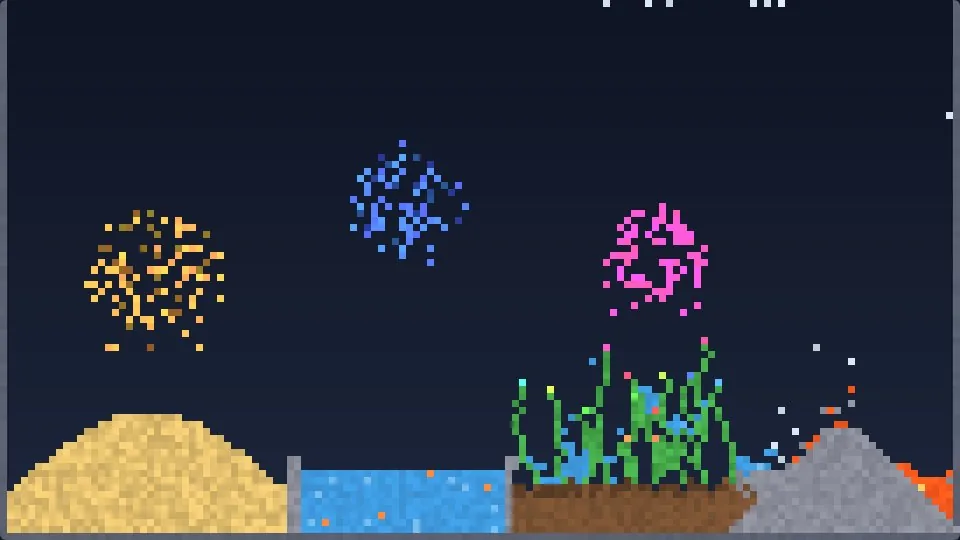
Tumblegrain is a falling sand game. You pour grains into a little world and each one behaves like itself: sand piles, water runs flat, lava creeps, steam rises. Then they start changing each other, and that's where it gets good.
This is our guide to playing Tumblegrain. Want to jump straight in? Play Tumblegrain right here in your browser.
Quick answers
How many players can play Tumblegrain?
Just you.
Do I need an account to play Tumblegrain?
No. Just open it and play. A free account is optional; it adds your scores to the leaderboards and backs up your progress.
Is there a daily challenge in Tumblegrain?
Yes. Tumblegrain has a new daily challenge every day, the same for every player, with its own leaderboard. See every daily on our daily challenges page.
Is Tumblegrain OK for kids?
Yes. Tumblegrain has no chat and no way to message other players, and nobody needs an account to play. Younger kids also have their own learning games.
How it works
Pick something from the tray at the bottom, then press and hold on the world to pour it. That's the whole game. Everything after that is watching what happens and trying the next idea.
There are three ways to play. Experiments give you a goal and a few things to pour. Free play is an empty world with everything you've opened, and it's kept for next time. The Daily Experiment is one a day, the same for everyone.
It's free and plays in your browser on a phone, tablet or computer. There's nothing to download and no account to make.
Controls
- Pour: press and hold on the world. Drag to draw a line of it.
- Tray: tap what you want to pour. The eraser is first.
- Brush size: the dot button at the top goes small, medium, large.
- Stop time: the bars button freezes the world so you can build something carefully, then let it go.
- Start over: the arrow button. In free play it asks twice before it clears your world.
- Keyboard: the arrow keys move the pointer, Space pours, the number keys pick from the tray, and the square bracket keys change the brush.
What things do
| Kind | Examples | How it moves |
|---|---|---|
| Powders | Sand, soil, salt, snow, ash, seeds | Fall and pile up |
| Liquids | Water, oil, lava, honey, acid | Fall, then spread out flat. Lava and honey creep. |
| Gases | Steam, smoke, fire, marsh gas | Rise |
| Solids | Stone, wood, glass, ice, metal, sponge | Stay where you put them |
Heavier things sink through lighter ones. Sand drops through water, and oil floats on top of it.
Reactions worth finding
There are 36 reactions, and the Discovery book keeps each one the first time you make it happen. A few to start with:
- Water on lava makes stone and a puff of steam.
- Steam rises, cools and falls back as rain.
- Soil and water make mud. A seed sprouts in mud, and a growing plant blooms.
- Wood burns slowly down to ash. Ash and water make mud again, so a burned forest can grow back.
- Lava melts sand into glass. So does lightning.
- Salt melts ice and snow, and it disappears into water. Boil the salt water and the salt is left behind.
- Lightning runs along metal, and a charged wire lights whatever it touches.
- A fuse carries fire along slowly. Fire launches firework powder, one rocket for each grain.
When the book shows two colors and the words Something happens with, you have both things open and haven't put them together yet.
Experiments and stars
There are 23 experiments on four shelves: First grains, Hot and cold, Kitchen chemistry and Sparks. Each one has a goal you can see, like filling a jar to the line, putting out a fire before it reaches the cabin, or growing two flowers where there's no soil at all.
Finishing one opens something new for free play, so you start with sand, water and stone and end with fireworks, fuses and fish. The bar at the top fills as you get closer. Use few grains and you earn a star: the result card tells you the number to beat.
Daily Experiment
One a day, laid out from the date so everyone gets the same one. It might be a jar to fill past a row of ledges, a fire to put out, ice to melt or glass to make. Fewest grains wins, and your first finish of the day goes on the leaderboard. You can play it again afterward for practice.
Tips
- Stop time before a tricky build. Lay a fuse or a wire with the world frozen, then start it.
- For a star, use the small brush. The large one spills.
- Fire rises. Light things from underneath or hold the flame right on them.
- Water runs along anything flat and drops off the edge, so a ledge can carry it where you can't pour.
- Lava keeps sinking through the glass it makes, so one pour on top of a sand bed turns a lot of it.
- To put out a fire, aim at the edge that is spreading, not the part that has already burned.
- In free play, build a stone bowl first. Liquids are much easier to enjoy when they stay put.
Questions
Is Tumblegrain free?
Yes. It's free, with nothing to download and no account needed.
What is a falling sand game?
A game where the screen is a grid of tiny grains. Each kind follows simple rules, like sand falling and water spreading, and the fun is in what they do together.
How do you get more elements?
Finish experiments. Each one opens one or two new things for free play, from soil and seeds to lightning and fireworks.
Does it save the world you build?
Yes. Your free play world is kept on your device and is waiting the next time you open the game.
Does it work on a phone?
Yes. Press and hold to pour, and swipe the tray to see everything you have. It works upright or sideways.
How do you make glass?
Pour lava on sand, or strike sand with lightning.
Behind the scenes: how Tumblegrain was made.
Related guides
 How to play Airscape FarmFarm and town builder
 How to play Linden LookoutHidden object
 How to play Copper Pot KitchenCooking
 How to play Alpha RainFalling letters
 How to play GlintfallFalling blocks
More to read
Hidden object game tipsStrategy article · Linden LookoutCooking game tips: how to get three stars every timeStrategy article · Copper Pot KitchenHow to get better at falling letters word gamesStrategy article · Alpha Rain Sand gamesRules, tips and games like this
 Physics GamesRules, tips and games like this