
Games / Tumblegrain / How it was made
How Tumblegrain Was Made
Falling sand games are wonderful toys: pour sand, water, fire and lava into a box and watch them tumble, flow and react. They can also feel aimless after a few minutes. Tumblegrain is our attempt to keep the wonder and add a reason to keep pouring.
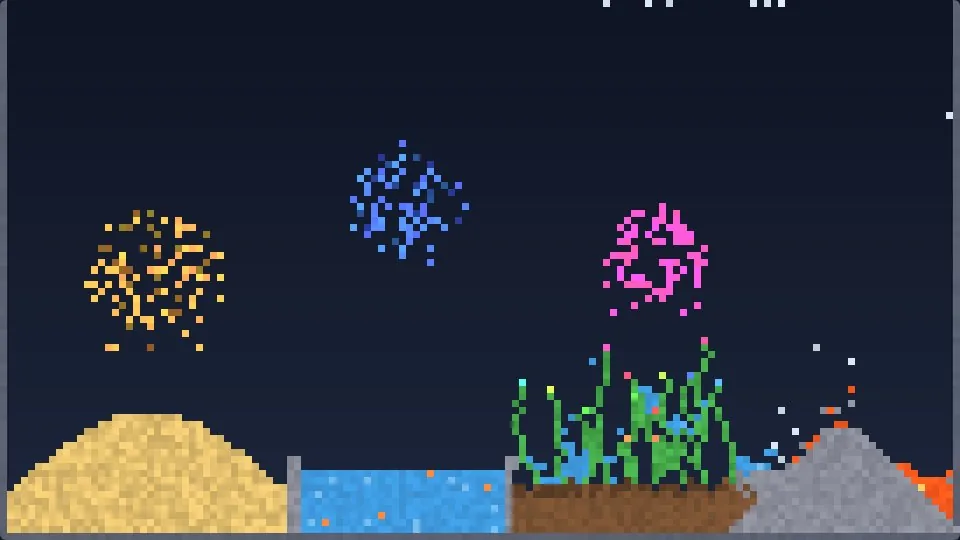
What we learned from the genre
We read reviews of the best known sand games. Players love the variety, the realistic way things pile and pour, and above all chain reactions: fire spreading along wood, acid eating through a wall, lava turning sand into glass. The most common complaint was the opposite side of that freedom: you open the game into an empty box with hundreds of choices, no idea where to start and nothing to achieve.
So Tumblegrain starts small and friendly, with sand, water and stone, and adds 23 experiments, each with a goal, the tools it allows and something new it opens when finished. A book of reactions fills up as we discover them, and a Daily experiment is the same for everyone. We kept the tone cozy: fireworks and volcanoes, no bombs.
How the grains work
The world is a grid of about ten thousand little cells. Each cell holds one kind of thing, and every tick it follows a few simple rules: sand falls and piles, water flows sideways, steam rises, fire tries to spread to whatever it touches. What happens when two kinds meet lives in one table of pairs, so water on fire makes steam, lava on sand makes glass and seeds in wet soil sprout. Everything is seeded, so the same start always gives the same world, which is what lets the Daily be the same for everyone.
When the experiments argued back
Writing a solution for every experiment and running it through the real rules found problems we would never have spotted just by playing. Water in this kind of world has no pressure, so it never rises in a second chamber, and an experiment about water finding its level could not be done; it became one about water finding a way along a lid and off its edge. Mud sealed the soil under it, so water now seeps through mud. Flames floated away before wood could catch, so a flame now always tries what it sits on first. A burning log spread fire as fast as a flame, which made fires impossible to put out, so glowing logs now pass fire on more slowly. Lava cooled before it could make glass, plants under water drank the whole tank, and a fuse could break its own chain. Each fix made the world feel more like it should.
Proving every star is possible
Every experiment has a written solution that the tests play through on three different seeds, and the target for its star is set a little above what that solution uses, so every star is proven reachable. Another set of checks makes sure sand piles, things float and burn as expected, glass forms, rain falls and a saved free play world loads back exactly.
Free play is still there
For anyone who just wants to pour and watch, free play is an empty world with everything we have opened so far, from sand and water all the way to fireworks, fuses and fish, and it is kept for next time. Tumblegrain is free in the browser, works with a finger on a phone or a mouse on a computer, and we will keep adding experiments as we see which ones players enjoy.