
Games / Puzzle Games / Ten Spot Match / Guide
How to play Ten Spot Match
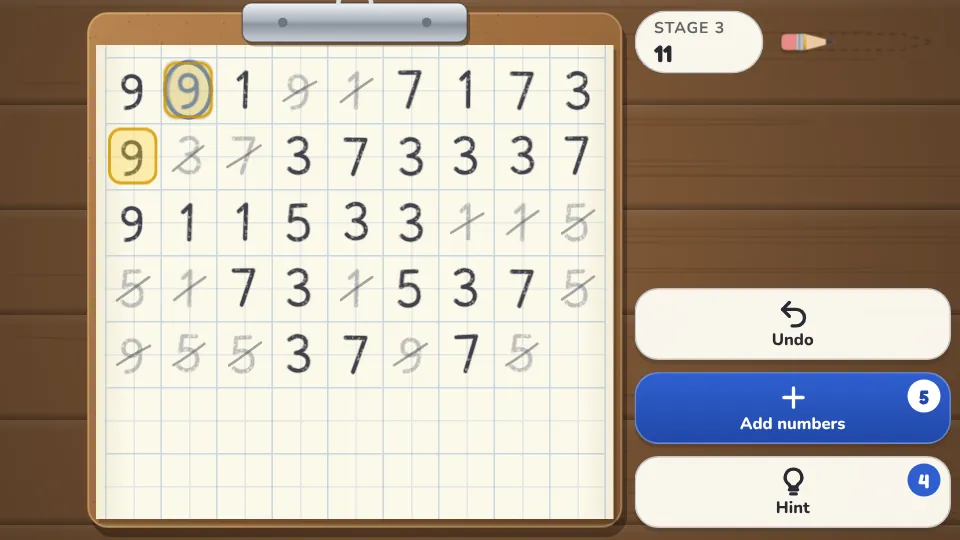
A number match game on a sheet of graph paper: cross out pairs of numbers that are the same or add up to ten, and keep going until the page is clear.
This is our guide to playing Ten Spot Match. Want to jump straight in? Play Ten Spot Match right here in your browser.
Quick answers
Does Ten Spot Match work on my phone?
Yes. Ten Spot Match works with touch on phones and tablets, and with a mouse or keyboard on a computer. It runs in the browser you already have, so there is no app to download.
Do I need an account to play Ten Spot Match?
No. Just open it and play, with no sign-up. If you like, a free account (username only, no email, for players 13 and older) puts your scores on the leaderboards and backs up your progress so it follows you to any device.
Is there a daily challenge in Ten Spot Match?
Yes. Ten Spot Match has a new daily challenge every day, the same one for every player, with its own daily leaderboard. Find it alongside the others on our daily challenges page.
Does Ten Spot Match save my progress?
Yes. It saves on this device on its own, so you can close the page and pick up where you left off. Sign in with a free account to keep the same progress on your phone and your computer.
Is Ten Spot Match OK for kids?
Yes, players of any age can enjoy it. There is no chat and no way to message other players, and nobody needs an account to play. Accounts are for players 13 and older, so younger players just play and their progress stays on their device. For ages 4 to 11 we also have learning games in their own kids area, with no ads, no accounts and no tracking.
A number match game you can play in your browser
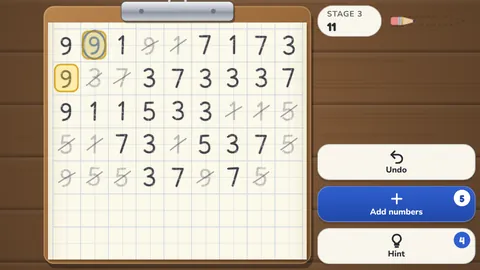
Ten Spot Match is our number match game. It comes from an old pencil and paper pastime: write out rows of digits, then cross them out two at a time. Two numbers go together when they're the same (7 and 7) or when they add up to ten (3 and 7). Clear every number and the page is done.
It plays on a phone, tablet or computer with nothing to install. The page is drawn as graph paper on a clipboard, with pencil digits and a yellow pencil along the top that grows as the page clears. There's a dark chalkboard look in Settings if you play at night.
Every board we deal is checked first. It starts with at least six pairs to find, and our own solver has cleared it within the five adds you get, so a board is never hopeless before you touch it.
How it works
The board is nine squares wide. Tap one number, then tap its partner. If they make a pair, both are crossed out and stay on the page as faint marks. If they don't, both squares shake once and nothing is lost. There's no penalty for a wrong guess.
When a whole row is crossed out, it slides away and the rows below move up. That matters, because rows that weren't neighbors before can become neighbors.
The rules, in order
- What makes a pair. Two numbers that are the same, or two numbers that add up to ten: 1 and 9, 2 and 8, 3 and 7, 4 and 6, 5 and 5.
- Touching pairs. The two squares can sit side by side, one above the other, or corner to corner on a diagonal.
- Pairs across a gap. They can also be farther apart in a straight line (across, down or diagonal) as long as every square between them is crossed out.
- The row end rule. The last number of one row connects to the first number of the next row, as long as only crossed-out squares lie between them. More on this below.
- Cleared rows leave. A row with every square crossed out is removed and the rows below move up.
- Add numbers. This writes every number still on the page again, in the same order, starting right after the last number. You get five on each board.
- Winning and losing. Cross out every number to clear the board. A Classic game ends when no pairs are left and no adds are left.
The row end rule, explained
This is the rule new players miss most often. Read the board the way you read a page of a book: left to right, then down to the start of the next line. Two numbers that are next to each other in that reading order are connected, even when one sits at the far right of a row and the other at the far left of the row below.
Picture a row that ends in 3, and the next row beginning with 7. They look far apart, on opposite edges of the page. But in reading order the 7 comes straight after the 3, so they pair up, because 3 and 7 make ten.
Crossed-out squares don't get in the way. If a row ends 6, then two crossed-out squares, and the next row starts with a crossed-out square and then a 4, the 6 and the 4 still connect: nothing but crossed-out squares lies between them. The first time a pair like this is available, the game points it out with a small hand.
Scoring and stages
| What you did | Points |
|---|---|
| A pair that touches | 1 |
| A pair across a gap, in a straight line | 2 |
| A pair around the end of a row | 4 |
| Clearing a row | 10 |
| Clearing the whole page | 150 |
| Each Add numbers you didn't use (Classic) | 60 |
| A page cleared with no Add numbers at all (Classic) | 100 more |
One rule keeps the score honest: adding never earns points. Pairs and rows score only for as many numbers as the page started with. A page that starts with 36 numbers pays for 18 pairs and 4 rows, and whatever Add numbers writes again scores nothing. So the big points are the 150 for the page and the bonus for the adds you kept.
In Classic, the boards grow. The first three are gentle: three, four and five rows that use only 1, 3, 5, 7 and 9, so partners are everywhere. Stage 4 brings in 2 and 8, and from stage 5 every digit is in play, one more row each stage up to nine. Each new board comes with five fresh adds, and one hint comes back, up to five. Your score carries on from stage to stage, the game ends on a board you can't clear, and the score goes on the best score leaderboard.
Hints, undo and the three modes
Hint lights up one pair. You get five per game and earn one back with each cleared board. Undo steps back one move at a time, as far as you like, and it can take back Add numbers too, which is handy if you tapped it by accident. If you run out of pairs and adds, the game offers to step back so you can try another way before you decide to finish.
Daily Board is one board that's the same for everyone on the same day, changing at your own midnight. It's ranked by the fewest adds first, then the fastest time. The house players on its leaderboard post honest, modest results, and a careful player can beat them. Relaxed has no limits on adds or hints and no leaderboard, for when you just want to cross things out. The Stats page keeps your games, best score and boards cleared.
On a computer, the arrow keys move around the board and Enter picks a number. A adds numbers, H gives a hint, U undoes and P pauses.
When to add numbers
Later than you think. Add numbers copies everything that's left, so every number you could have crossed out first gets written again and has to be dealt with twice. Before you tap it, check the whole page once more: the diagonals, the gaps, and both ends of every row.
The best moment is when the page is truly out of pairs. The game tells you so in words and the button glows. Adding with only a few numbers left is cheap. Adding with forty left doubles your work, and none of the copies score. In Classic every add you don't use is worth 60 points when the page clears, and clearing a page with none at all earns 100 more.
Five tips
- Scan in more than one direction. Most people read along the rows and stop. Run your eye down each column and along the diagonals as well. Half the pairs on a fresh board are there.
- Look past the crossed-out squares. Every pair you clear opens a lane. After each move, check what the two squares you just cleared were standing between.
- Check the row ends. The last number of each row and the first number of the next are neighbors. Those pairs score 4 and are the easiest to overlook.
- When you have a choice, keep your options. If a 6 could go with either of two 4s, take the one that leaves the other 4 with a partner. Near the end, work out the order before you tap: with six numbers left there's usually one order that clears them all.
- Finish rows. A row that's nearly crossed out is worth finishing. It's 10 points, and when it leaves, the rows above and below it meet and new pairs appear.
Getting better
Once the scanning is quick, the game becomes one of order. Every number has only so many partners, and each pair you take changes who can reach whom. Before you take an easy pair, ask what it leaves behind: a 3 that could have gone with either of two 7s is fine, but a 7 whose only 3 you just used will sit there until the next add.
Count partners near the end. Numbers pair inside five groups: 1 with 9, 2 with 8, 3 with 7, 4 with 6, and 5 with 5. If a group has an odd count, one of its numbers can't be cleared without Add numbers, so plan to add once and make that add count. Apart from the very first practice board, our Classic boards start with an even count in every group, which means a clean page with no adds is possible in principle, and that's where the 100 point bonus comes from.
Use Undo as a tool, not an apology. It's free and unlimited, so when a page dries up with a few numbers stranded, step back five or six moves and try the other order. The Daily Board is the place to practice this: it ranks by fewest adds first, and our own best line for the day is shown when you finish.
More number puzzles from us
If you like quiet number puzzles, try Ninebark Sudoku for classic nine by nine logic, Cagewise for cages with a little arithmetic, or Sumleaf Kakuro for cross sums.
Questions
How do you play a number match game?
Tap two numbers that are the same or add up to ten. They have to touch (side by side, up and down, or diagonally), or have only crossed-out squares between them in a straight line or in reading order. Clear every number to win.
Can numbers match across rows?
Yes. The last number of one row pairs with the first number of the next row when only crossed-out squares lie between them. Numbers also match straight down a column and along diagonals.
When should I add numbers?
Only when you can't find another pair. Add numbers copies everything left on the page, so clearing all you can first keeps the board small. You get five adds on each board, the copies score nothing, and unused adds are worth 60 points each in Classic.
Does adding numbers give more points?
No. Pairs and rows score only for as many numbers as the page started with, so numbers written by Add numbers score nothing. The points are in clearing the page with as few adds as you can.
Is every board possible to clear?
Yes. Before a board is dealt, our solver has cleared it within the five adds (Classic boards within three), and it starts with at least six pairs. Clearing it yourself still takes care, and the order you choose matters.
Can two people play Ten Spot Match?
It's a one player puzzle, but the Daily Board is the same for everyone each day, so two people can each play it and compare adds and times.
Is Ten Spot Match free?
Yes. Classic, the Daily Board, Relaxed mode, hints and undo are all free in your browser, with no download.
Related guides
 How to play Ninebark SudokuSudoku
 How to play CagewiseMath logic puzzle
 How to play Sumleaf KakuroKakuro
 How to play Trinket TrioMatch 3 tiles
 How to play Dewdrop DellMatch 3
More to read

You might also like
10 minSavesNinebark Sudoku
SudokuClassic sudoku from Easy to Master, rated by the techniques each puzzle needs. Hints that explain the next step, notes, unlimited undo and a daily sudoku with streaks.