
Games / Puzzle Games / Sum Sprout / Guide
How to play Sum Sprout
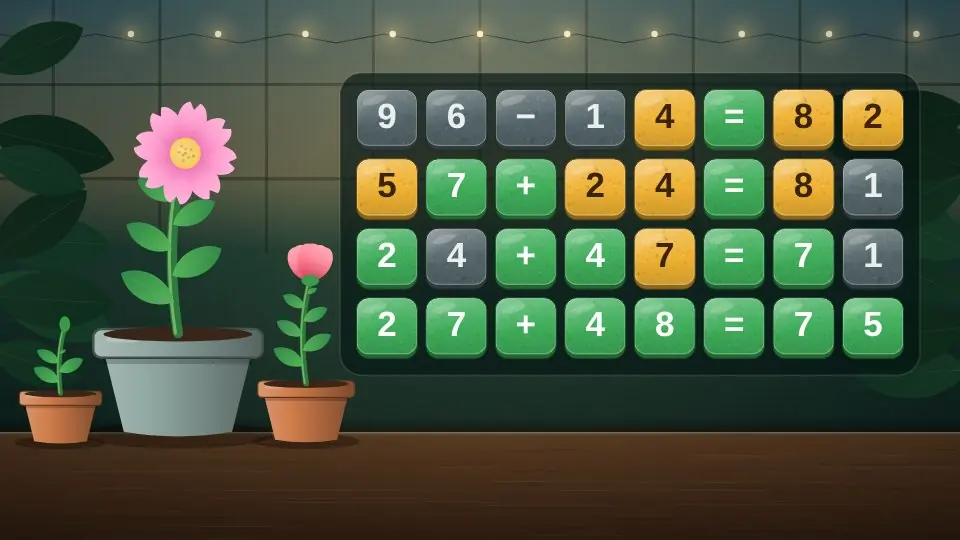
Sum Sprout is a daily math puzzle and equation guessing game. A sum like 12+35=47 hides behind eight tiles, you get six tries to find it, and every guess turns the tiles green, gold or gray to point the way.
This is our guide to playing Sum Sprout. Want to jump straight in? Play Sum Sprout right here in your browser.
Quick answers
Does Sum Sprout work on my phone?
Yes. Sum Sprout works with touch on phones and tablets, and with a mouse or keyboard on a computer. It runs in the browser you already have, so there is no app to download.
Do I need an account to play Sum Sprout?
No. Just open it and play, with no sign-up. If you like, a free account (username only, no email, for players 13 and older) puts your scores on the leaderboards and backs up your progress so it follows you to any device.
Is there a daily challenge in Sum Sprout?
Yes. Sum Sprout has a new daily challenge every day, the same one for every player, with its own daily leaderboard. Find it alongside the others on our daily challenges page.
Does Sum Sprout save my progress?
Yes. It saves on this device on its own, so you can close the page and pick up where you left off. Sign in with a free account to keep the same progress on your phone and your computer.
Is Sum Sprout OK for kids?
Yes, players of any age can enjoy it. There is no chat and no way to message other players, and nobody needs an account to play. Accounts are for players 13 and older, so younger players just play and their progress stays on their device. For ages 4 to 11 we also have learning games in their own kids area, with no ads, no accounts and no tracking.
What is an equation guessing game?
It's the number cousin of the five letter word puzzle. Instead of a hidden word, a hidden equation sits behind a row of tiles. You type any true sum that fills the row, press Enter, and the colors tell you how close you were. Six tries, one answer, and the same daily math puzzle for everyone who plays that day.
The arithmetic is never hard. The answers use whole numbers and the four basic signs, so the real puzzle is logic: which digits are in, which are out, and where does the equals sign sit? Sum Sprout is free and plays in the browser on a phone, tablet or computer, with nothing to download.
How to play
Tap the big keypad to fill a row with a sum that balances, so the left side really does make the right side. Then press Enter. Each tile flips to one of three colors:
- Green: that number or sign is in the answer and in the right spot.
- Gold: it's in the answer, but in a different spot.
- Gray: it's not in the answer, or there are no more of it.
The keypad keeps score for you. Keys turn green, gold or gray as you learn about them, so one glance shows which digits are still worth trying. Tiles you've already turned green wait faintly in the next row. Type the whole sum as usual: the same key passes over a waiting tile and a different key replaces it. You can also tap any tile to move the cursor there, and waiting tiles you never reach still count when you press Enter.
If a guess doesn't balance, nothing is lost. The row gives a small shake and a note under the tiles says why, for example "12+35 makes 47, not 48". Fix it and try again. It doesn't cost a try.
Rules for a fair guess
Any true equation that fills the row is accepted, including ones the hidden sum would never be, such as 47=12+35 or 13+4=9+8. That freedom is handy for testing digits. A few things are turned away, each with a plain reason:
- A row with empty tiles, no equals sign, or more than one equals sign.
- Two signs side by side, or a sign at the very start or end.
- A number that starts with zero, like 07.
- Dividing by zero.
- A sum that doesn't balance.
Multiplying and dividing happen before adding and subtracting, and after that we work from left to right. So 2+3×4 makes 14, not 20.
What the hidden sum always looks like
The answers follow stricter rules than the guesses, which helps you narrow things down. There is exactly one equals sign with a single number after it. No number starts with zero and no number is zero by itself, though zeros inside numbers such as 50 or 108 are fine. Nothing is multiplied or divided by 1. Every step along the way is a whole number above zero, so you'll never need fractions or negatives. Classic answers have at least five different symbols, and they never ask for awkward division: a two digit divisor is always 10, 11, 12, 15, 25 or a round number like 30.
Swapped orders count
If the answer is 12+35=47 and you enter 35+12=47, you've found the same sum, and we count it as solved. The same goes for swapped numbers in a multiplication. It would be a shame to lose a try to a coin flip.
How repeated numbers are colored
This is the rule people ask about most. Colors are handed out one copy at a time. Say the answer has a single 5 and your guess has two. If one of your 5s is in the right spot, it turns green and the other turns gray, because the answer has no more 5s to give. If neither is in the right spot, the first one turns gold and the second turns gray.
So a gray tile doesn't always mean "never". When the same digit shows green or gold elsewhere in the row, gray means "no more of these". Two golds for the same digit mean the answer holds at least two.
Three sizes every day
| Size | Tiles | Signs | Example |
|---|---|---|---|
| Classic | 8 | + − × ÷ | 9×6−9=45 |
| Gentle | 6 | + − × ÷ | 3×8=24 |
| Seedling | 5 | + and − only | 9−6=3 |
All three are new each day and the same for everyone. Classic is the main event, with one or two signs on the left side. Gentle is a quick warm up with times tables and small sums. Seedling keeps to single digits with adding and taking away, which makes it a nice one to share with a child who is learning number facts.
The day changes at midnight where you are. Classic sums don't come back for years, and Gentle sums wait at least 200 days before returning. Seedling has only 72 possible sums in the world, so those come around again after about seven weeks. We also keep number families apart: the same set of numbers in any arrangement (14÷2=7 and 2×7=14, say) stays at least two weeks away in Gentle and Seedling and a month away in Classic.
The balance helper and the lamp
Under the tiles, the balance helper shows what the left side makes as you type, and tells you when the whole row balances. After each guess it also says how many sums still fit every color so far (Settings can turn that off). It takes the mental arithmetic off your plate so you can think about the logic. You can switch it off in Settings if you'd rather work it out yourself.
The lamp button at the top turns one tile green for you. Classic gives you two lamps per puzzle and the smaller sizes give one. On a daily puzzle each lamp costs 50 points, and a small lamp shows up beside your result when you share it. Sharing sends the size, how many tries you took and your rows of colored squares, never the sum.
Points, the garden and the archive
A daily solve scores points for every try you didn't need: 100 per unused try in Classic, 60 in Gentle and 40 in Seedling, counting the winning try as unused. Solving Classic on the third guess is worth 400. Your three sizes add up to one score for the day on the daily leaderboard, to a best possible 1,200. Only sums finished on their own day count. One finished after midnight, or played from the Archive, still grows a flower but earns no points.
Every solve also grows a flower. The sprout in the corner gets taller as you find green tiles and blooms when you finish, and the flower moves to a shelf in your Garden. Fewer tries grow a bigger bloom. An unsolved sum stays a sprout, with no penalty beyond that.
The Archive is a calendar of every past day in all three sizes, so a missed day is never gone. Practice deals fresh sums whenever you want more, and after any practice sum, Challenge a friend sends them the same sum as a link (never the answer) with your number of tries to beat. The flowers come in ten kinds, from daisies to sunflowers, and there are fifteen seed packets to earn, for things like solving in three tries, finishing all three sizes in one day, or solving on seven different days. A run of days in a row is shown quietly on the home screen, and nothing is taken away if you skip one.
Tips and strategy
- Open wide. A good first guess uses many different digits and a sign you haven't tested. 48−32=16 tries six digits in Classic. Follow it with something built from the other four, such as 95−20=75.
- Find the equals sign early. In Classic it sits in the fifth, sixth or seventh tile. Its spot tells you how long the answer is: an answer with three digits means a big product or a sum over 99.
- Let the signs split the puzzle. A gray + and a gray − leave only × and ÷. A green × with a three digit answer means a two digit number times one digit.
- Use the last digit. In an addition, the last digits of the two numbers decide the last digit of the answer. If you know the answer ends in 7, the pairs that work are few.
- Spend a guess to learn. When four answers still fit, a guess that can't be right but tests the digits that differ often solves it a try sooner than hoping.
- Remember the answer rules. No leading zeros and nothing times 1. A gold 0 can only be the second or third digit of a number.
- Read gold carefully. A gold tile rules out that spot. Two guesses with the same gold digit rule out two spots, which often leaves only one home for it.
Controls
On a phone or tablet, everything is on the keypad: digits on the left like a calculator, signs down the right side, and a wide Enter key. On a computer you can type on the keyboard. Use * or x for times, / for divide, Enter to check, Backspace to delete and the arrow keys to move the cursor. Esc opens the menu.
Settings has a color friendly mode that swaps green and gold for blue and orange and adds a small mark to every colored tile. Regulars who want a stiffer test have two switches: Sharp tries gives five tries instead of six and keeps its own line in the stats, and Strict rows makes every guess use what the colors have already shown. If you like this kind of puzzle with letters, try Letter Lantern, and for number logic on a grid there's Cagewise.
Questions
Is Sum Sprout free?
Yes. It's free to play in your browser on a phone, tablet or computer, with no download and no sign up needed.
What is a good first guess for a daily math puzzle?
One that uses many different digits. In Classic, 48−32=16 tests six digits and the minus sign. In Gentle, 3×8=24 is a strong start, and in Seedling 4+1=5 works well. New players get a suggested starter under the tiles.
Does 35+12=47 count if the answer is 12+35=47?
Yes. The same sum in another order counts as solved, for both adding and multiplying.
Why did one of my two matching digits turn gray?
Colors are given one copy at a time. If the answer has only one of that digit, one of yours turns green or gold and the extra one turns gray.
Does a rejected guess use up a try?
No. If a row doesn't balance or breaks a rule, we explain why and you keep all your tries.
Can I play past puzzles?
Yes. The Archive has every past day in all three sizes, and Practice has as many fresh sums as you like.
Related guides
 How to play Letter LanternDaily word
 How to play CagewiseMath logic puzzle
 How to play Ninebark SudokuSudoku
 How to play Poker GridCard puzzle
 How to play Doubloom2048 Number Puzzle
More to read
Daily word puzzle strategy: solve it in fewer guessesStrategy article · Letter LanternSudoku techniques, from hidden singles to X-wingsStrategy article · Ninebark SudokuMerge number puzzle strategy: corner, chain and recoverStrategy article · Doubloom Riddles With AnswersRules, tips and games like this
 Number GamesRules, tips and games like this