
Games / Puzzle Games / Crossroads Math / Guide
How to play Crossroads Math
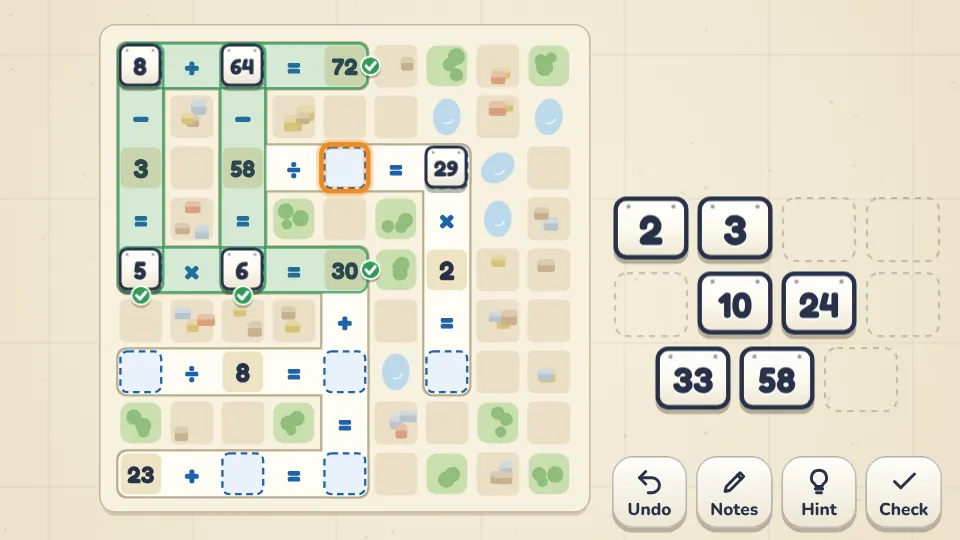
Our math crossword puzzle is drawn as a small-town street map. Every street and avenue is an equation with a few empty parking spots, and you park the number tiles from the tray so that every crossing equation comes out true.
This is our guide to playing Crossroads Math. Want to jump straight in? Play Crossroads Math right here in your browser.
Quick answers
Does Crossroads Math work on my phone?
Yes. Crossroads Math works with touch on phones and tablets, and with a mouse or keyboard on a computer. It runs in the browser you already have, so there is no app to download.
Do I need an account to play Crossroads Math?
No. Just open it and play, with no sign-up. If you like, a free account (username only, no email, for players 13 and older) puts your scores on the leaderboards and backs up your progress so it follows you to any device.
Is there a daily challenge in Crossroads Math?
Yes. Crossroads Math has a new daily challenge every day, the same one for every player, with its own daily leaderboard. Find it alongside the others on our daily challenges page.
Does Crossroads Math save my progress?
Yes. It saves on this device on its own, so you can close the page and pick up where you left off. Sign in with a free account to keep the same progress on your phone and your computer.
Is Crossroads Math OK for kids?
Yes, players of any age can enjoy it. There is no chat and no way to message other players, and nobody needs an account to play. Accounts are for players 13 and older, so younger players just play and their progress stays on their device. For ages 4 to 11 we also have learning games in their own kids area, with no ads, no accounts and no tracking.
How it works
Crossroads Math is a math crossword puzzle, sometimes called a cross math puzzle: a grid of short equations that cross each other the way words do in a crossword. It's free and it plays in your browser on a phone, tablet or computer, with nothing to download.
Streets read left to right and avenues read top to bottom. Some numbers are printed on the map. The rest are missing, and each missing number is an empty parking spot with a dashed blue outline. The tray under the map holds one license-plate tile for every spot. Your job is to park every tile so that each street and each avenue is a true equation. A number that sits at a crossing has to work in both.
Every puzzle has exactly one answer. We don't take that on trust: our solver tries every way of parking the tiles and a puzzle only ships when it finds one way and no more. So you never need to guess between two answers that both look right.
The rules in order
- Tap an empty parking spot, then tap a tile in the tray. The tile parks there. You can also tap the tile first and the spot second, or drag the tile onto the spot.
- Tap a parked tile to send it back to the tray. A tile dropped anywhere off the map also goes back. No tile is ever lost.
- Every tile is used exactly once, and every spot takes one tile.
- A street shows a small green check sign at its end when its equation is true. A street that is full but not true gets a soft amber line. A street with an empty spot shows nothing.
- There's no penalty for a wrong try. Park, look, take it back.
- The puzzle is finished when every street and avenue is true.
If you'd rather not be told as you go, turn off Street signs in Settings. That's the purist way to play: the map stays quiet until it's finished. The setting is remembered. The Daily Crossroads always plays this way.
Notes, Undo, Hint and Check
Notes lets you pencil up to four small numbers into an empty spot: tap Notes, tap a spot, then tap the tiles you're considering. Undo takes back your last move. Hint parks one correct tile on the spot you could work out next and tells you why, and that tile stays put (Undo starts again from there). Check marks every tile that is in the wrong spot. Hints and checks are counted on the result card, and a puzzle solved with neither earns a gold star in its pack.
How order of operations is handled
Most equations here have one sign, like 6 + 7 = 13 or 42 ÷ 6 = 7, so there's nothing to decide. The Expert pack adds longer equations with two signs, like 12 × 6 ÷ 8 = 9. For those we use one rule everywhere: work the equation left to right, exactly as written. So 12 × 6 comes first (72), then 72 ÷ 8 gives 9.
We also build the longer equations so that this rule can never disagree with what school teaches. A longer equation only mixes plus with minus, or times with divide. It never puts a plus next to a times. With signs of the same rank, the school order of operations is left to right too, so both ways of reading give the same answer. A student who has learned that multiplication comes before addition won't be tripped up by anything on our maps.
Two more promises keep the arithmetic friendly. Nothing ever goes below zero, not even partway through a longer equation. And every division comes out whole, with no remainders and no dividing by zero.
Packs and the Daily Crossroads
| Pack | Map | What's in it |
|---|---|---|
| Easy | 5 by 5 | Plus and minus, numbers to 20 |
| Medium | 7 by 7 | Times joins in, numbers to 50 |
| Hard | 9 by 9 | All four signs, numbers to 81 |
| Expert | 11 by 11 | Longer equations, numbers to 99 |
Each pack has 200 puzzles and all four packs are open from the start, so you can begin wherever the arithmetic feels right. Inside a pack the puzzles get harder gradually. We grade them by how they solve, not just by size: early puzzles can be finished one easy step at a time, and later ones make you compare two crossing equations before any tile is certain.
The Daily Crossroads gives everyone the same three fresh maps each day: a Short Trip (7 by 7), a Day Trip (9 by 9) and a Road Trip (11 by 11). Each trip has its own board. You start with 3,600 points and lose one for every second. The Daily has no street signs: streets don't turn green or amber, so the map has to be worked out rather than guessed. On the Daily, Check works once every spot is full, and adds 10 seconds plus 30 for every tile it marks wrong; hints add 60 seconds, then 90, 120 and so on. The map stays hidden until you tap Start, and from then the clock runs in real time until the map is done, even if you pause or leave the page. The added time shows on the clock as you play, so a time on the board always means the same thing.
Solving tips
Start with equations that have one blank
A street with a single empty spot is a plain sum. If it reads 6 + ? = 13, the answer is 7, so find the 7 in the tray and park it. Every tile you park may leave a crossing avenue with just one blank of its own. In the Easy pack you can often ride that chain all the way to the end.
Work backward from the answer
When the blank is the first number, turn the equation around. For ? − 9 = 15, add: the blank is 24. For ? ÷ 4 = 6, multiply: the blank is 24 again. Subtraction undoes addition and division undoes multiplication, and using that is quicker than trying tiles.
Let the tray narrow it down
When a street has two blanks, lots of pairs would make it true, but only pairs you actually hold can be the answer. For ? × ? = 36 with a tray of 4, 5, 9 and 20, it has to be 4 and 9. The tray is as much a clue as the map.
Read the crossing
Knowing it's 4 and 9 doesn't say which goes where. Look at the avenue through each spot. If one of them reads ? + 11 = 20, that spot is the 9. From the Hard pack on, most puzzles have a few spots like this, where neither equation settles it alone but the two together do.
Use notes for the maybes
If a spot could be 4 or 9, pencil both in and move on. When a tile gets parked somewhere else, the note tells you what's left without working it out again.
Big and odd tiles first
A 96 or a 71 can only live in a few places: the answer of a multiplication, the start of a subtraction or a division. Place the awkward tiles early and the small ones sort themselves out.
Getting better
Speed here comes from number facts, not from fast fingers. If the times tables to 9 × 9 are solid, the Hard pack opens up, because you start to see 56 and think 7 and 8 without stopping. The Easy pack is honest practice for addition and subtraction within 20, and Medium brings in multiplication a little at a time.
We tested the puzzles with robot players. One that reasons like a careful person, taking one-blank equations first and then crossings, finishes every puzzle. In the packs the street signs are a friendly helper, and a patient player could lean on them to guess their way through. That's why the Daily turns them off and only checks a full map: there, robots that guess, or do the easy sums and guess the rest, reach the best house score on fewer than 2 days in 100, while the careful robot beats it on most days. On the boards, thinking wins.
When a puzzle stalls, resist the Hint for one more minute and count the blanks on every street again. There is nearly always one street with a single blank that you walked past.
Questions
How do you solve a math crossword puzzle?
Start with any equation that has only one number missing and work it out. Park that tile, then look at the equations that cross it, because one of them often has a single blank now. When no equation has just one blank, find a spot where only one of your remaining tiles makes both of its equations work.
Does Crossroads Math follow the order of operations?
Yes. Longer equations are worked left to right as written, and we only mix plus with minus or times with divide inside one equation. For those pairs the standard order of operations is also left to right, so the two never disagree.
Is it good for the classroom or for homework practice?
We think so. Easy covers addition and subtraction within 20, Medium adds multiplication, Hard adds division with whole answers, and Expert adds two-step equations. There's no penalty for a wrong try, no account is needed, and a wrong tile simply goes back to the tray, so it suits practice from about third grade to sixth grade and up. The game sits on our main site, not in the kids section, so the page looks the same as our other puzzle pages.
What grade level are the puzzles?
Roughly: Easy for grades 2 and 3, Medium for grades 3 and 4, Hard for grades 4 and 5, Expert for grades 5 and 6 and for adults who like a workout. Every pack is open from the start, so a child can begin at the right spot.
Are there negative numbers, fractions or remainders?
No. Every number on the map and in the tray is a whole number from 1 to 99, no subtraction goes below zero, and every division comes out whole.
Can two people play together?
It's built for one player, but it works well side by side on one screen: one person calls the sums and the other parks the tiles. For a friendly race, each of you can play the same Daily Crossroads on your own device and compare times.
Can I play with a keyboard?
Yes. Arrow keys move between spots and tiles, Enter or Space picks, typing a number parks that tile on the chosen spot, and Backspace sends a tile back. N is notes, U is undo, H is hint and C is check.
Is Crossroads Math free?
Yes. All 800 pack puzzles and the Daily Crossroads are free, with no download and no sign-up needed.
Related guides
 How to play Sum SproutDaily math puzzle
 How to play Sumleaf KakuroKakuro
 How to play CagewiseMath logic puzzle
 How to play WrenwordMini Crossword
 How to play CrosswortDaily crossword
More to read
You might also like
2 minSavesSum Sprout
Daily math puzzleGuess the hidden equation in six tries while the tiles turn green, gold or gray. A new daily math puzzle in three sizes, a big calculator keypad, a balance helper, practice sums and a full archive.