Games / Puzzle Games / Dune Drop / Guide
How to play Dune Drop
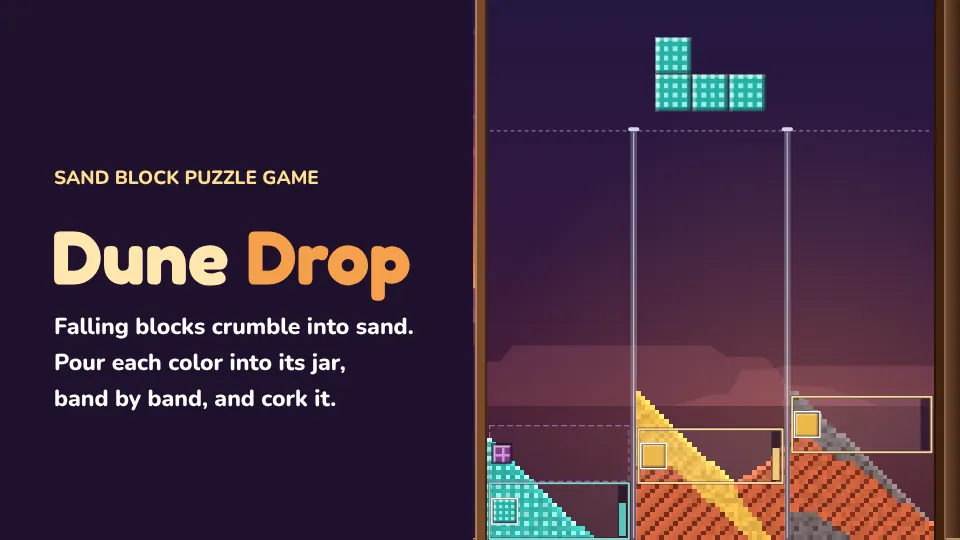
A sand block puzzle game on a desert windowsill: falling blocks crumble into colored sand, and we pour each color into the glass jar whose order asks for it, band by band, until the jar is corked.
This is our guide to playing Dune Drop. Want to jump straight in? Play Dune Drop right here in your browser.
Missing something you need? Tell us.
Quick answers
Does Dune Drop work on my phone?
Yes. Dune Drop works with touch on phones and tablets, and with a mouse or keyboard on a computer. It runs in the browser you already have, so there is no app to download.
Do I need an account to play Dune Drop?
No. Just open it and play, with no sign-up. If you like, a free account (username only, no email, for players 13 and older) puts your scores on the leaderboards and backs up your progress so it follows you to any device.
Is there a daily challenge in Dune Drop?
Yes. Dune Drop has a new daily challenge every day, the same one for every player, with its own daily leaderboard. Find it alongside the others on our daily challenges page.
Does Dune Drop save my progress?
Yes. It saves on this device on its own, so you can close the page and pick up where you left off. Sign in with a free account to keep the same progress on your phone and your computer.
Is Dune Drop OK for kids?
Yes, players of any age can enjoy it. There is no chat and no way to message other players, and nobody needs an account to play. Accounts are for players 13 and older, so younger players just play and their progress stays on their device. For ages 4 to 11 we also have learning games in their own kids area, with no ads, no accounts and no tracking.
A sand block puzzle game you can play in your browser
Dune Drop is our sand block puzzle game. Blocks made of four squares fall into a tall glass frame, and the moment a block lands it crumbles into hundreds of grains that slide into a soft dune, the way real sand does.
The frame holds three glass jars side by side. Each jar has an order drawn on its glass: colored bands to fill from the bottom up, like layered sand art. Pour the right sand into the open band, fill every band, and the jar is corked and carried off. A fresh jar with a new order takes its place.
There are four sands: turquoise, terracotta, gold and plum. Each has its own grain pattern (fine dots, diagonal stripes, plain, and crossed lines), and each band on the glass shows a chip of its sand, so the orders can be read without relying on color. It plays on a phone, tablet or computer with nothing to install.
How it works
One block falls at a time. Slide it over a jar, turn it, lower it or drop it at once; a white outline shows where it will land. When it lands it crumbles into sand inside the jar it fell in. Sand of the open band's color fills that band. Any other color, or more sand than the band needs, lands as dull mixed sand: it takes up room and lowers the jar's purity.
Three blocks wait in a tray under the frame. Once for each block you can tap one of them to take it instead of the falling block, which then waits in its place. A spare dish beside the tray holds one block, for a color no jar wants right now.
A block that lands across a glass wall pours some of its sand into each jar. That is a tool, not just an accident: a band that needs half a block can be finished exactly by splitting a block over the wall.
The rules, in order
- Jars. Three jars stand in the frame, divided by thin glass walls that rise to a rim. Blocks fall from above the rims.
- Orders. Each jar has two bands to pour, bottom first. Most bands are a block and a half of sand, some are one block. The open band has a bold outline and a bar that fills as it is poured; the next one is dashed.
- Pouring. Each grain is counted once, when it comes into a jar: the open band's color fills the band; anything else turns into mixed sand. When a band is full, the next one opens.
- Corking. When the last band of a jar is full, the jar is corked, scored and carried off, and an empty jar with a new order slides in.
- The tray and the dish. Three blocks wait in the tray. Once for each block you may take one of them, or set the falling block in the spare dish (or swap it with the block already there).
- Spills. If sand in a jar rises over its rim, the jar spills: it is emptied with no points and the streak ends. In Classic a spill also costs 400 points, and the third one ends the game. In Daily Jars some of its sand splashes into the jars beside it as mixed sand. In Relaxed a spill costs nothing.
- Speed. In Classic the blocks fall a little faster after every 8 corked jars.
Scoring
| What happens | Points |
|---|---|
| A corked jar, for each band, at 100% pure | 100 |
| A corked jar at 80% pure | half of that |
| A corked jar at 60% pure or less | 0 |
| Jar at least 95% pure | 250 more for each band |
| A band finished exactly, nothing past it | 50 |
| Each jar in a streak (corked within 6 blocks of the last) | 50 more, up to 300 |
| A spill in Classic | 400 taken away |
| Finishing the Daily's 100 blocks | up to 49 for pace |
Purity is the share of the jar's sand that went into its bands. A tidy two-band jar poured exactly scores 200 + 500 + 100 = 800; the same jar with half a block poured past one band is about 86% pure and scores about 170. Careful pouring is the whole game: match the color, then finish each band exactly, often by splitting a block across a glass wall.
Modes
Classic speeds up as you go and ends at the third spill; the best score goes on the leaderboard. Relaxed never ends: a jar that spills is emptied and the streak ends, with no points lost, and there is no leaderboard. Daily Jars gives everyone the same 100 blocks and the same jar orders on the same local day, at one gentle speed with no clock. The first run of the day is the one that counts; after that it is practice.
A game in progress is saved as you play, so you can close the page and pick it up later with Continue.
Controls
On a phone or tablet, drag sideways anywhere on the frame to slide the block, tap to turn it, and swipe down to drop it. Dragging down slowly lowers it faster. The tray and the dish sit under the frame (beside it on a phone held sideways): tap a block to take it, or tap the dish. In Settings you can switch on Slide, Turn and Drop buttons and a left-hand layout.
On a computer, Left and Right slide, Up or X turns, Z turns the other way, Down lowers, Space drops, 1, 2 and 3 take a block from the tray, D uses the dish, and P pauses.
Settings also has a Calm switch for less shake and fewer sparkles.
When a jar gets full
A jar's rim line turns orange when it is close to spilling. Mixed sand is usually the reason: it takes room but never counts toward a band.
- Finish it. A corked jar is emptied at once, mixed sand and all. Look at its open band and pick that color from the tray.
- Send other sand elsewhere. If a block fits no jar, put it in the dish, or drop it in the jar with the most room.
- Split carefully. A block across a wall pours into both jars, so keep splits for bands that need them.
Tips for getting better
- Read all three jars first. Before moving the block, look at the three bold bands. The falling block usually fits one of them.
- Use the tray every time. If the falling block fits nowhere, one of the three waiting blocks almost always does. Taking it costs nothing.
- Count in squares. A band of one block takes exactly one block. A band of a block and a half needs a block plus half of another: split one over a glass wall into a neighbor that wants the same color.
- Keep the dish for emergencies. One block of a color nobody wants can wait there until a band asks for it.
- Finish jars one after another. Corking jars within a few blocks of each other builds a streak. Work on the jar closest to done.
- Purity is worth more than speed. A pure jar scores many times what a muddy one does. A slower jar with clean sand beats a fast one.
- Aim with the outline. The white landing outline shows exactly where the block goes, so you can see a split before it happens.
More falling block and matching games from us
If you like this one, try Glintfall for classic falling blocks and row clears, Bloom Blocks for a calm block puzzle with no clock, or Moon Jar for dropping and merging moons in a jar.
Questions
How do you play a sand block puzzle with jars?
Slide each falling block over the jar whose open band is its color and drop it. It crumbles into sand and fills the band. Fill every band of a jar, bottom first, and the jar is corked and scored.
What happens if sand goes in the wrong jar?
It turns into dull mixed sand. It takes up room in that jar and lowers its purity, so the jar scores less when it is corked. It is not lost forever: corking the jar empties it.
What ends the game?
In Classic, the third time a jar overflows its rim. In Daily Jars the run ends after 100 blocks (a spill there costs the jar and the streak, and splashes the jar next door), and in Relaxed it never ends.
How is the score worked out?
A corked jar scores 100 points a band times its purity, nothing at 60% pure or less, plus 250 a band when it is at least 95% pure, plus 50 for each band finished exactly and 50 for each jar in a streak of jars corked within 6 blocks of each other. A spill costs 400 in Classic.
Can two people play Dune Drop?
It's a one player game, but Daily Jars gives everyone the same 100 blocks and the same jars each day, so two people can each play it and compare scores.
Is Dune Drop free?
Yes. Classic, Relaxed and Daily Jars are all free in your browser, with no download.
Related guides
 How to play GlintfallFalling blocks
 How to play Bloom BlocksBlock puzzle
 How to play Moon JarDrop and merge
 How to play Poker GridCard puzzle
 How to play Doubloom2048 Number Puzzle