
Games / Strategy Games / Main Street Lots / Guide
How to play Main Street Lots
A property trading board game set in a small town: roll two dice, buy lots around the square, build shops and collect a visit fee whenever another player stops by.
This is our guide to playing Main Street Lots. Want to jump straight in? Play Main Street Lots right here in your browser.
Quick answers
Does Main Street Lots work on my phone?
Yes. Main Street Lots works with touch on phones and tablets, and with a mouse or keyboard on a computer. It runs in the browser you already have, so there is no app to download.
Do I need an account to play Main Street Lots?
No. Just open it and play, with no sign-up. If you like, a free account (username only, no email, for players 13 and older) backs up your progress so it follows you to any device.
Is there a daily challenge in Main Street Lots?
Not in Main Street Lots itself, but many of our other games have a fresh daily challenge, the same for every player. See them all on our daily challenges page.
Does Main Street Lots save my progress?
Yes. It saves on this device on its own, so you can close the page and pick up where you left off. Sign in with a free account to keep the same progress on your phone and your computer.
Is Main Street Lots OK for kids?
Yes, players of any age can enjoy it. There is no chat and no way to message other players, and nobody needs an account to play. Accounts are for players 13 and older, so younger players just play and their progress stays on their device. For ages 4 to 11 we also have learning games in their own kids area, with no ads, no accounts and no tracking.
A property trading board game you can play in your browser
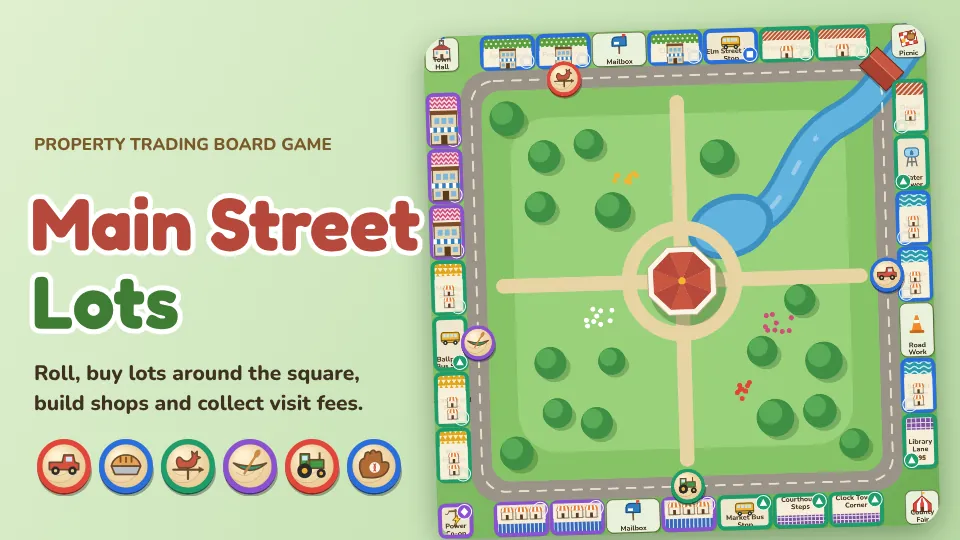
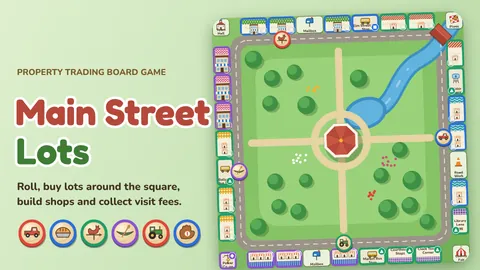
Main Street Lots is our property trading board game. The idea is more than a hundred years old and easy to love: move around a board, buy the places you land on, and collect from everyone who visits them afterwards. We built our own town for it. The board is a loop road with 32 spaces around a park with a bandstand, a river runs under a covered bridge in one corner, and the tokens are little wooden pieces: a pickup truck, a pie, a rooster weathervane, a canoe, a tractor and a baseball glove.
The money is play money, wooden coins, and nothing in the game costs anything real. You can play a Quick game of 15 rounds or a Full game, against one to three friendly house players or with friends by passing one phone or tablet around. It is free and there is nothing to download.
How it works
Twenty-one of the spaces are lots, grouped in seven neighborhoods of three: Orchard Row, Depot District, Lakeshore, Courthouse Square, Mill Creek, Fairgrounds and Hilltop. Each neighborhood has its own color and its own pattern, so they are easy to tell apart even without color. Prices rise as you go around the loop, from 60 coins for Apple Lane to 400 for Summit Street.
The other spaces are three bus stops, the Water Tower and the Power Co-op (all five can be bought), two Mailbox spaces, Town Hall, a Picnic spot by the river, Road Work and the County Fair. Tap any space on the board to see its card: the price, every fee, who owns it and what we can do with it.
Setup
Everyone starts at Town Hall. In a Full game each player starts with 900 coins and the whole town is open. In a Quick game the town is already partly settled: each player starts with a few lots dealt at random (six each with two players, four each with three or four) and enough coins to make everyone's starting worth the same.
Going first is a small advantage, so players later in the turn order start with a few extra coins: 40 for the second of two players, and 25, 50 and 75 for the second, third and fourth of four. In a game against house players, our seat in the turn order is picked at random.
Turn order
- Roll. Tap Roll and the token moves clockwise by the total of the two dice. Doubles roll again after the move. A third double in a row sends the token to Road Work instead.
- Land. An open lot can be bought. A lot that belongs to someone else costs its visit fee. A Mailbox space gives a card. Road Work costs the next turn. The Picnic is a rest. The County Fair pays a bonus that starts at 30 coins and grows by 10 after every round in which nobody visits.
- Pass Town Hall. Every time a token passes or lands on Town Hall, its player collects 160 coins.
- Build or trade. Before rolling or after moving, we can build shops, put a lot up for lease or offer a trade.
- End the turn. Tap End turn and the next player rolls.
Buying lots and auctions
When we land on an open lot, bus stop or utility, we can buy it at the listed price. If we would rather not, it goes to a quick auction among all the players, including us. Each player makes one sealed bid, the bids are shown together, and the highest bid buys the lot for the amount bid. Bids go in steps of 5 coins, starting at 10, and nobody can bid more coins than they have. If two bids tie, the lot goes to the tied player whose turn comes soonest after the player who passed on it. If nobody bids, the lot stays open.
Auctions are where bargains happen. A house player who passes on a lot bids only about half of what it normally would, so a modest bid often wins. If we are a few coins short of a price, we can put another lot up for lease first and then buy.
Bus stops charge by how many the owner holds: 35 coins with one, 80 with two and 170 with all three. The Water Tower and the Power Co-op charge 6 times the dice total with one, and 14 times with both.
Building shops
Owning all three lots of a neighborhood doubles the visit fee on each of them, and it lets us build. A small shop, the one with the striped awning, raises the fee to three times the basic fee. Two shops make it six times and three shops ten times. Then the three shops can be traded up to a big two story store, at fifteen times.
Shops must be built evenly: every lot in the neighborhood gets its first shop before any lot gets a second. Each shop costs the neighborhood's build price, from 35 coins in Orchard Row to 160 on Hilltop. No lot in the neighborhood may be up for lease while we build.
Trading
On our turn we can offer any mix of lots and coins to another player for any mix of theirs. Lots in a neighborhood that has shops stay put until the shops are sold. A lot that is up for lease can be traded and keeps its sign.
House players answer by one clear rule that anyone can check. They count every lot at its listed price, and a lot that completes a neighborhood for them a little more: only what the whole neighborhood can still earn in fees, which shrinks as the game nears its end and is nothing in the last round. A pair, a bus stop or a utility counts just its price. They say yes when a trade leaves them ahead by that count and gives them a fair share of what we gain, and they never bid more for a lot than it is worth to them by the same count. When they say no, they tell us their count and about how many more coins would change the answer. One-sided offers never work, and fair ones usually do.
House players make offers too. Dottie, the trader, will ask for the one lot that finishes a neighborhood for her. Before saying yes, look at what the trade gives the other side: the offer card warns when it would hand over a whole neighborhood.
When we hold two lots of a neighborhood and a house player holds the third, the Trade button turns into Suggested trade. One tap shows the deal, the price and the true reason; one more tap offers it or passes. The house player who holds that lot also offers it to us before house players make that kind of deal among themselves.
Short of coins
If we owe more than we have, we can sell shops back for half of what they cost, or put lots up for lease. A lot with a For lease sign pays us half its price at once and collects no fee until we take the sign down, which costs six tenths of the price. One button raises the coins for us in a sensible order, leasing spare lots before touching any shops.
A player who still cannot pay is out of coins for this game. Their lots go back to the bank and are auctioned to the players who remain.
Quick game or Full game
A Quick game lasts 15 rounds. At the end, each player's worth is counted: coins, plus the listed price of every lot (half for a lot that is up for lease), plus what was paid for every shop. The richest player wins. Because shops count at full value, building never lowers our worth, and every fee it earns is a gain.
A Full game starts with an empty town and plays until one player is left, or until round 40, when worth is counted the same way. It has more room for long plans, big stores and comebacks.
Mailbox cards
There are 40 Mailbox cards and we wrote every one. Most are small good news, such as a blue ribbon for a pie or a sold out lemonade stand. Some are small bills, such as new tires for the pickup. A few move the token: to the next bus stop, to Town Hall, to the County Fair, to the Picnic, ahead three spaces or back two. Two of them build a small shop for free.
Strategy: which neighborhoods pay back fastest
We ran many thousands of games between robot players to tune the numbers, and the same games show where the coins come from.
- The cheaper neighborhoods pay back fastest. In four player Quick games, Depot District, Orchard Row and Lakeshore earned back more than their full purchase price in fees, and Courthouse Square nearly all of it. Hilltop, the most expensive, earned back about four tenths in that time.
- The middle of the board collects the most coins in a short game. Courthouse Square, Lakeshore and Mill Creek brought in the most fees per game, because they are cheap enough to build on early and dear enough to matter.
- The expensive end wins long games. In Full games Fairgrounds and Hilltop collected the most of all, once there was time to put stores on them.
- The second and third shops are the best buys in the game. The first shop adds one basic fee, the second adds three more and the third adds four more, all for the same price.
- Lease spare lots to pay for shops. A lone lot earns one small fee. The same coins in shops earn several times as much.
- Keep a few coins for auctions. A lot at half price is worth more than a shop bought one turn sooner.
Tips
- Tap a lot on the board before buying or trading to read its fees.
- On a small screen, the magnifier button zooms in on the side of the board where the action is, and the arrows on a lot card step around the loop.
- The skip button plays the house players' turns at once. Their moves are still in the log.
- Watch the County Fair bonus on the top bar. It is worth a detour when it has grown.
Questions
How do you play a property trading board game?
Roll two dice and move around the board. Buy the lots you land on, collect a visit fee from anyone who lands on them, and build shops once you own a whole neighborhood. In a Quick game the richest player after 15 rounds wins; in a Full game the last player with coins wins.
Can I play with a friend on one device?
Yes. Pick Pass and play on the title screen for two to four players on one phone, tablet or computer. Nobody needs to type a name. Auction bids are sealed, so the device is passed to each player in turn to bid out of sight.
What is a suggested trade?
When one lot stands between us and a whole neighborhood and a house player would sell it at a fair price by the public trade rule, the Trade button shows Suggested trade. It names the lot, the coins and why it helps. We can offer it with one tap or pass.
How do auctions work?
When a player passes on an open lot, every player makes one sealed bid. The highest bid buys the lot and pays what was bid. A tie goes to the tied player whose turn comes soonest.
How do you build shops?
Own all three lots of one neighborhood, then open the lot's card and tap Build shop. Build evenly, up to three small shops on each lot, then trade them up to a big store.
What happens when a player runs out of coins?
First they can sell shops back at half price and put lots up for lease. A player who still cannot pay is out for this game, and their lots are auctioned to the others.
Are the dice fair?
Yes. Every roll comes from a generator set when the game starts, and the roll is saved before it is shown, so reloading the page never changes it. House players do not know the dice or the card order.
Is Main Street Lots free?
Yes. It is free to play in your browser, with play money only and nothing to buy.
Related guides
 How to play Airscape LudoLudo
 How to play Tile TycoonWord tiles
 How to play Grant Central StationTrain tycoon
 How to play Zach's Storage AuctionStorage auction
 How to play Driftwood DominoesClassic dominoes
More to read
You might also like
10 minSavesAirscape Ludo
LudoThe classic race board game: roll a six to come out, race four tokens round the cross and home, and send rivals back to their yard. House rules from blockades to no safe squares, partners two against two, seven house players from gentle to sharp, pass and play, friends online with one room code and a Daily Race.
Long playSavesGrant Central Station
Train tycoonBuild a railroad, collect 31 real kinds of trains, grow a grand station with Grant, and take the throttle yourself. Saves to your account.
10 minSavesZach's Storage Auction
Storage auctionPeek inside storage units, outbid friendly rivals as Auntie Lou counts going once, going twice, sold, then open every box, haggle with Gus, sell at the fair and fill a Collection Book with over 1,000 things to find. Daily Mystery Unit with a profit board.