
Games / Puzzle Games / Yarn Basket / Guide
How to play Yarn Basket
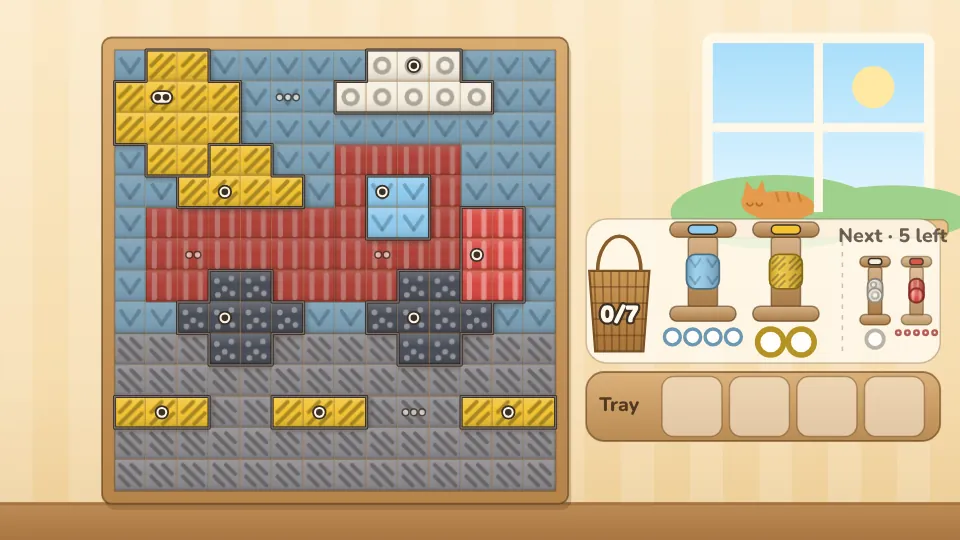
In our yarn puzzle game we get a small knitted picture and a row of wooden spools. We tap a patch on top to unravel it, and its yarn winds onto the spool of the same color. Unravel the whole picture and every spool rolls into the basket.
This is our guide to playing Yarn Basket. Want to jump straight in? Play Yarn Basket right here in your browser.
Missing something you need? Tell us.
Quick answers
Does Yarn Basket work on my phone?
Yes. Yarn Basket works with touch on phones and tablets, and with a mouse or keyboard on a computer. It runs in the browser you already have, so there is no app to download.
Do I need an account to play Yarn Basket?
No. Just open it and play, with no sign-up. If you like, a free account (username only, no email, for players 13 and older) puts your scores on the leaderboards and backs up your progress so it follows you to any device.
Is there a daily challenge in Yarn Basket?
Yes. Yarn Basket has a new daily challenge every day, the same one for every player, with its own daily leaderboard. Find it alongside the others on our daily challenges page.
Does Yarn Basket save my progress?
Yes. It saves on this device on its own, so you can close the page and pick up where you left off. Sign in with a free account to keep the same progress on your phone and your computer.
Is Yarn Basket OK for kids?
Yes, players of any age can enjoy it. There is no chat and no way to message other players, and nobody needs an account to play. Accounts are for players 13 and older, so younger players just play and their progress stays on their device. For ages 4 to 11 we also have learning games in their own kids area, with no ads, no accounts and no tracking.
How it works
Yarn Basket is a yarn puzzle game we play with one finger, free in the browser on a phone, tablet or computer. Every level is a knitted picture of an everyday thing: a barn, a pickup truck, a slice of cherry pie, a cardinal on a branch. The picture is made of yarn patches that lie on top of one another, the way a real knitted picture is built up in layers.
Under the picture stand two or three wooden spools, each waiting for one color. We tap a patch, its yarn pulls loose stitch by stitch, and it winds onto the spool that wants it. There are 150 pictures in 5 chapters, and each one we finish hangs on our picture wall. The Daily Skein is one picture that is the same for everyone that day. Our solver has checked every level, so every one can be finished, and it can always show a safe next tap.
How unraveling works
- A patch can be pulled only when it is on top, with no other patch lying over any part of it. Patches on top are bright and have a dark edge and a soft shadow. A patch tucked under another one is dimmer.
- The dots on a patch show how many lengths of yarn it holds: one, two or three.
- Each length goes to the spool of the same color. If two spools want that color, the one that has waited longer gets it first.
- The rings under a spool show how many lengths it wants. When every ring is filled, the spool rolls into the basket and the next spool in line takes its place.
- If a patch holds more yarn than its spool wants, the extra goes to the next spool of that color if one is standing there, and otherwise to the tray.
- The picture is finished when every patch has been unraveled, every spool is full and the tray is empty.
- Small round knots on a patch, like an eye or a button, are embroidery. They belong to the patch they sit on and leave with it.
A tap is refused, with a short note, if the patch is still tucked under another one or if its yarn would not fit anywhere. Nothing is ever lost by a refused tap.
Using the tray
The tray is the heart of the puzzle. When no spool wants a color right now, that yarn waits in the tray, one slot for each length. The tray has five slots in the first three chapters and four in the last two, where every picture can still be finished with a slot to spare.
Tray yarn does not need another tap. The moment a spool of its color rolls up, the yarn winds on by itself, oldest first. So the tray is a place to park a color for a little while, and the question is always whether its spool is coming soon enough.
The last slot turns a gentle amber when the tray is nearly full. If the tray is full and nothing on top fits a spool, the game tells us and Undo steps us back. Undo is free and has no limit.
Each length that goes to the tray counts as one tray use. Fewer tray uses earn more stars: three for the fewest possible, two for one more, one for finishing. Our solver knows the fewest any picture can be finished with.
Reading the spool queue
To the right of the active spools stand the next two spools in line, a little smaller, each with its rings. The label also says how many spools are still to come. A new spool only arrives when one of the active spools is full, and it takes that spool's place.
Reading the queue tells us which colors are safe to park. If the very next spool is green, a green patch can go to the tray without worry, because filling either active spool will bring green up and empty the tray again. A color that is nowhere in sight is the risky one.
Knotted patches
From the third chapter on, some patches carry a pink bow. That is a knot. The first tap pulls one length loose, and the second tap pulls the rest. A knot lets us send just one length where it is needed, but the patch stays on the picture until the second tap.
The any-color spool
From the fifth chapter on, a striped spool marked any can show up. It takes the first color sent to it when no other spool wants that color, and then it keeps that color until it is full. We choose its color with care, because the rest of the queue was planned around it. If it takes the wrong color, some yarn will have no spool at the end. The game says so as soon as that happens, and Undo takes us back.
Tips
Feed the spools first
If a patch on top matches a spool, that tap costs nothing. We take those first, unless a patch holds more than the spool wants and the extra would crowd the tray.
Park only what the queue is about to take
Before we send yarn to the tray, we look at the next two spools. Yarn for a spool that is next in line will leave the tray soon. Yarn for a color we can't see yet may sit there for the rest of the level.
Count lengths, not patches
A patch with three dots fills three tray slots at once. Two big patches in the tray and we are nearly out of room. Small patches are cheap to park, big ones are not.
Peek before digging
The Peek button fades the top patches for a moment so we can see what lies under them. If the color a spool wants is buried, we work out which patch to clear to reach it, and what that patch will cost.
Use Undo like an eraser
Undo takes back a tap and its tray uses. If the game says an order can no longer finish the picture, one or two Undos is usually enough to find the fork where it went wrong.
Getting better
We measured three kinds of test players on every level. One taps at random, one always grabs a patch a spool wants, and one also reads the queue before parking yarn. In the first chapter all three finish every picture. By the last chapter, with its four slot tray, the random tapper finishes about a third of the pictures, the grabber about half, and even the queue reader slips on about one in five. Reading the queue is the skill that matters, and Undo is there for the rest.
We like to try a picture once for the feel of it, then tap Again and go for three stars. The line under the picture shows how many tray uses still earn three stars. The Hint button shows a safe tap from exactly where we are, and a good way to learn is to guess first and then check.
The Daily Skein scores 2,000 points, less 60 for each tray use over the fewest possible, less one point for every five seconds up to 59. So a tidy tray comes first and time only breaks ties. The Daily Skein has one rule of its own, and the game says so before the first tap: yarn that went to the tray still counts after an Undo, so a clean first try scores best.
Questions
How do you play a yarn puzzle game?
We tap a patch that is on top of the knitted picture. Its yarn unravels and winds onto the spool of the same color. Yarn that no spool wants waits in a small tray. Unravel every patch to finish the picture.
What happens when the tray is full?
A tap whose yarn would not fit is refused. If nothing on top fits a spool any more, the game says so right away and Undo takes us back a tap. Undo is free and unlimited, so nobody is ever stuck for good.
How do we use the tray well?
We park only colors whose spool is coming in the queue, and we count lengths, not patches. A patch with three dots takes three slots.
Which spool gets the yarn when two want the same color?
The spool that has been waiting longer gets it first. Any extra goes to the other spool of that color, and after that to the tray.
Can every level be finished?
Yes. Our solver has proved that all 150 pictures and every Daily Skein can be finished with at least one tray slot to spare.
Is Yarn Basket free?
Yes. All 150 pictures, the Daily Skein, hints and Undo are free in the browser, with no download and no account needed.
Can two people play?
It is a one-player puzzle, but it is fun to pass the phone and see who finishes a picture with fewer tray uses. Again restarts the same picture for the next player.
Related guides
 How to play Wool GatesBlock jam
 How to play HexbloomHex color sort puzzle
 How to play Jelly JarsSort puzzle
 How to play Thimbleberry StitchColor by number
 How to play Bloom BlocksBlock puzzle
More to read
You might also like
10 minSavesWool Gates
Block jamHerd fluffy flocks across a patchwork pasture and out through the gate dyed their color. Every move turns the gate colors.