
Games / Arcade Games / Ragtime Rush / Guide
How to play Ragtime Rush
A piano game you play online with your thumbs: navy tiles slide down four lanes in time with a tune, and every tile you tap plays its note on our upright piano.
This is our guide to playing Ragtime Rush. Want to jump straight in? Play Ragtime Rush right here in your browser.
Missing something you need? Tell us.
Quick answers
Does Ragtime Rush work on my phone?
Yes. Ragtime Rush works with touch on phones and tablets, and with a mouse or keyboard on a computer. It runs in the browser you already have, so there is no app to download.
Do I need an account to play Ragtime Rush?
No. Just open it and play, with no sign-up. If you like, a free account (username only, no email, for players 13 and older) puts your scores on the leaderboards and backs up your progress so it follows you to any device.
Is there a daily challenge in Ragtime Rush?
Yes. Ragtime Rush has a new daily challenge every day, the same one for every player, with its own daily leaderboard. Find it alongside the others on our daily challenges page.
Does Ragtime Rush save my progress?
Yes. It saves on this device on its own, so you can close the page and pick up where you left off. Sign in with a free account to keep the same progress on your phone and your computer.
Is Ragtime Rush OK for kids?
Yes, players of any age can enjoy it. There is no chat and no way to message other players, and nobody needs an account to play. Accounts are for players 13 and older, so younger players just play and their progress stays on their device. For ages 4 to 11 we also have learning games in their own kids area, with no ads, no accounts and no tracking.
A piano game online, with real tunes under your thumbs
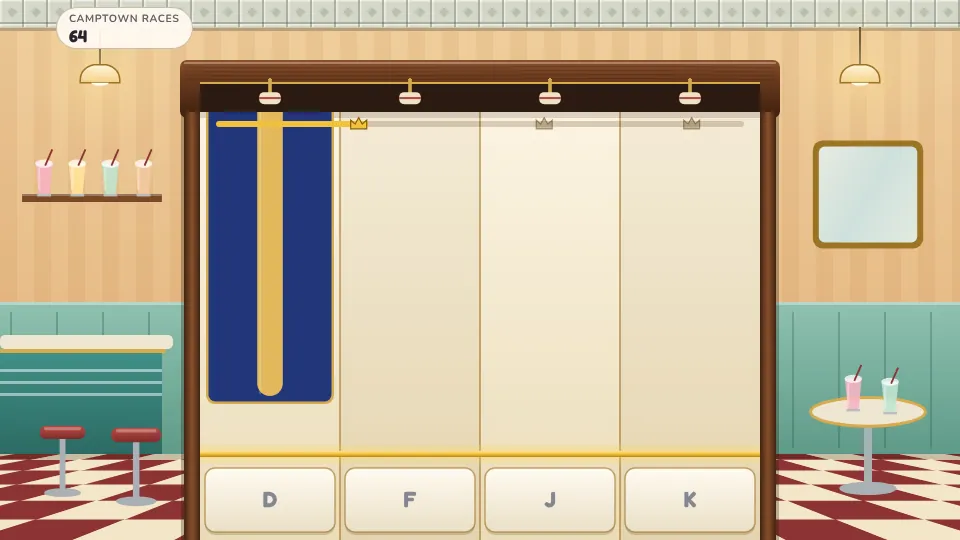
Ragtime Rush is our piano game. It's set at an old upright piano in a small-town soda fountain, with a tin ceiling, warm lamps and a checkerboard floor. Four cream lanes run down the screen. Navy tiles with a brass edge slide down them in time with the music, and a gold line near the bottom shows where to tap.
The part we like best: the game doesn't play the melody for you. You do. Each tile is one note of the tune, and it sounds the moment you tap it, while the left hand keeps time underneath. Play the tiles well and you've played Ode to Joy, or The Entertainer, or Jingle Bells.
It runs in the browser on a phone, tablet or computer, with nothing to download. There are 25 tunes in the songbook: 20 old favorites that are long out of copyright (Scott Joplin's The Entertainer is in twice, once slow and early, once in full near the end), and 4 tunes we wrote ourselves in a ragtime and soda fountain spirit.
How it works
Pick a tune and the first tile waits on the gold line. Nothing moves and nothing sounds until you tap it. That first tap starts the song. The very first time you play, the first four tiles of Ode to Joy each wait on the line for their tap, with a pointing hand, and only then does the tune start to move.
From then on, tap each tile as it reaches the line. You don't have to hit the tile itself. Anywhere in its lane counts, top to bottom, so on a phone your thumbs can rest on the big pads under the line. A tap counts when your finger lands, not when it lifts.
The lanes follow the tune. When the melody goes up, the next tile is to the right. When it goes down, the next tile is to the left. After a few tunes your hands start to feel the shape of the music.
The rules, in order
- Short tiles. One tap as the tile reaches the gold line.
- Long tiles. These have a brass stripe. Press as the tile reaches the line and hold until the stripe ends. Letting go a touch early (about a tenth of a second) still counts.
- Double tiles. From the sixth tune on, two tiles sometimes arrive side by side, joined by a brass bar. Tap both, one with each thumb.
- Missing. In Classic, a tile that slides past the line untapped ends the run. So does a tap in a lane with no tile on the way. On the first seven tunes of the songbook, the first miss in a run is let go (the lane flashes gray and the tune goes on); the second one ends it.
- Too soon. On the gentler tunes (the first eight, and Take Me Out to the Ball Game), a tap that's only a little early (about a fifth of a second before the tile) is let go once: you hear a soft click, the tile stays, and you can still tap it on time. A second early tap on the same tile counts as a tap in an empty lane. On the quicker tunes, where tiles come closer together, an early tap is never let go. Drumming on a lane without listening doesn't get through a tune.
- Letting go of a long tile early. You keep the points for the tap and lose only the extra point for the hold. It never ends a run.
- Finishing. Tap the last tile and the tune is done. The card shows your score and how many crowns it earned.
Timing and scoring
Every tap is judged against the exact moment its note belongs in the music.
| Call | How close | Points |
|---|---|---|
| Perfect | Within 50 thousandths of a second | 3 |
| Good | Within 100 | 2 |
| OK | Within 160 | 1 |
| Long tile held to its end | 1 more |
The first seven tunes are kinder: Perfect within 60, Good within 120, and OK from 170 early to 250 late, so a tap that comes a little after the beat still counts while you find your feet.
Each tune has three crowns. The first comes at 40 percent of the tune's top score (from the eighth tune on it never needs more than 60 points), the second at 62 percent and the third at 90 percent. A top score means every tile Perfect and every long tile held, so three crowns takes a clean run with mostly Perfect taps.
Crowns open the songbook. The first three tunes are open from the start. The fourth opens at 1 crown, the fifth at 3, and the count climbs by about a crown and a half per tune, up to 33 crowns for the last one.
Timing tips
- Listen more than you look. The left hand plays a steady bass and chord pattern. Tap along with it the way you'd tap your foot, and use your eyes only to see which lane comes next.
- Watch the line, not the tile. Keep your eyes just above the gold line and let the tiles come to you.
- Use two thumbs. Left thumb for the two left lanes, right thumb for the two right lanes. Fast runs become a simple left, right, left.
- Hum the tune. You already know most of these melodies. If you can hum the next note, your thumb knows when it's due.
- Early is safer than late. A slightly early tap is forgiven. A late one lets the tile slide past.
- Start with Practice on a new tune. One slow pass in Practice teaches your hands the lanes before a Classic run counts.
Fixing lag: the tap test
Phones, wireless earbuds and some speakers add a small delay between a tap and its sound. If your taps feel late, or you keep getting Good when you're sure you were on the beat, the game can measure that delay.
Open Settings and choose Tap test. You'll hear twelve clicks. Listen to the first four, then tap the big round button in time with the other eight. The game takes the middle value of your eight taps and shifts the tiles and the judging by that much. It takes about ten seconds, and the number is remembered on that device.
If you never run the test, timing is automatic: the game uses the delay the browser reports for its own sound output. Reset in Settings goes back to automatic. Wireless earbuds usually add the most delay, so run the test again when you switch between earbuds and the phone's speaker.
Four ways to play
- Songbook (Classic). One time through a tune. The run ends at the first miss, and crowns are earned here.
- Practice. The tune never stops early. Misses are only counted. You can play at full speed or at three quarters speed, and once in each run the pause card can take you back to the last checkpoint (there's one every eight bars). Practice doesn't earn crowns.
- Endless. A tune goes round and round, 10 percent faster each time, until the first miss. It never goes past double speed, and never so fast that tiles come closer than about a tenth of a second apart.
- Daily Tune. One tune a day at a set speed, the same for everyone, scored out of 1,000. Your first try of the day goes on the board. After that you can replay it for fun.
Getting better
Most early misses aren't about speed. They come from tapping the lane you expected and not the lane that's there. Slow tunes like Brahms Lullaby and Auld Lang Syne are good for learning to read one tile ahead.
When a tune keeps ending in the same spot, that's a rhythm you haven't heard yet. Play it in Practice, let the miss happen, and use the checkpoint to hear that stretch again. Dotted rhythms (long, short, long) in Yankee Doodle and Oh! Susanna catch nearly everyone the first time.
For three crowns, aim for calm hands. A run of Good taps scores two thirds of a run of Perfects, and that's under the 90 percent a third crown needs. The fix is almost always the tap test, then listening to the bass.
The last few tunes (The Entertainer, Can-Can and our own Ragtime Rush) have runs of quick notes. Alternate thumbs and keep them close to the glass.
The song list
Every tune was arranged by us for our own piano sound, which is built in code with no recordings. The 20 older tunes were all published long before 1929.
| No. | Tune | Written by | Year |
|---|---|---|---|
| 1 | Ode to Joy | Ludwig van Beethoven | 1824 |
| 2 | Twinkle, Twinkle, Little Star | French melody, Ah! vous dirai-je, maman | 1761 |
| 3 | Brahms Lullaby | Johannes Brahms | 1868 |
| 4 | Skip to My Lou | American play-party song | 1840s |
| 5 | The Entertainer, slow | Scott Joplin | 1902 |
| 6 | Row, Row, Row Your Boat | American round, tune by Eliphalet Oram Lyte | 1881 |
| 7 | Home on the Range | Daniel E. Kelley, words by Brewster Higley | 1873 |
| 8 | Soda Fountain Waltz | Us, for this game | 2026 |
| 9 | Auld Lang Syne | Scottish traditional | 1799 |
| 10 | Take Me Out to the Ball Game | Albert Von Tilzer | 1908 |
| 11 | Jingle Bells | James Lord Pierpont | 1857 |
| 12 | Pop Goes the Weasel | English traditional | 1853 |
| 13 | Camptown Races | Stephen Foster | 1850 |
| 14 | Yankee Doodle | American traditional | 1770s |
| 15 | Oh! Susanna | Stephen Foster | 1848 |
| 16 | Minuet in G | Christian Petzold, from the Notebook for Anna Magdalena Bach | 1725 |
| 17 | Greensleeves | English traditional | 1580 |
| 18 | She'll Be Coming Round the Mountain | American traditional | 1890s |
| 19 | Checkerboard Stomp | Us, for this game | 2026 |
| 20 | Canon in D | Johann Pachelbel | 1680 |
| 21 | Für Elise | Ludwig van Beethoven | 1810 |
| 22 | The Entertainer | Scott Joplin | 1902 |
| 23 | Brass Rail Two-Step | Us, for this game | 2026 |
| 24 | Can-Can | Jacques Offenbach | 1858 |
| 25 | Ragtime Rush | Us, for this game | 2026 |
Playing with a keyboard
On a computer, D, F, J and K play the four lanes from left to right, so two fingers of each hand rest where touch typists already keep them. Hold the key down for a long tile. Space starts a tune, and P or Esc pauses. The mouse works too, but keys are much easier for the faster tunes.
If you like rhythm games, try Pulse Bloom. For more quick-finger play there's Echo Bat, and Letter Storm gives a keyboard the same kind of workout.
Questions
How do you play a piano tap game like this?
Tap the first tile to start the tune, then tap each tile as it reaches the gold line. Anywhere in the tile's lane counts. Hold long tiles until their brass stripe ends, and tap double tiles with two thumbs.
Can you play Ragtime Rush with a computer keyboard?
Yes. D, F, J and K play the four lanes from left to right. Hold a key for a long tile, press Space to start a tune and P or Esc to pause. Keys are judged exactly like taps.
Why do my taps feel late, and how do I fix it?
Your device or earbuds are adding a delay between the tap and the sound. Open Settings, choose Tap test, and tap along with eight clicks. The game measures the delay and lines the tiles up with your device.
Is Ragtime Rush free?
Yes. All 25 tunes, every mode and the Daily Tune are free in the browser. Tunes open by earning crowns, never by paying.
What songs are in the game?
Twenty old favorites, among them Scott Joplin's The Entertainer, Ode to Joy, Für Elise, Canon in D, Oh! Susanna, Yankee Doodle, Home on the Range, Jingle Bells and Take Me Out to the Ball Game, plus four tunes we wrote. The full list with composers and years is above.
How do you unlock more songs?
Earn crowns in Classic. Three tunes are open at the start, the fourth opens at 1 crown, and the last needs 33. A casual run usually earns one crown, so every open tune helps.
Can two people play?
It's a one player game. For a friendly contest, take turns on the Daily Tune: it's the same tune at the same speed for everyone that day, and each score is out of 1,000.
Related guides
 How to play Pulse BloomRhythm
 How to play Echo BatOne touch
 How to play Letter StormTyping action
 How to play ChimefallPeg shooter
 How to play Orbit HopOne tap