
Games / Mossback & Flit / How it was made
How Mossback & Flit Was Made
Mossback & Flit is our puzzle platformer about a tortoise and a little bird who can only get home together. Two character puzzle games are some of the best loved games for playing side by side, and also some of the most frustrating to play alone. This is how we tried to keep the first part and lose the second.
What players love, and what they don't
We started by reading what people say about two character puzzle platformers. The praise was consistent: rooms where each character truly needs the other, a first room that teaches by doing, an extra goal like gems or a quick time for replay, and two people sharing one keyboard. So were the complaints: steering two characters at once is hard on your own, simple controls asked to make very precise jumps, failing because of a hazard you weren't watching, a lot of trial and error, and needing a partner of exactly the same skill.
Order, not precision
We made one firm rule: the puzzles are about the order of things, not the precision of a jump. Nothing ends a room. A slip into water or brambles just pops that one character back a few steps. Jumps are forgiving, with a moment of grace after leaving a ledge and a jump that waits for us if we press a little early. On a touch screen we can simply tap where a character should go and it walks there.
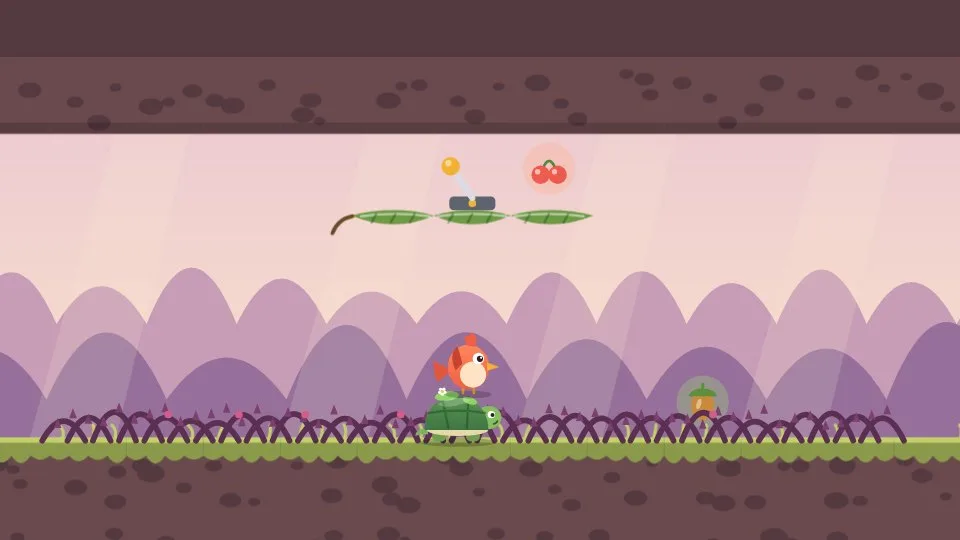
The two friends are built to need each other. Mossback is heavy and steady: it wades through water, walks straight through brambles, pushes crates and holds down heavy plates, but it only jumps one tile up. Flit is light: it jumps two tiles, glides, stands on leaves and rides warm air, but it is too light for heavy plates. Flit can also ride on Mossback's back across shallow water and thorns.
Proving every room can be finished
Each of the 16 rooms is drawn as a small letter map with a written answer, and an automatic test plays every answer through the real game rules, both as drawn and mirrored left to right, and fails if a single acorn or berry is left behind or anyone slips. The same planner that checks the rooms also powers tap to go and the hint button, so the hint can never suggest something the rules don't allow.
What testing changed
Playing the rules this way caught real problems before anyone else could. Mossback could clear a three tile gap, which broke some puzzles, so its speed and jump came down until one and two tile gaps were fine and three were not. A rider being carried could get pushed into a ledge and popped back, so riders now collide properly while carried. Warm air one tile wide threw Flit out the far side, so open air columns are now two tiles wide. And asking Mossback to go to the far side of a crate let it hop over instead of pushing, so pushing became its own clear action that stops by itself on a plate, at a wall or at a drop.
Stars, the Daily Room and two players
Every room has three stars: one for getting both friends home, one for every acorn and berry, and one for a quick time. Some treats are easy to miss if things happen in the wrong order, which gives a good reason to replay a room. The Daily Room is one room a day, picked by the date so everyone gets the same one, sometimes turned left to right. Two people can play side by side on one keyboard, or with on screen buttons on a tablet.