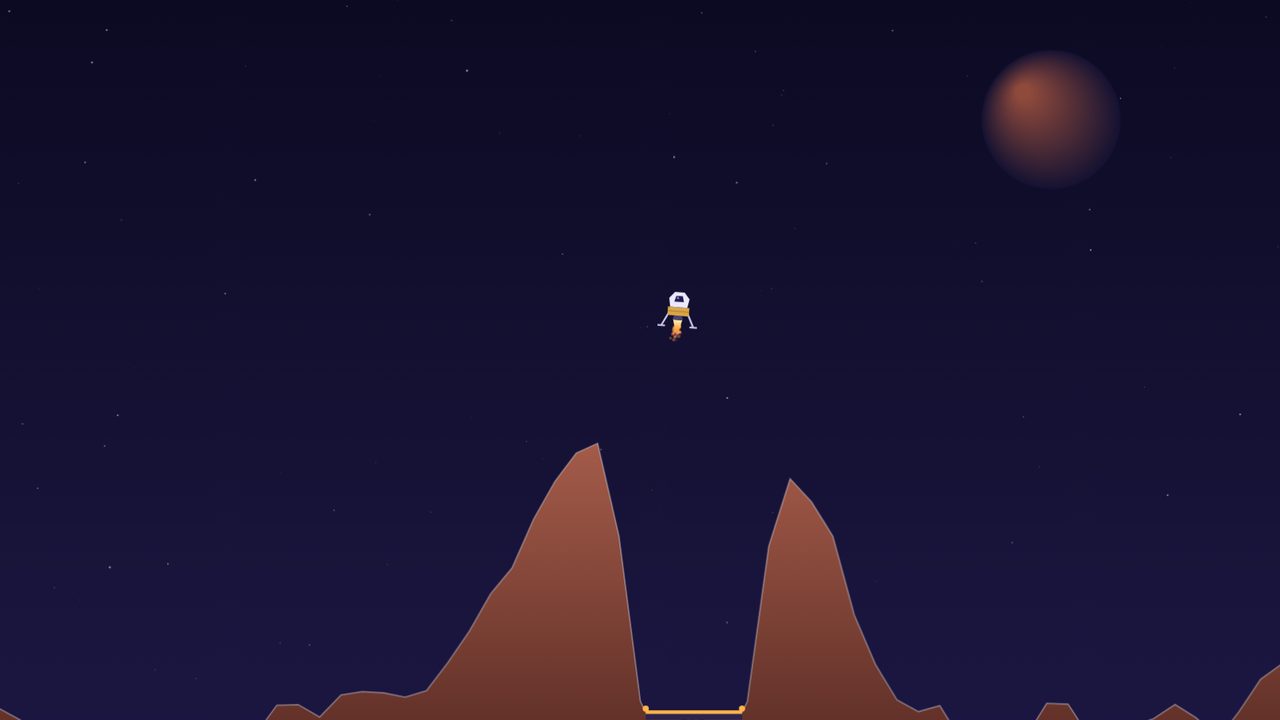
Small on purpose
Iron Tide is big. Low-G Lander was the opposite exercise: how much fun fits in a game you can understand in five seconds? One pod, one engine, two tilt directions and a pad. The whole game is a single HTML file of about 30 KB with no libraries at all. It draws everything on a 2D canvas, so it loads instantly even on a slow phone connection.
The physics
Each frame the pod gets pulled down by the world's gravity, pushed sideways by the wind, and pushed along its own tilt when the engine fires. Speed carries over from frame to frame, which is what makes it feel like a lander: you can't stop instantly, you have to plan your burn. Gravity starts very low on the first world, 0.5 m/s², so new players have time to learn. The last world, Nadir, uses 1.62 m/s², the real gravity of Earth's Moon.
What counts as a landing
The pod has two feet and a body. If the body touches the ground first, it breaks. If both feet land on the pad, the game checks three limits for that world: how fast you were falling, how fast you were sliding sideways, and how far you were tilted. Each crash tells you exactly which limit you broke and by how much, so a failed landing teaches you something.
Worlds that teach
The eight worlds are designed as lessons, each adding one new problem. Pebble puts the pad straight below you. Thistle moves it to the side so you learn to tilt and correct. Kestrel starts you already drifting. Marrow adds steady wind, Drift adds gusts that change, Hollow hides the pad in a canyon, Cinder puts it on a ridge, and Nadir combines everything at Moon gravity.
The terrain on each world is generated from a fixed seed, so it's random-looking but identical every time you play it. That makes practice meaningful and keeps the file tiny, since no level data needs to be stored beyond a handful of numbers.
Scoring that rewards skill
Any safe landing earns a star and unlocks the next world. For more stars, the score rewards three things: fuel left (up to 500 points), a soft touchdown (up to 300) and landing near the middle of the pad (up to 200). 600 points earns three stars. Going back for three stars on every world is where most of the replay value is.
Phones
On a phone or tablet the controls switch to big buttons: tilt on the left, a round Thrust button on the right when you hold it sideways, and a bar along the bottom when you hold it upright. You can turn the phone either way and the game adjusts.
How I built it
Like Iron Tide, I built Low-G Lander with Claude, an AI coding assistant, as my programming partner, and tuned it by playing it over and over until each world felt hard but fair.
What's next
More worlds and maybe a time-trial mode. If you have ideas or land on something weird, send me feedback.