Games / Card Games / Hand Heist / Guide
Hand Heist
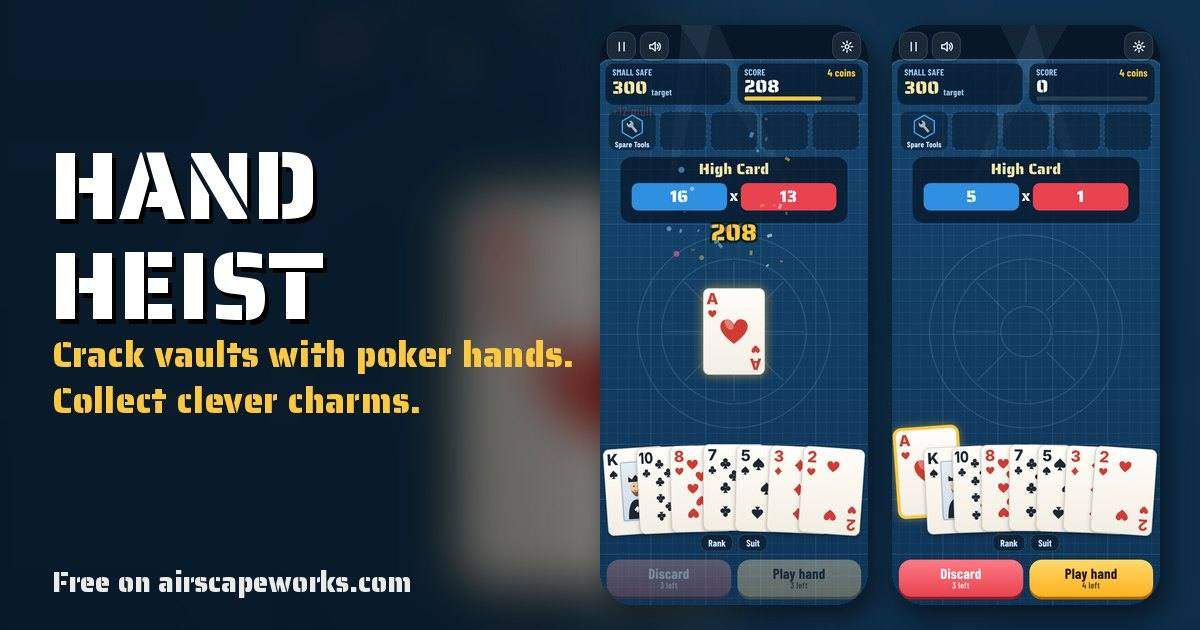
Hand Heist is a poker roguelike where every poker hand you play chips away at a vault. Crack 24 vaults across 8 districts, collect charms that bend the scoring rules, and see how far one run can go.
What is Hand Heist?
Hand Heist mixes two things: the poker hands you already know (pairs, straights, flushes) and the structure of a roguelike, where each run starts fresh and you build up a set of upgrades as you go. There's no betting and no opponent at the table. You draw cards, pick the best poker hand you can make, and score points against a target.
Each target is a vault. Every district has three of them: a Small Safe, a Big Safe and a Boss Vault with a nasty special rule. Crack all eight districts, from Pebble Lane up to the Grand Vault, and you've pulled off the Grand Heist. It's free, plays in the browser on a phone, tablet or computer, and needs no download.
How to play
- You're dealt a hand of 8 cards from a standard 52-card deck.
- Select up to 5 of them and press Play. The game reads them as a poker hand and scores it.
- Or select cards and press Discard to throw them away and draw replacements.
- Keep going until your total score for the vault reaches the target. Run out of plays first and the run is over (you're busted).
- Crack the vault and you earn coins, then visit the Gadget Shop before the next one.
With the starting crew you get 4 plays and 3 discards per vault, and the deck is reshuffled for every vault. Before the first vault you also pick one free charm from three on offer.
Poker hand rankings
If you're new to poker hands, this is the whole list, weakest to strongest. You can play fewer than 5 cards; only the cards that make up the hand count toward its score (so in a Pair, just the two paired cards score).
| Hand | What it is | Base chips x mult |
|---|---|---|
| High Card | No combination. Your highest card scores | 5 x 1 |
| Pair | Two cards of the same rank | 10 x 2 |
| Two Pair | Two different pairs | 20 x 2 |
| Three of a Kind | Three cards of the same rank | 30 x 3 |
| Straight | Five ranks in a row, any suits | 30 x 4 |
| Flush | Five cards of the same suit | 35 x 4 |
| Full House | Three of a kind plus a pair | 40 x 4 |
| Four of a Kind | Four cards of the same rank | 60 x 7 |
| Straight Flush | A straight, all in one suit | 100 x 8 |
Aces can be high or low in a straight, so both A 2 3 4 5 and 10 J Q K A count. Suits don't rank against each other.
Scoring: chips x mult
Every hand produces two numbers, chips and mult, and your score is chips multiplied by mult. The hand type gives you a starting value for each (the table above). Then each scoring card adds its own chips: Aces are worth 11, J, Q and K are worth 10, and every other card is worth its number.
A quick example: play a pair of Kings. The Pair starts at 10 chips and 2 mult. The two Kings add 10 chips each, so you have 30 chips x 2 mult = 60. A Flush of 9, 7, 6, 4, 2 starts at 35 chips and 4 mult, the cards add 28 chips, so it's 63 x 4 = 252.
The order matters once charms get involved. Cards score first, left to right, along with any stamps or card-based charms. Then charms that add flat chips or mult. Then, last of all, charms that multiply mult (the x1.5 and x2 kind). So a x2 charm doubles everything you've stacked before it.
Leveling up hands
Blueprints from the shop raise a hand type's level, which raises its base chips and mult for the rest of the run. A level 2 Pair, for example, starts at 25 x 3 instead of 10 x 2. Higher hands gain more per level: a Straight Flush gets +40 chips and +4 mult each time.
Vaults, coins and the Gadget Shop
The targets climb fast. Here's the Small Safe target in each district; the Big Safe is 1.5 times that and the Boss Vault is 1.8 times.
| District | Small Safe target |
|---|---|
| 1. Pebble Lane | 300 |
| 2. Market Row | 650 |
| 3. Clock Tower | 1,250 |
| 4. Harbor Docks | 2,300 |
| 5. Museum Mile | 4,200 |
| 6. Sky Bank | 7,500 |
| 7. Gold Exchange | 13,000 |
| 8. Grand Vault | 22,000 |
Cracking a vault pays 3, 4 or 5 coins (Small, Big, Boss), plus 1 coin for every play you didn't need, plus interest: 1 coin for every 5 you're holding, up to 5. You start a run with 4 coins.
The shop offers three charms, one blueprint (3 coins) and one stamped card to add to your deck (4 coins). You can reroll the charms for 2 coins, and each reroll after that costs 1 more. You can hold up to 5 charms, and you can sell one any time for half its price.
Stamped cards
| Stamp | When the card scores |
|---|---|
| Gold | +4 mult |
| Steel | +30 chips |
| Glass | x1.5 mult, but 1 in 4 chance the card breaks for good |
| Lucky | 1 in 3 chance of +15 mult |
| Coin | +2 coins |
Charms
Charms are the heart of a run. There are 41 of them in three rarities, and you'll rarely see the same set twice. A few to give you the flavor:
- Common: Lucky Penny (+4 mult), Lockpick (+40 chips), Red Rose (each scored heart gives +3 mult), Twin Keys (+8 mult if the hand has a Pair), Spare Tools (+4 mult per discard left), Piggy Bank (3 coins after each vault), Bolt Cutters (+1 discard).
- Uncommon: Snowball (gains +1 mult every play), Quiet Feet (+18 mult if you play 3 or fewer cards), Four Corners (Straights and Flushes need only 4 cards), Deep Pockets (+1 hand size), Extra Gloves (+1 play), Kickoff and Last Call (x2 mult on your first or last play of each vault).
- Rare: Golden Ratio (x1.5 mult), Monochrome (x2 if every card is the same color), Big Score (x2 for Full House or better), Night Owl (x2 if no face cards are played), Echo Hall (scored J, Q, K trigger twice), Momentum (x0.1 more mult for every vault cracked this run).
Some charms start locked and open through milestones, which the Charm Book tracks. Echo Hall needs you to reach District 4, Momentum District 6, Mirror Shard needs 10 vaults cracked, Big Score needs a Full House, Four Corners needs 5 Flushes, and Night Owl opens when you win a run.
Boss vaults
The third vault in each district has a rule that fights your plan. You see it before you start, so you can shop for it.
| Boss | Rule |
|---|---|
| Laser Grid | Cards of one suit score no chips and trigger nothing |
| Spotlight | Face cards score no chips and trigger nothing |
| Time Lock | Only 3 plays |
| Jammer | Only 1 discard |
| Narrow Vent | Play at most 4 cards |
| Tripwire | Each hand type scores only once |
| Tight Pockets | Hand size is 1 smaller |
| Thick Walls | Target is bigger than usual |
| Grand Vault | The final vault, with the biggest target of all |
Crews
Crews change your starting rules. You begin with the Rookies (4 plays, 3 discards) and unlock more as you go.
| Crew | Effect | Unlock |
|---|---|---|
| Rookies | 4 plays, 3 discards | Start |
| Pickpockets | +1 discard, start with Lockpick | Crack 5 vaults |
| Planners | Pair and Two Pair start at level 2 | Reach District 3 |
| Big Spenders | Start with 12 coins, 1 less discard | Reach District 5 |
| Stamp Club | 8 cards in your deck start stamped | Reach District 6 |
| Night Crew | Start with Night Owl. Hand size 9, 3 plays | Win a run |
Controls (phone and computer)
On a phone or tablet, tap cards to select them, then tap Play or Discard. Tap a charm to read it or sell it, and tap the screen during scoring to speed it up. On a computer:
| Key | Action |
|---|---|
| 1 to 9 | Select a card |
| Enter or P | Play |
| D or Backspace | Discard |
| R / S | Sort by rank or suit |
| C | Clear selection |
Daily Heist and leaderboards
Daily Heist gives everyone the same run that day: same deck order, same shop, same bosses, always with the Rookies crew. Every charm can show up in the daily, even ones you haven't unlocked yet. Your score in both modes is your total haul across every vault, and signed-in players can post it to the leaderboard.
Tips and run strategy
- Mult beats chips. Early on, +4 mult on a Pair is worth more than +40 chips. Later, once you have a x2 or x1.5 charm, every point of mult you add gets multiplied again.
- Pick a hand and commit. Runs that win usually lean on one or two hand types. If you find Paint Can and a Flush blueprint, play Flushes and spend your discards fishing for suits.
- Use discards before plays. A discard is free information. Throw away what doesn't fit your plan, then play when the hand is ready.
- Leftover plays are coins. Each unused play pays 1 coin, so cracking a vault in two big hands beats four small ones.
- Save for interest. Holding 25 coins pays 5 interest every vault. In the first few districts, skipping a so-so charm to build savings often pays off.
- Read the boss early. Spotlight wrecks a face-card build and Laser Grid can shut off one suit, so if your plan depends on hearts, keep a backup. Tripwire means you'll need several different hand types ready.
- Glass is a gamble. x1.5 mult per card is huge, but every time it scores there's a 1 in 4 chance it shatters and leaves your deck.
- Sell to make room. You can only hold 5 charms. Selling a weak early charm for 2 coins to fit a rare x2 is almost always right.
Want more poker hands with a puzzle twist? Try Poker Grid.
Questions
What are the poker hand rankings from lowest to highest?
High Card, Pair, Two Pair, Three of a Kind, Straight, Flush, Full House, Four of a Kind, Straight Flush.
What is a poker roguelike?
It's a game where you score points with poker hands across a series of rounds, collecting upgrades that change the scoring. Each run starts fresh, so every attempt plays out differently.
How is the score calculated in Hand Heist?
Score is chips times mult. The hand type sets the base chips and mult, each scoring card adds its chips (Ace 11, faces 10, others their number), and charms add or multiply on top.
Does a Flush beat a Straight?
Yes. A Flush ranks above a Straight in poker, and in Hand Heist it starts at 35 chips x 4 mult versus 30 x 4.
Can Aces be low in a straight?
Yes. In Hand Heist an Ace works as high or low, so A 2 3 4 5 and 10 J Q K A are both straights.
Is Hand Heist free?
Yes. It's free in your browser on phone, tablet or computer, with no download and no real money involved.