Games / Learning Games / Coin Cafe / Guide
Coin Cafe
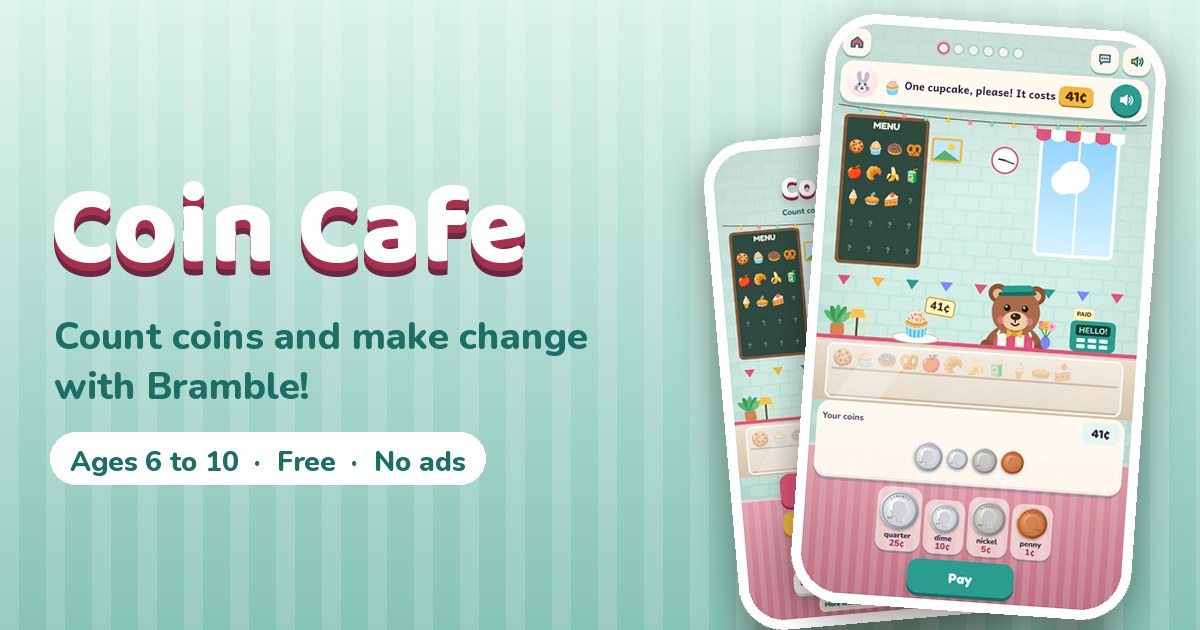
Bramble the bear runs a little snack cafe, and your child works the counter. Customers pay with coins, ask for cookies at 37¢ and want their change, so every order is a real money problem.
What your child learns
Coin Cafe starts with what each coin is called and ends with making change from a five-dollar bill. The eight levels build on each other:
| Level | What it practices |
|---|---|
| 1. Meet the coins | Penny, nickel, dime, quarter: names, values, which is worth more |
| 2. Pennies and nickels | Counting and paying up to 20¢ |
| 3. Dimes too | Amounts up to 50¢, and making an amount another way |
| 4. Quarters too | Amounts up to 99¢ |
| 5. Fewest coins | Paying with as few coins as possible |
| 6. Dollars and cents | One and five dollar bills with coins, like $3.45 |
| 7. Make change | Change from $1 by counting up |
| 8. Big change | Change from $5 |
That covers the money standard in Grade 2 (counting coins and bills and using the $ and ¢ signs) and the change problems kids meet in Grades 3 and 4. The coins are drawn at their true relative sizes and colors, so your child learns the trap that trips up so many kids: the dime is the smallest coin but it's worth more than the nickel and the penny.
How it works
Each customer's order is read aloud and shown on screen. Depending on the level, your child will:
- Find a coin. Tap the nickel, or the coin worth 25¢.
- Count a coin purse. Look at a pile of coins and pick how much it is.
- Pay for a treat. Tap coins from the tray onto the plate, then tap Pay. Tap a coin on the plate to take it back.
- Pay a different way. Make 25¢ with no pennies, or 50¢ without quarters.
- Use the fewest coins. 30¢ works as three dimes, but a quarter and a nickel is better.
- Give change. A cookie costs 35¢ and the customer paid with a dollar. Count up to $1.00 with coins.
A round is six orders and takes a couple of minutes. On a computer, the keys P, N, D and Q add coins and 1 and 5 add bills.
Levels and how it adapts
The age setting picks where to start: 4 to 6 begins at Meet the coins, 6 to 8 at Pennies and nickels, and 8 to 11 at Quarters too. Finishing a level opens the next one. The game remembers which amounts your child finds tricky and brings them back more often.
Early levels show a running total as coins go on the plate, plus each coin's name and value on the tray. When your child gets three in a row right on the first try, the total hides so they count in their head, and it comes back after a mistake. The bill levels leave it hidden.
Mistakes turn into a lesson. If your child picks the number of coins instead of the amount, Bramble explains that coins are worth different amounts. If they pay too much or too little, the game says how much more is needed and lights up each coin with a running count, biggest first. In the fewest coins level it suggests trades like "Trade 5 pennies for a nickel." After a second miss, Bramble shows one right way, counts it out, and a similar order comes back soon.
Every finished round adds a new treat to the menu, and stars unlock decorations for the cafe, from a potted fern to a golden bell. Kids also earn stickers for the Sticker Book shared by all our learning games.
Today's challenge
Today's challenge is eight orders that are the same for everyone that day, picked to match the age setting. Finishing it builds a day streak.
Tips for grown-ups
- Empty a coin jar on the table. Sort the coins into piles, then count each pile together, biggest coins first.
- At a store, let your child find the price and choose the coins or bills to pay. Then count the change together by counting up, the way a cashier does.
- Play "how many ways": how many different ways can you make 25¢?
- Ask why a dime is worth more than a nickel even though it's smaller.
Privacy and safety
Coin Cafe has no ads, no accounts, no chat and no leaderboards, and it collects nothing about your child. Progress is saved only in the browser on your device. The only links go to our learning games page and the Sticker Book. It's free and runs in the browser on a phone, tablet or computer, with nothing to install.
Questions
What age is Coin Cafe for?
Ages 6 to 10. The first level, naming coins and their values, works for 4 and 5 year olds too.
Does it use real US coins?
Yes. Pennies, nickels, dimes, quarters and one and five dollar bills, drawn at their true relative sizes and colors.
How does the game teach making change?
Your child counts up from the price to the amount paid, adding coins until they reach it. The game shows the running total and walks through it after a miss.
What grade is counting money?
Counting coins and bills is a Grade 2 math standard in most US schools. Coin names often show up in Grade 1, and change problems in Grades 3 and 4.
Is there a timer or a way to lose?
No. There are no timers and no lives. A wrong answer gets a hint, and after two tries the game shows the answer.
Is Coin Cafe free?
Yes. It's free, with no ads and nothing to buy.